Cockatiels are rewarding birds to live with, but they need specific daily care to stay healthy and happy. Whether you just brought one home, found one outside, or realized your bird needs better care starting today, this guide walks you through everything: setup, feeding, handling, spotting illness early, and what to do in a real emergency. Canaries have different nutrition and care needs, so use a canary-specific guide for details on feeding, habitat, and health this guide walks you through everything.
How to Care for a Cockatiel Bird: Daily Guide
Marcus Holloway
2 Apr 2026
Cockatiel vs. cockatoo: they are not the same bird
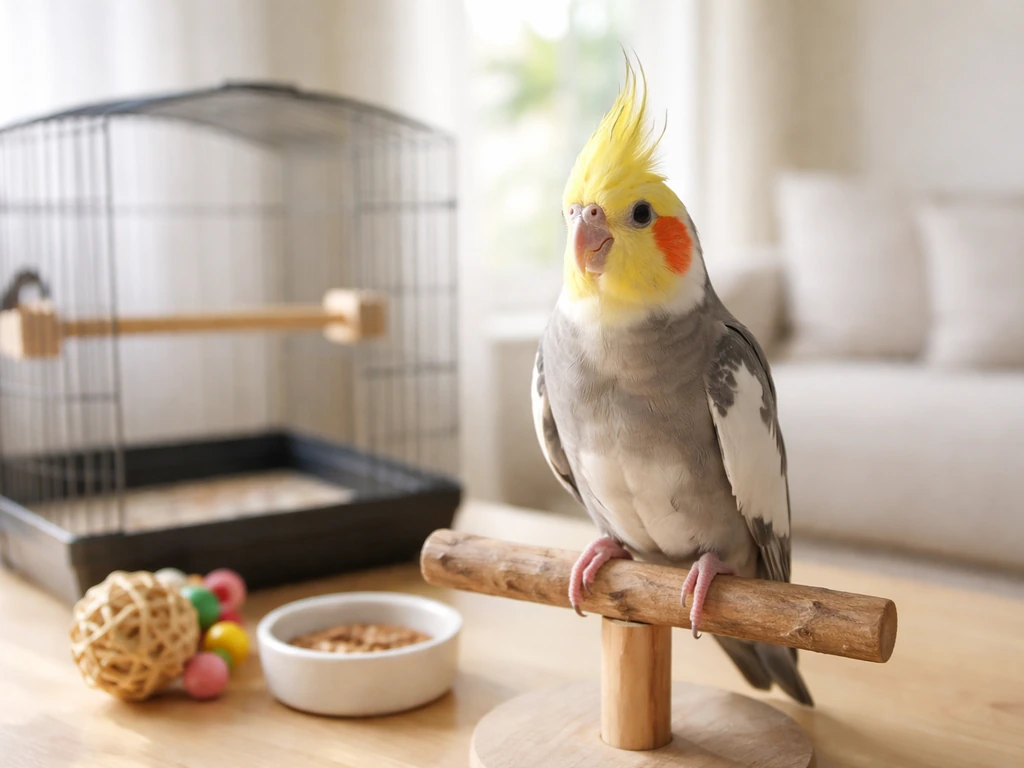
This is worth clearing up right away. Cockatiels (Nymphicus hollandicus) and cockatoos are related but very different animals. Cockatiels are technically the smallest members of the cockatoo subfamily, averaging around 80 grams with a slender body and long tail. If you searched 'cockatoo care' and ended up here, or vice versa, the distinction matters: a cockatoo is a much larger, heavier hookbill parrot with the strength, chewing power, housing demands, and diet of a large parrot closer to a macaw or African grey. A cockatiel is smaller and more delicate, and treating it like a cockatoo (bigger cage bar spacing, tougher toys, different food portions) can actually put it at risk.
The care in this guide is specific to cockatiels. If you have a large white crested bird that is noticeably bigger than a standard dinner plate and weighs closer to 300 to 800 grams, you likely have a cockatoo and should seek cockatoo-specific guidance instead.
What to do today: your immediate checklist
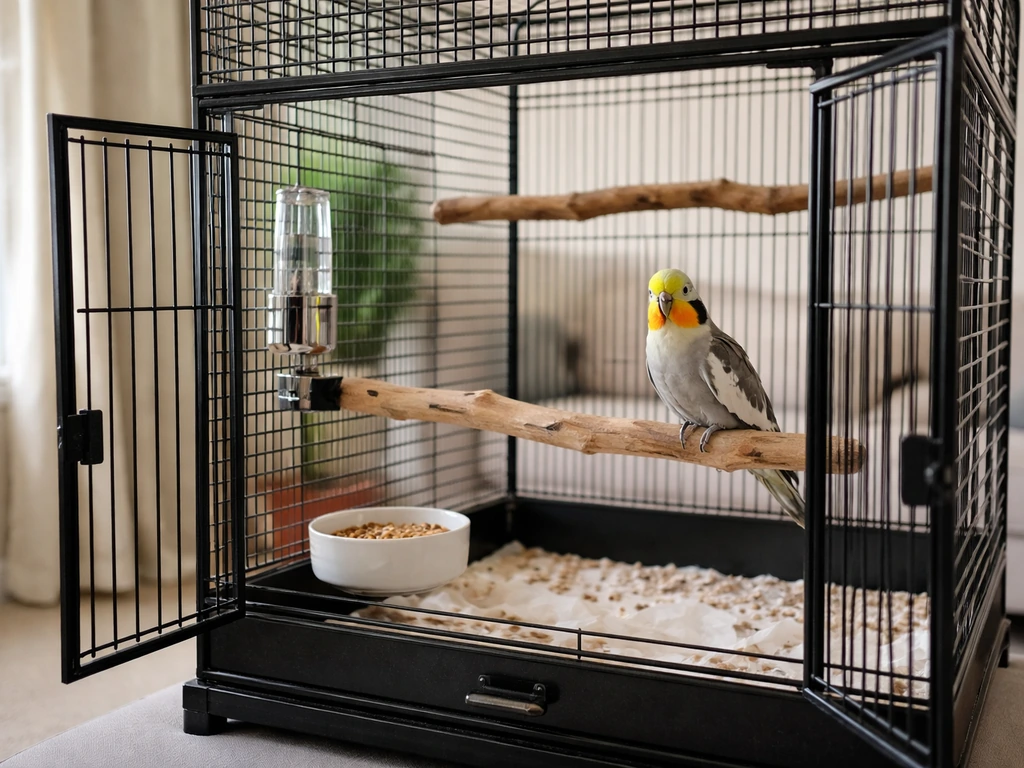
Whether you just got a cockatiel or found one, here is what needs to happen in the next few hours.
- Confirm the bird is a cockatiel (small, about the size of your fist, crested head, long tapered tail, typically grey or pied coloring).
- If the bird is found outside and appears injured or disoriented, do not offer food or water yet. Place it in a small cardboard box with air holes and crumpled paper towels, keep it warm and dark, and call a licensed wildlife rehabber or avian vet immediately.
- If the bird is a new pet, set up an appropriate cage before letting it out. Do not free-roam an unsettled cockatiel in an unfamiliar house.
- Check the cage bar spacing: it should be no more than 1/2 inch (about 1.3 cm) to prevent head entrapment.
- Provide fresh water right away in a clean, stable dish or bottle.
- Keep the environment quiet and calm for the first 24 to 48 hours so the bird can decompress.
- If the bird shows any red-flag symptoms (listed below), call an avian vet before doing anything else.
Setting up a safe, stimulating home
The cage itself
The cage should be large enough for the bird to fully extend and flap its wings without hitting the sides. Bigger is always better. The bar spacing must be no more than 1/2 inch (1.3 cm): anything wider risks a cockatiel getting its head or a foot caught, which can cause serious injury. Avoid round cages, which can be disorienting for birds and limit usable perch space. Place the cage in a room where the family spends time (so the bird does not feel isolated) but away from the kitchen, where cooking fumes and non-stick cookware at high heat can be toxic.
Perches, toys, and enrichment
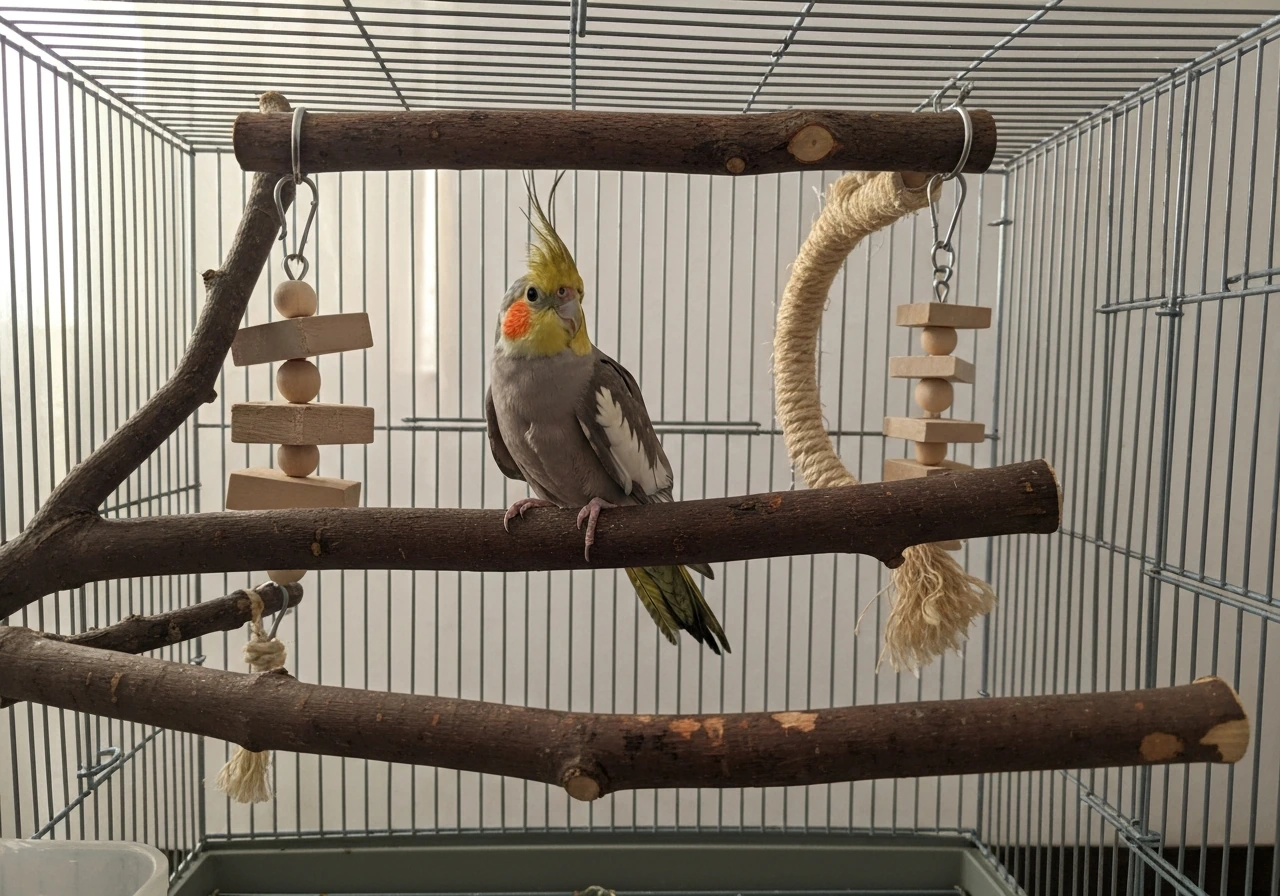
Give your cockatiel at least two or three perches of different diameters and textures. Varying the diameter keeps foot muscles active and reduces pressure sores. Natural wood branches, rope perches, and textured perches all serve different purposes. Avoid sandpaper-covered perches, which can abrade the feet.
Toys matter more than people realize. Cockatiels are intelligent and get bored, which leads to feather-destructive behaviors and stress. Rotate toys every week or two to keep things interesting. Foraging toys, shreddable items, bells, and mirrors are all commonly enjoyed. Just avoid anything with small parts that could be swallowed, frayed ropes that could trap a toe, or toxic materials like lead or zinc.
Keep the room temperature between roughly 65 and 80°F (18 to 27°C) and away from drafts, air conditioning vents, and direct sun. Cockatiels tolerate normal household temperatures well but do not handle sudden drops or extreme heat.
Bathing
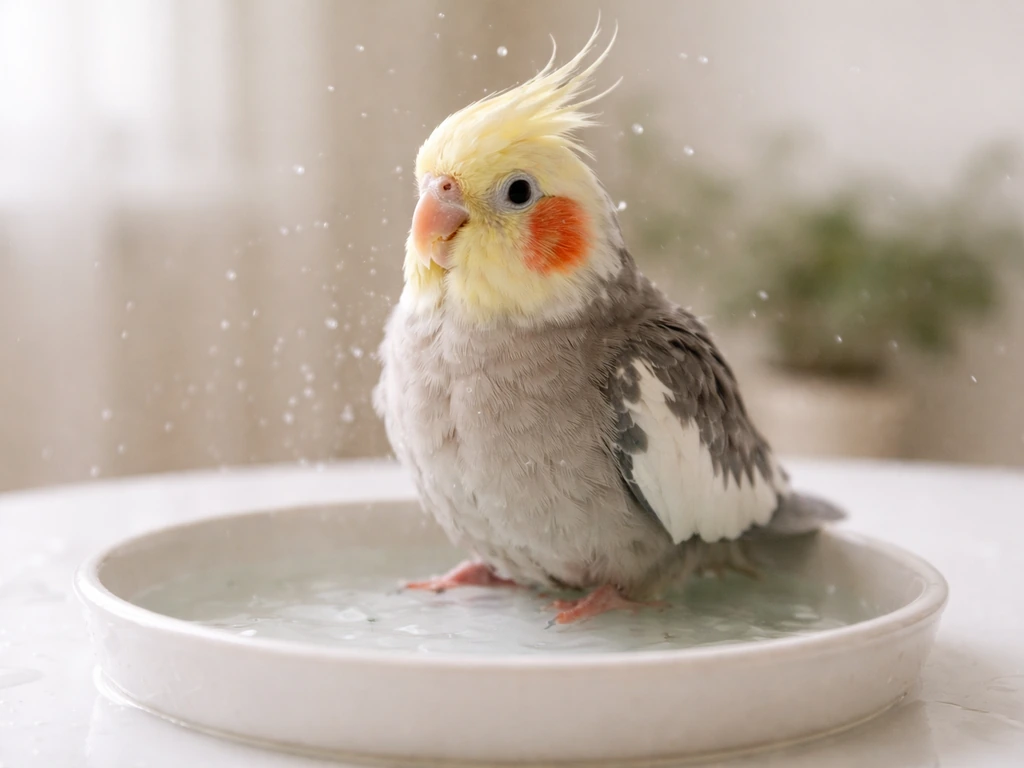
Most cockatiels enjoy a light misting or a shallow dish bath a few times a week. Use only plain water, nothing added. Offer baths at the time of day the bird naturally seems most active and receptive, typically mid-morning. Never force a bird to bathe, and make sure the bird can dry off in a warm (not cold or drafty) room afterward.
What to feed a cockatiel (and what to keep away from it)
The safest approach to cockatiel nutrition is to make a quality, species-appropriate pellet the foundation of the diet. If you are looking specifically for how to feed a Maya bird, the diet and portion guidance will differ from cockatiels, so use a bird-appropriate feeding plan What to feed a cockatiel. Pellets are formulated to be nutritionally complete in a way that seeds simply are not. A seed-heavy diet leads to fatty liver disease and vitamin A deficiency over time, which are common causes of early death in cockatiels.
Fresh fruits, vegetables, and leafy greens are a healthy addition, but keep them to around 20 to 25 percent of the daily diet. More than that and you risk disrupting the nutritional balance that pellets provide. Offer fresh food in the morning, remove uneaten portions after a few hours to prevent spoilage, and wash everything before offering it.
If your bird is currently on a seed-only diet and you are transitioning to pellets, do it gradually. Swap a small portion of seeds for pellets and increase the ratio over several weeks. This can take patience but is worth doing for long-term health. General bird care principles apply here too: consistency and gradual change reduce stress during dietary transitions.
| Food category | Offer freely? | Notes |
|---|---|---|
| Species-appropriate pellets | Yes, as staple | Should make up the bulk of the diet |
| Leafy greens (kale, romaine, spinach in moderation) | Yes, limited | Keep to 20-25% of total daily intake |
| Vegetables (carrots, broccoli, bell pepper) | Yes, limited | Wash thoroughly, remove uneaten portions quickly |
| Fruits (apple without seeds, mango, berries) | Yes, limited | High sugar, keep portions small |
| Seeds (millet, sunflower) | Occasionally as treats only | Not a dietary staple; can cause nutritional deficiency |
| Eggs (cooked, plain) | Occasionally | Good protein source in small amounts |
| Avocado | Never | Toxic to birds |
| Chocolate or caffeine | Never | Toxic to birds |
| Onion and garlic | Never | Toxic to birds |
| Fruit pits and apple seeds | Never | Contain compounds toxic to birds |
| Salty, sugary, or processed human food | Never | No nutritional value, potentially harmful |
Fresh, clean water should be available at all times. Change it daily. Water dishes get contaminated with droppings and food debris fast, so rinse and refill every morning at minimum.
Handling, socialization, and keeping stress low
Cockatiels are social birds and genuinely need daily interaction. Isolation leads to anxiety, screaming, and feather-destructive behavior. Plan for at least one to two hours of out-of-cage time each day in a safe, bird-proofed room.
When you handle your cockatiel, move slowly and speak quietly. Sudden movements, loud noises, and rough handling are major stressors. Let the bird approach and step up at its own pace as much as possible, especially while building trust with a new bird. Never restrain a cockatiel longer than necessary, and always watch for signs that it is becoming stressed: crouched posture, rapid breathing, or frantic wing-flapping while being held.
Social enrichment matters, but be thoughtful about it. Cockatiels can form strong bonds with their owners, and certain types of petting (particularly stroking under the wings or the back) can trigger hormonal behaviors that cause health problems over time. Stick to head and neck scratches for routine interaction.
If you have a single cockatiel and cannot provide several hours of interaction daily, consider whether a companion bird makes sense. Two cockatiels often do well together, but introductions need to be done slowly and carefully to avoid aggression. This is also relevant for lovebirds, another small companion bird with similar bonding needs.
How to tell when something is wrong
Birds instinctively hide illness until they can no longer manage it. By the time a cockatiel looks obviously sick, it has often been unwell for some time. Learning the early warning signs is one of the most important things you can do as a bird owner.
Early warning signs
- Fluffed feathers when not sleeping (the bird looks puffed up during the day)
- Sitting on the cage floor instead of a perch
- Reduced activity, quietness, or loss of interest in food
- Changes in droppings: unusual color, consistency, or much more or less than normal
- Discharge around the eyes or nostrils
- Overgrown or abnormal beak or nails
- Sneezing more than occasionally (a couple of sneezes a day is normal, frequent sneezing is not)
Emergency red flags: call a vet immediately
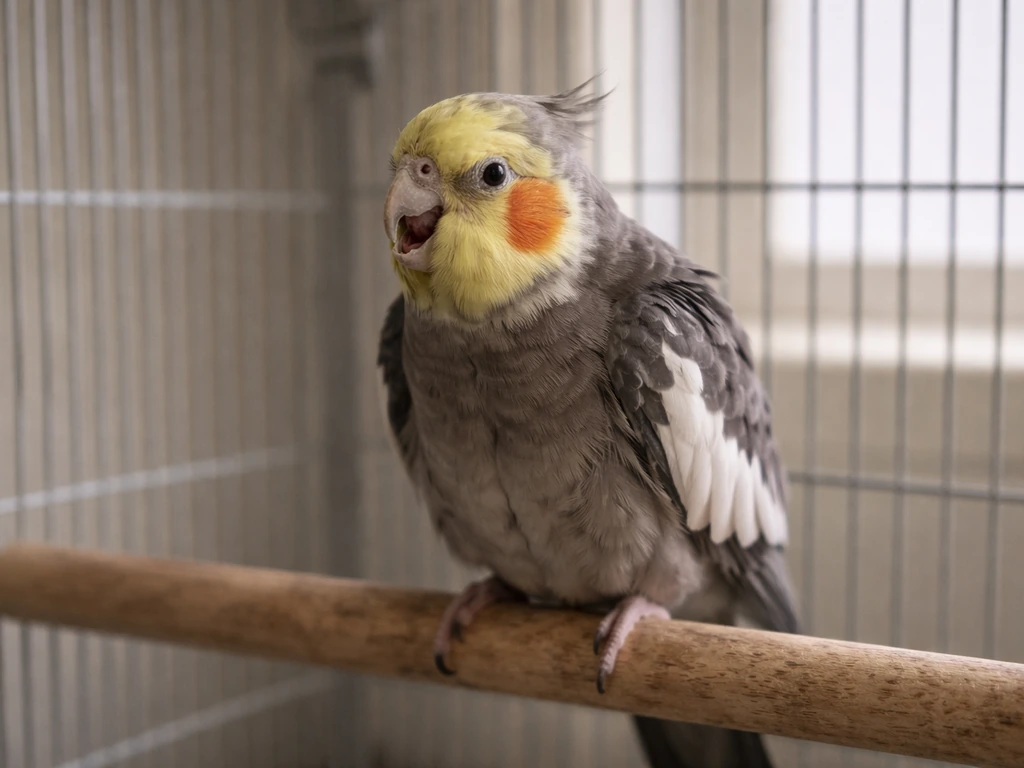
- Open-mouth breathing or labored breathing at rest
- Rapid breathing or wheezing
- Tail bobbing up and down with each breath (a sign of respiratory effort)
- Inability to perch or stand, or falling off the perch
- Visible injury: bleeding, broken wing or leg, impact injury from flying into a window
- Swelling around the face or eyes
- Seizure or loss of coordination
- Unresponsive or extremely weak
Breathing difficulty is always an emergency. Any bird showing open-mouth breathing, tail bobbing with each breath, or wheezing needs to be seen by an avian vet the same day. Do not wait to see if it improves.
First aid steps and when to get professional help
First aid for a sick or injured cockatiel is primarily about stabilization. Your job is to keep the bird calm and safe until you can get it to a professional. You are not diagnosing or treating the underlying problem.
For a sick or injured pet cockatiel
- Move the bird to a small, secure container (a clean cardboard box or carrier works) lined with a non-slip surface like paper towels.
- Keep the environment warm: aim for about 80 to 85°F (27 to 29°C). You can place one end of the box near (not on top of) a heating pad set to low, so the bird can move away if it gets too warm.
- Keep it dark and quiet. Covering the box reduces visual stimulation and helps the bird stay calm.
- Do not attempt to drip water or food into the bird's mouth. This can cause aspiration, meaning the fluid goes into the lungs instead of the stomach, which can be fatal.
- For very minor external bleeding (like a clipped nail that nicked the quick), styptic gel can be applied carefully. This is only for minor surface wounds, not deep injuries or broken blood feathers.
- Call an avian vet as soon as possible. Describe what you are seeing clearly, including when symptoms started, the bird's behavior, and any recent changes to its environment or diet.
- If it is after hours and symptoms are serious, look for an emergency exotic animal clinic in your area.
For a found cockatiel (possible escaped pet or unknown history)
Cockatiels are not native wild birds in most of the world, so a cockatiel found outside is almost certainly an escaped pet. It may be disoriented, dehydrated, or injured. The steps are similar: place it in a secure, quiet, warm box and contact an avian vet or local bird rescue. Do not attempt to force food or water. Even if the bird seems hungry, incorrect feeding of a stressed or debilitated bird can make things worse. Let a professional assess first.
Check local lost-pet boards and social media groups to try to find the owner, but prioritize the bird's immediate welfare first. A vet or rehabber can hold the bird safely while you make those inquiries.
How to prepare for the vet or rehab visit
- Bring the bird in the secure container you used for transport, not in a large open cage.
- Note what symptoms you observed and when they started.
- If the bird has vomited or had unusual droppings, try to describe or photograph them.
- Bring any food the bird has been eating so the vet knows its recent diet.
- Do not clean the cage before going. The vet may want to see the droppings or environment.
The most important thing to remember is that first aid buys time. It does not replace professional evaluation. A sick cockatiel can decline fast, so erring toward calling the vet sooner is always the right call. The same approach applies broadly to parrot care emergencies, where stabilization and prompt veterinary contact make the biggest difference in outcomes.
FAQ
How often should I clean the cage and replace cage liner or paper?
At minimum, do a spot-clean daily for droppings, wet food, and soiled areas, and do a deeper clean weekly. Replace liner or paper as soon as it is soiled (do not wait for weekly), because residue and ammonia smell can irritate a cockatiel’s respiratory system. For cleaning, use bird-safe, fragrance-free cleaners and rinse thoroughly so no fumes or residue remain.
What’s the safest way to handle a cockatiel that bites or refuses to step up?
Assume it is fear-based until proven otherwise. Offer your finger or perch near its body, not above it, and let it step onto your finger voluntarily. Keep sessions short (a few minutes), use calm speech, and avoid chasing or grabbing. If it repeatedly bites during handling, pause handling training for a day, focus on trust (treats offered from the cage), and reassess diet, sleep, and noise level since stress can be the trigger.
Can I give treats, and what should I avoid?
Yes, treats can help with training, but keep them small and limit them to a few times per week. Avoid sugary foods, processed human snacks, and anything high in fat since cockatiels are prone to fatty liver issues when the diet is unbalanced. Also avoid avocado, chocolate, alcohol, and caffeine, and be cautious with table foods like salty foods because even small amounts can be harmful.
How do I know if my cockatiel is getting enough sleep?
Most cockatiels do best with about 10 to 12 hours of sleep nightly. Provide a consistent dark, quiet period and avoid late-night loud activity, since disrupted sleep can worsen stress, screaming, and feather problems. If the room stays bright or noisy, use a breathable cover to reduce light, but never fully seal it and ensure good airflow.
What bath routine is safest for a cockatiel that seems nervous about bathing?
Try a shallow dish of plain water first, place it when the bird is naturally active, and keep the room warm. If it flinches or panics, switch to light misting from a short distance so the bird can choose to approach. Never force water onto the face or under the wings, and stop if the bird becomes chilled or overly agitated.
Is it okay to use cuttlebone, mineral blocks, or vitamin supplements?
Cuttlebone and mineral blocks can be useful, especially for calcium support, but they should not replace a balanced pellet-based diet. In general, avoid adding vitamins to water unless an avian vet specifically recommends it, because dosing errors and over-supplementation can create health problems. If your bird is a picky eater or you suspect a deficiency, use pellets and consult a vet rather than guessing with supplements.
What’s the best way to transition my cockatiel from seeds to pellets if it refuses pellets?
Keep pellets available alongside the current seeds, then gradually increase the pellet portion over several weeks. You can also try pellet sizes or brands that match your bird’s preference, and offer pellets in the morning when appetite is highest. If it refuses for multiple days, do not abruptly remove all seeds, instead slow the change and keep the environment low-stress. Monitor body condition and droppings, and ask an avian vet if weight loss occurs.
Do cockatiels need grit or any extra calcium?
Most cockatiels do not need grit if they are eating an appropriate pellet diet. Calcium needs should be met primarily through diet, and mineral sources like cuttlebone can help. If you have a breeding female or you notice shell issues, consult an avian vet for guidance, since too much calcium or incorrect supplementation can be harmful.
What are the most common early illness signs I should watch for?
Early signs can include quieter behavior, fluffed posture that lasts longer than a brief nap, reduced appetite, changes in droppings (watery, very small, or discolored), and changes in breathing effort. Also watch for persistent tail bobbing, clicking or wheezing sounds, and sitting low on the perch with reduced movement. Because birds hide illness, any sustained change from normal warrants same-day contact with an avian vet.
If my cockatiel has breathing trouble, what should I do immediately before the vet?
Treat it as urgent. Keep the bird warm and calm, reduce handling and noise, and keep it in a quiet room away from drafts. Use a secure, ventilated container so it cannot injure itself, and do not give food or medications unless a vet instructs you. If the bird is open-mouth breathing or wheezing, contact an avian emergency clinic right away.
How should I respond if I find a cockatiel outside, and when should I contact help?
Place it in a secure, warm box with ventilation and minimal stress, then contact an avian vet or local bird rescue promptly. Do not try to force-feed or force-water, even if it seems eager, because stress or dehydration can make swallowing risky. If it is injured, lying on its side, bleeding, or breathing unusually, prioritize emergency veterinary assessment rather than searching for the owner first.
What cage accessories are unsafe, even if they seem common?
Avoid toys or bedding that can shed toxic dust, contain lead or zinc, or include small parts that can be swallowed. Be cautious with swing-style or hanging toys that can entangle toes, and skip anything with frayed ropes. Also avoid sandpaper-covered perches (they can abrade feet) and watch for sharp edges on ladders or platforms that can cause cuts.
Can I put a cockatiel near other birds or in a multi-pet home?
It can work, but introduce carefully and supervise always. Keep separate cages initially, manage visual contact if there is any aggression, and prevent access to predators like cats and dogs. Even if the birds seem calm, sudden stress can trigger illness or injuries, so keep routines consistent and have a plan for quick isolation if one bird shows fear or bullying behavior.
Next Article
How to Release a Hand-Reared Bird Safely and Humanely
Step-by-step humane release for hand-reared wild birds: species checks, anti-imprinting care, soft vs hard release, afte