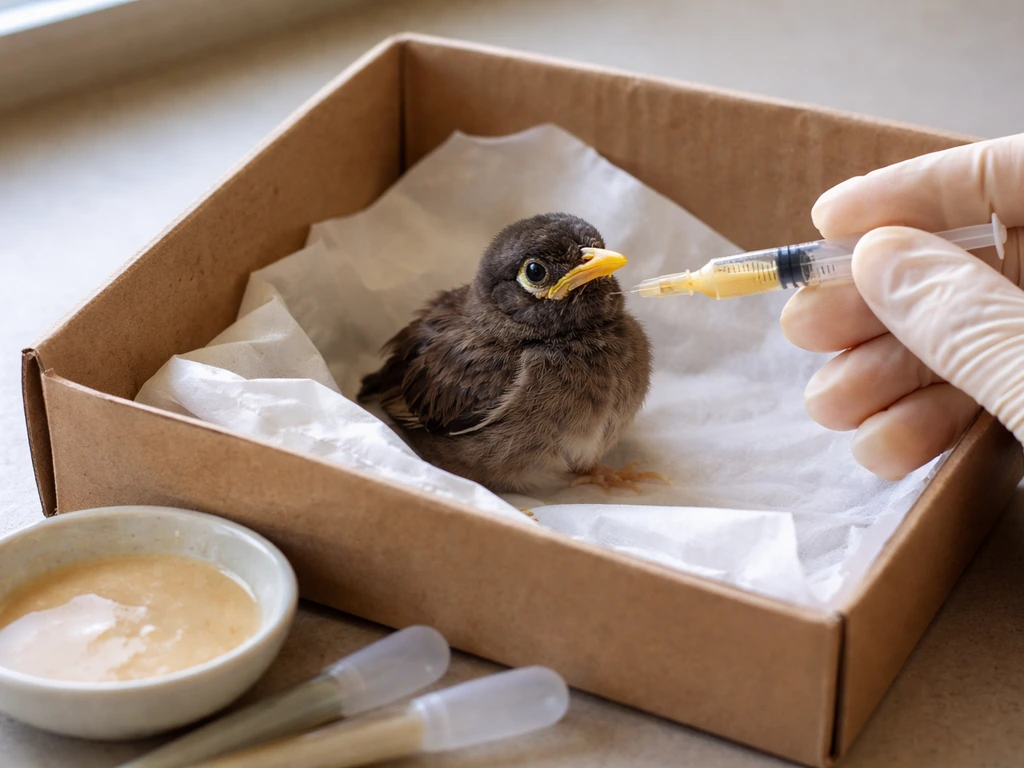
If you've found a small bird someone is calling a 'maya' and you're not sure what to do, here's the honest starting point: contain the bird gently in a ventilated box, keep it warm and quiet, and contact a licensed wildlife rehabilitator as soon as you can. Don't force-feed it, don't give it water by mouth, and don't hold it longer than you have to. The steps below will walk you through exactly what to do right now, in order.
How to Take Care of a Maya Bird: Rescue Steps Now
Marcus Holloway
4 May 2026
First, confirm what you're actually dealing with
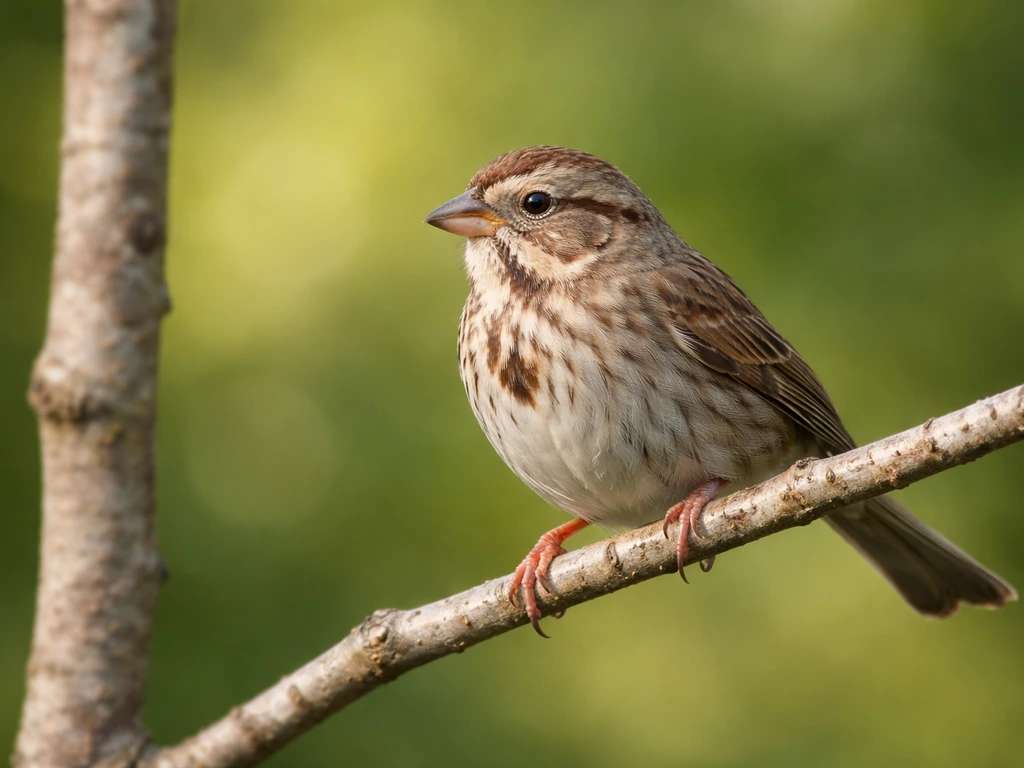
'Maya' is a folk name, not a single species. In the Philippines it commonly refers to small seed-eating passerines like Lonchura atricapilla (the chestnut munia, often called 'mayang pula') or related small finch-like birds. In other regions, people use 'maya' to describe entirely different small birds. Because rescue decisions depend on the actual species and the bird's condition, take a quick look before you do anything else.
Look at these things: How big is it (roughly sparrow-sized, smaller, larger)? What does the beak look like (short and thick for seeds, thin and pointed)? Does it have full adult feathers, patchy feathers, or barely any feathers at all? Is it hopping around on its own or lying still? These observations tell you more than a name does, and they'll also help a wildlife rehabber or vet when you call them.
Next, figure out whether the bird is a nestling, a fledgling, or an adult. This changes everything about what you should do. A nestling is mostly naked or has only downy fuzz, can't stand well, and is completely helpless. A fledgling has most of its feathers, can hop or perch, and may look 'lost' even though it's actually in a normal developmental stage. An adult in trouble is a different situation again. If you're unsure, err on the side of containment and calling for help.
The fledgling vs. nestling distinction matters a lot
Many fledglings are found on the ground and assumed to be orphaned when they're not. Parents are usually nearby and still feeding them. If the bird is hopping around, looks alert, and has most of its feathers, the best thing you can do is leave it alone and watch from a distance for 30 to 60 minutes. If you see a parent return to feed it, the bird is fine. Only step in if the bird is clearly injured, in immediate danger from a cat or dog, or if no parent appears after an hour or more.
A nestling on the ground is a different story. If you can safely reach the nest and the bird is uninjured, you can gently place it back. The parent will not reject it because you touched it. If the nest is gone or unreachable, move on to the containment steps below.
Immediate first-aid safety steps: stress, handling, and containment
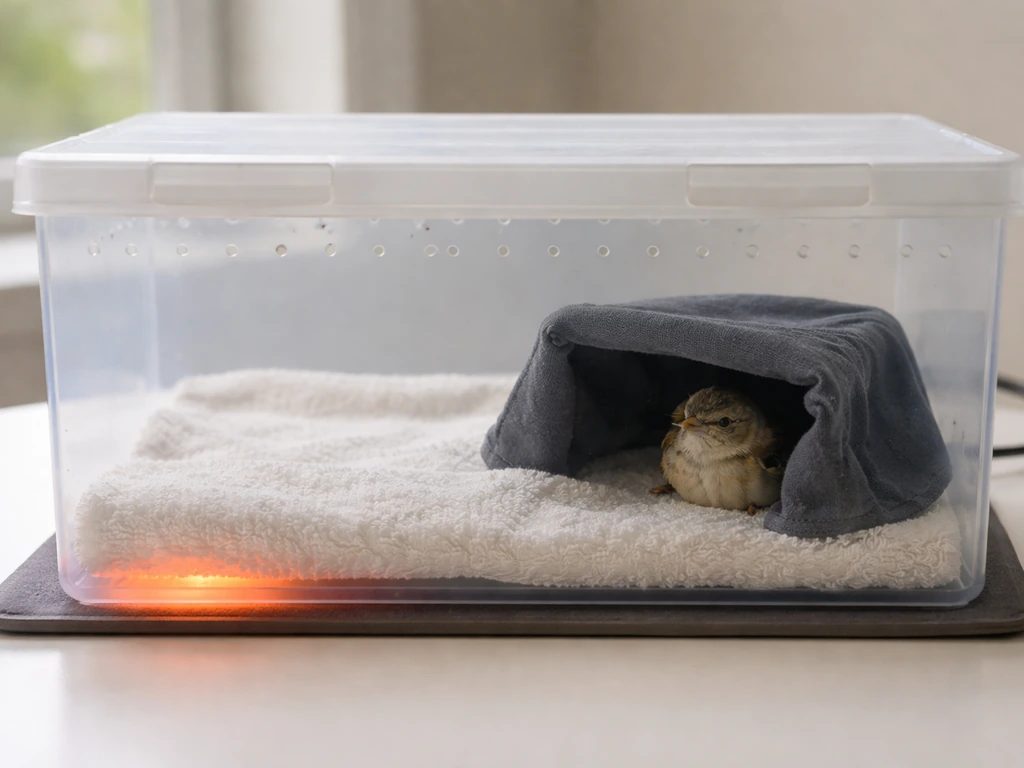
Stress alone can kill a small bird. The moment you pick it up, its heart rate spikes and it starts burning energy it may not have. So your goal from the start is to reduce handling to the minimum needed to get the bird contained safely.
To pick up the bird, cup it gently in both hands or use a light cloth or small towel. Don't squeeze. Don't let it flap repeatedly trying to escape, as that can worsen injuries. Cover its head lightly with the cloth if it's panicking, which often calms small birds quickly.
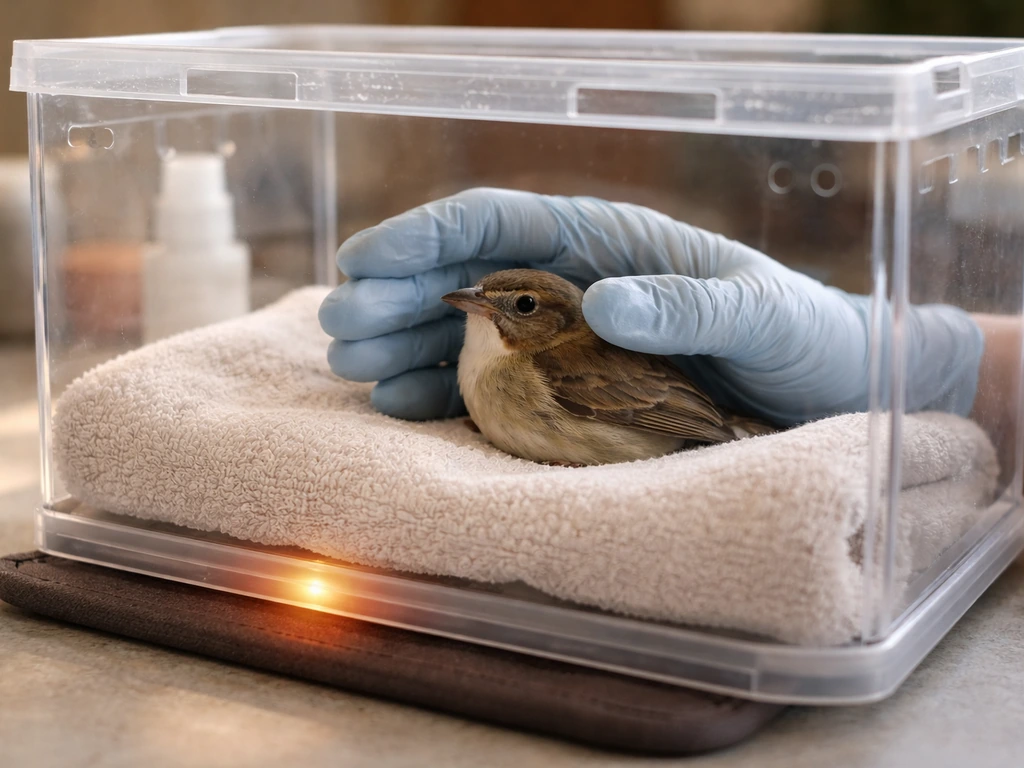
Place it in a cardboard box or paper bag with air holes punched in the sides. Line the bottom with crumpled paper towels to give it something to grip. Put the lid on or fold the bag closed. The dark, enclosed space reduces visual stress and keeps the bird from injuring itself further. Keep the box away from children, pets, loud noises, and direct sunlight. Once the bird is in the box, stop handling it.
Warmth, quiet, and monitoring while you figure out next steps
Injured and orphaned small birds lose body heat fast, especially nestlings and birds in shock. A target temperature of around 85°F (about 29°C) is appropriate for an injured songbird-sized bird while you arrange care.
Place a heating pad set on its lowest setting under one half of the box only, with a folded towel between the pad and the box. This 'half-on, half-off' setup lets the bird move away from the heat if it gets too warm. Never put the heat source inside the box, and never set the pad on high.
Check on the bird by lifting the lid briefly every 20 to 30 minutes. You're looking for signs of improvement (more alert, upright posture) or signs it's getting worse (labored breathing, lying on its side, not responding). Keep a simple note of what you observe and when, because a rehabber will ask you.
Keep the room as quiet as possible. Don't show the bird to family members or friends out of curiosity. Every time you open that box, you're adding stress. Resist the urge.
Feeding and hydration: when it's safe and when it's not
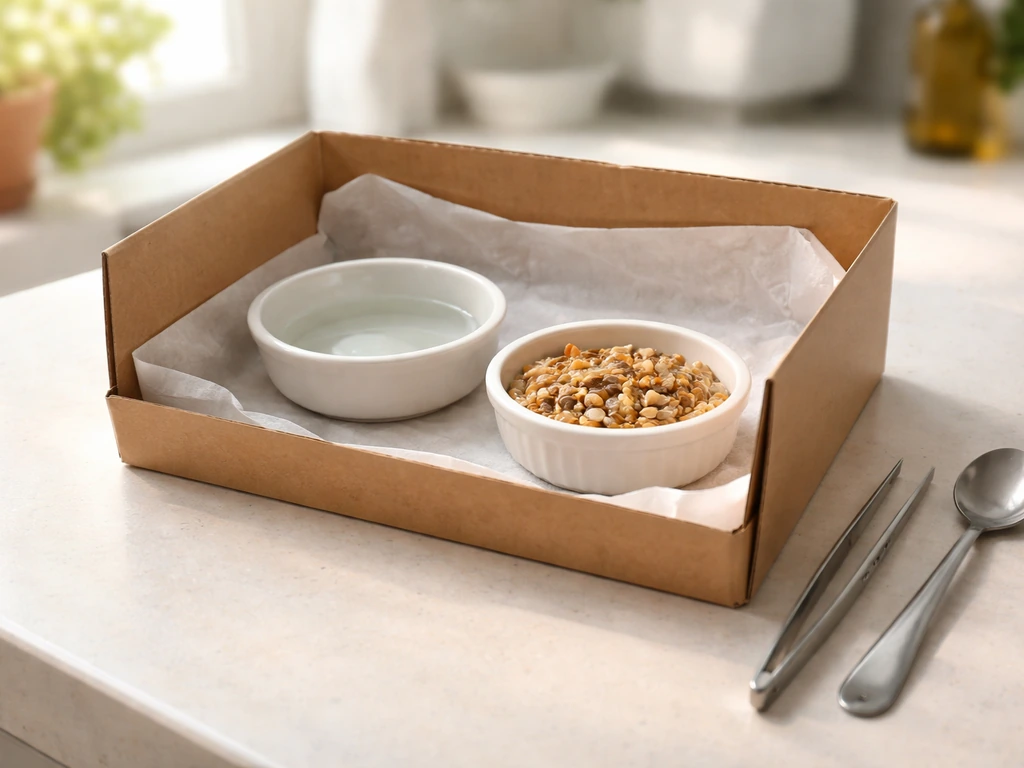
This is the area where well-meaning people cause the most accidental harm. The clear, consistent guidance from wildlife rescue organizations is this: do not force-feed food or water into the mouth of any injured or confined wild bird. The risk is aspiration, where liquid or food enters the airway instead of the stomach. In a small bird, that can be fatal within minutes.
Even if the bird looks hungry or is opening its mouth, hold off. An injured bird's digestive system may not be working normally, and adding food or water before a professional assesses it can do real damage. The same applies to nestlings: they have specific dietary needs based on their age and species, and feeding the wrong thing (bread, milk, fruit juice, water from a dropper) can injure or kill them.
The only situation where you might offer food is if you are certain the bird is an uninjured adult, it is alert and moving normally, it has been contained for more than a few hours while you wait for a rehabber, and you have confirmed its species and appropriate diet. Even then, place food in the box rather than hand-feeding it.
For a small seed-eating bird like a munia-type 'maya,' millet or small mixed seeds in a shallow dish are appropriate. If the bird is a small seed-eating maya, feed only the appropriate species-safe seeds in a shallow dish when and if it is safe to do so feed a small seed-eating maya.
If you end up keeping care going longer at home, you can use the same gentle handling, warmth, and basic nutrition principles described in our guide on how to care for a canary bird For a small seed-eating bird like a munia-type 'maya,' millet or small mixed seeds in a shallow dish are appropriate. . But honestly, if you're at the point of a multi-hour wait, the better move is to escalate your calls to a rehabber.
Treating likely problems: what you can and can't do at home
Some emergencies need an immediate response before you even get the bird in a box. Here's what to watch for and what to do.
Bleeding
If the bird is actively bleeding, apply gentle, firm, direct pressure with a clean cloth or piece of gauze. Hold it steady for one to two minutes. Don't pull the cloth away quickly or you'll reopen the wound. Once bleeding slows, get the bird into the box and call a rehabber immediately. Profuse bleeding that doesn't slow is an emergency that requires professional care, not more DIY treatment.
Shock and weakness
A bird lying on its side, barely responsive, or with its eyes half-closed is likely in shock. Warmth and darkness are your two tools here. Get it into the heated box setup described above and call for help right away. Don't try to stimulate it or give it anything by mouth.
Difficulty breathing
Open-mouth breathing, a tail bobbing up and down with each breath, rattling or clicking sounds, or a bird that can't hold its head up are all signs of respiratory distress. This is an emergency. Get the bird contained, keep it calm and warm, and get to a vet or rehabber as fast as possible. Don't delay.
Entanglement in string, fishing line, or thread
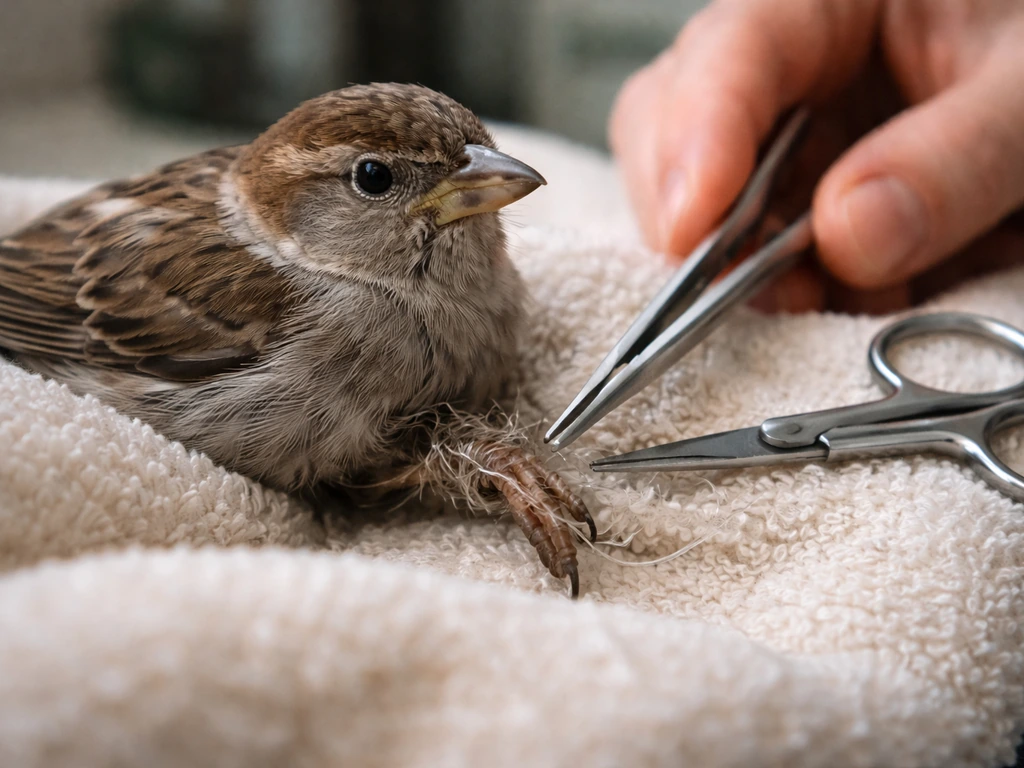
Do not try to cut or unwrap fishing line, thread, or wire yourself. These materials can be wrapped tightly around legs, wings, or necks in ways that aren't visible from the outside, and pulling at them can cause serious injury or cut off circulation. Contain the bird, keep it still, and get it to a rehabber or vet urgently. Entanglement cases deteriorate quickly.
Cat or dog attack
Even if the bird looks fine after a cat attack, treat it as a veterinary emergency. Cat saliva carries bacteria (especially Pasteurella) that can cause fatal infection in birds within 24 to 48 hours. Cornell’s Cornell Feline Health Center notes that Pasteurella-related infections can become serious, with onset around 24 to 48 hours after cat bites within 24 to 48 hours. A bird that 'seems okay' after a cat bite needs antibiotics from a vet, not just observation at home.
Broken wing or leg
Don't try to splint it. Immobilize the bird in the box so it can't thrash and worsen the injury, and call for professional help. A drooping wing held away from the body, or a leg that won't bear weight, needs X-rays and proper treatment.
What not to do: common mistakes that hurt more than they help
- Don't force water or food into its mouth. Aspiration is a real and fast danger.
- Don't give cow's milk, bread, fruit juice, or human food. None of these are appropriate for wild birds.
- Don't keep the bird in a cage with perches if it has an injury. A flat-bottomed box is safer.
- Don't put it outside 'to see if it flies away' if it's clearly injured. It won't, and you've added stress for nothing.
- Don't keep it warm with a heat lamp or a pad on high. Overheating is just as dangerous as cold.
- Don't try to treat wounds with antiseptic creams, hydrogen peroxide, or rubbing alcohol. These damage tissue.
- Don't keep the bird as a pet or plan on long-term DIY care. In many places, keeping a wild bird without a permit is illegal under migratory bird protection laws, and birds kept by untrained people rarely recover well.
- Don't handle the bird repeatedly to check on it or show others. Every unnecessary interaction adds stress.
- Don't assume a quiet bird is recovering. Quiet can mean shock. Monitor carefully.
When to call a wildlife rehabber or vet, and how to prepare
Call for professional help immediately if the bird shows any of the following: trouble breathing, profuse or ongoing bleeding, broken or deformed limbs, a head tilt or loss of balance, puncture wounds from a cat or other animal, maggots or visible parasites on the skin, large fluid bubbles under the skin, or a complete lack of response. These are not 'wait and see' situations.
Even if the bird seems stable, the goal is always to get it to a licensed wildlife rehabilitator as quickly as possible. Home care is a bridge, not a solution. If you end up caring for a pet cockatiel instead, the basics are different and you'll want a cockatiel-specific care routine pet cockatiel care. The longer a wild bird stays in improvised care, the harder recovery becomes.
How to find a rehabber
Search online for 'wildlife rehabilitator near me' plus your city or region. In the US, the National Wildlife Rehabilitators Association (NWRA) and the Wildlife Center of Virginia both maintain directories. If you're in Virginia specifically, you can call the Virginia Department of Wildlife Resources toll-free wildlife helpline at 1-855-571-9003. Your local animal control office, Humane Society, or exotic animal vet can also point you to the nearest permitted rehabber. Once a lovebird is stable and safe, seek advice from a qualified avian vet or rehabber on proper daily care proper daily care for lovebirds.
What to tell them when you call
Have this information ready before you dial. It speeds up the intake process and helps them prepare.
- Where you found the bird (specific location, including indoors vs. outdoors)
- What the bird looks like (approximate size, color, beak shape, feather development)
- What you think happened (found on ground, after window strike, after cat attack, fallen from nest, etc.)
- What symptoms you're observing right now (breathing issues, bleeding, unresponsiveness, injury type)
- How long you've had the bird
- What you've done so far (box setup, heat, anything you tried to feed or not)
Preparing the bird for transport
Use the same ventilated box you've been using. Keep the heating pad in place under half the box during the drive. Don't play music in the car, and keep conversation low. Keep the box off the seat where it can slide, and don't place it in a hot trunk. Keep the box out of direct sunlight through the window. A calm, dark, stable ride is the goal.
When you arrive, tell the rehabber or vet everything you told them on the phone and hand over the bird in the box. Let them open it. You've done your part by getting it there safely.
A quick reference: what the situation calls for
| Situation | What to do right now | Urgency |
|---|---|---|
| Fledgling on ground, alert, hopping, no visible injury | Observe from distance 30-60 min; look for parent activity | Low, unless parents don't return |
| Nestling on ground, no feathers or very few | Try to return to nest; if nest is gone, box it and call rehabber | Moderate, act within hours |
| Any bird after cat/dog attack | Box gently, call vet or rehabber immediately | High, treat as emergency |
| Bird with visible bleeding | Gentle pressure to wound, then box and call immediately | High |
| Bird breathing with open mouth or tail-bobbing | Box, warmth, call rehabber/vet immediately | Emergency |
| Bird lying on side, unresponsive | Box, heat, call immediately | Emergency |
| Entangled in string or fishing line | Box without removing entanglement, call rehabber immediately | High |
| Broken wing or drooping limb | Box carefully, do not splint, call rehabber | Moderate to high |
| Alert bird, mild weakness, no obvious injury | Box, warmth, monitor, call rehabber same day | Moderate |
Taking care of a maya bird or any small wild bird in trouble is mostly about getting out of the way quickly and safely. Your job is containment, warmth, calm, and speed. If you end up with a healthy pet parrot later, you can also use this guide on how to take care of parrot bird as a starting point for ongoing husbandry and diet. The rehabilitator's job is everything else. If you are looking for how to take care of love bird after treatment, a rehabber can also guide the right species-specific diet and housing The rehabilitator's job is everything else.. The faster you make the handoff, the better that bird's chances.
FAQ
How do I tell if a “maya” is actually a nestling or a fledgling when it looks scruffy or wet?
Use ability to stand and feather coverage. A nestling is mostly naked or only has down and cannot reliably stand, while a fledgling has most feathers and can hop or perch even if it looks messy. If it can hold position and react when you’re nearby, treat it as a fledgling and watch from a distance first (30 to 60 minutes).
Should I put the bird back where I found it, even if it’s on a busy street or under a tree?
Only attempt a return if you are confident it’s an uninjured fledgling and there is a safe spot close by where parents can access it. Avoid placing it in a spot with ongoing hazards like active mowing areas, heavy foot traffic, or where cats can reach. If you cannot safely relocate it, contain it and call a rehabber.
What should I do if the bird won’t stop flapping or keeps trying to escape from the box?
Minimize handling and maximize darkness. Keep the lid closed and the box partially covered with a cloth to reduce visual stimulation (do not block ventilation holes). Ensure the box is in a quiet, dim room, and avoid repeated lid checks unless it’s time for your 20 to 30 minute monitoring.
Is it safe to use a heat lamp or hot water bottle instead of a heating pad?
Prefer a heating pad set low with the half-on, half-off method described in the article. Heat lamps can overheat quickly and burn feet or breast skin. Hot water bottles are harder to regulate and can cool unevenly, creating cold spots or sudden overheating.
How often should I check for breathing problems, and what signs mean I should escalate immediately?
Do quick checks during your scheduled 20 to 30 minute monitoring, then escalate right away if you notice open-mouth breathing, repeated tail bobbing, rattling or clicking sounds, a bird that cannot hold its head up, or worsening responsiveness. If breathing seems labored at any time, do not wait for the next interval.
Do I need to give the bird water at all while I’m waiting for help?
Do not give water by mouth. For wild birds in a container, hydration is best handled by a licensed rehabber. If the bird is dehydrated or shocky, warmth and calm come first, then professional care.
What if I think it’s uninjured and I’m only waiting a few hours, can I feed it right then?
Feeding should be avoided unless all conditions match: uninjured adult, alert and moving normally, confirmed species for diet, and a verified safe wait period while you contact a rehabber. Even then, place food in a shallow dish in the box rather than hand-feeding. If you are unsure of species or age, skip feeding and keep focusing on containment and warmth.
Can I offer birdseed even if I’m not sure what species “maya” is?
Only offer seeds if you are confident it’s a small seed-eating species appropriate to the bird. “Maya” is a folk name and can refer to different small birds in different regions. If you cannot confirm the diet type, use containment and call a rehabber instead.
What should I do if I find feathers missing or the bird looks partially feathered but it is hopping around?
Partially feathered birds can be fledglings, not necessarily injured. If it is hopping, alert, and can posture normally, watch from a distance for 30 to 60 minutes unless you see an injury. If you find bleeding, a deformed limb posture, or it cannot bear weight, treat it as an urgent injury case.
A cat or dog may have been involved, but I see no visible wounds. Is it still an emergency?
Yes. Cat saliva can cause severe infection even when the puncture wound is not obvious. Treat any suspected cat bite, claw puncture, or close contact as veterinary urgent and do not rely on “it seems fine” observation.
What if the bird is entangled in fishing line or thread and I can’t remove it safely?
Do not pull or cut anything yourself. Contain the bird so it cannot thrash, keep the line undisturbed, and seek rehab or vet care urgently. Entanglements can restrict circulation in ways you cannot see externally.
Can I use a shoebox, plastic tub, or aquarium to hold the bird temporarily?
Use a ventilated cardboard box or paper bag with air holes. Plastic tubs or unventilated containers can trap heat and reduce airflow, increasing stress. If you only have a tub, drill or cut adequate ventilation and still ensure darkness, warmth control, and minimal handling.
How should I transport the bird to the rehabber to avoid making it worse?
Keep the box stable and dark, reduce motion, and keep the heating pad under half the box during transport. Avoid placing it in direct sunlight, on the seat where it can slide, or in a hot trunk. Keep the ride quiet to prevent additional stress.
What information should I tell the wildlife rehabilitator, and why does it matter?
Report where you found it, approximate size, whether it was hopping or lying still, feather condition, any observed bleeding or breathing issues, and how long it has been in your care. This helps them decide age category, likely diet type, and how urgently to treat for dehydration, shock, infection risk, or respiratory distress.
Next Article
How to Feed a Maya Bird: Step-by-Step Emergency Guide
Humane emergency steps to identify a Maya bird and safely feed by stage with correct formula, amounts, and aftercare.