Finding a dove that seems to need help is stressful, and the decisions you make in the first few minutes matter. Whether you've found an injured or orphaned wild dove, you're worried about a sick bird at home, or you just picked one up and aren't sure what to do next, this guide walks you through every step: triage first, then housing, feeding, handling, health monitoring, and knowing when to hand the bird off to a professional.
How to Take Care of a Dove Bird: Rescue to Recovery
Marcus Holloway
6 Apr 2026
Quick triage: is your dove injured, orphaned, or just a pet
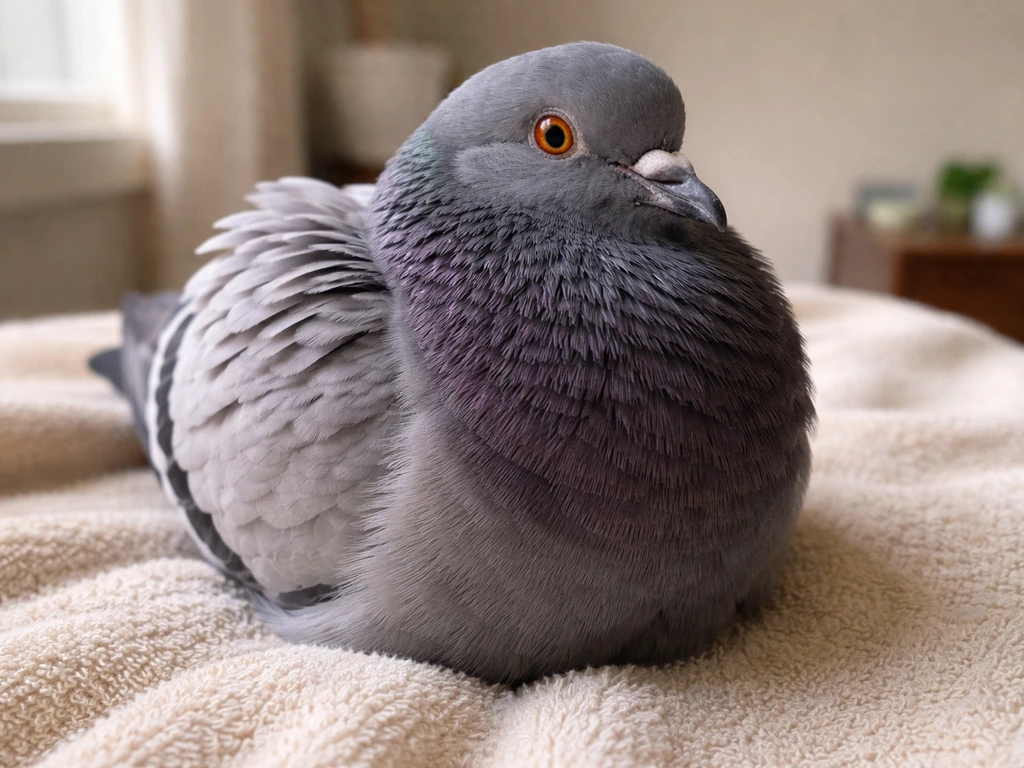
Before you do anything else, figure out what you're actually dealing with. This single step changes everything that comes after it.
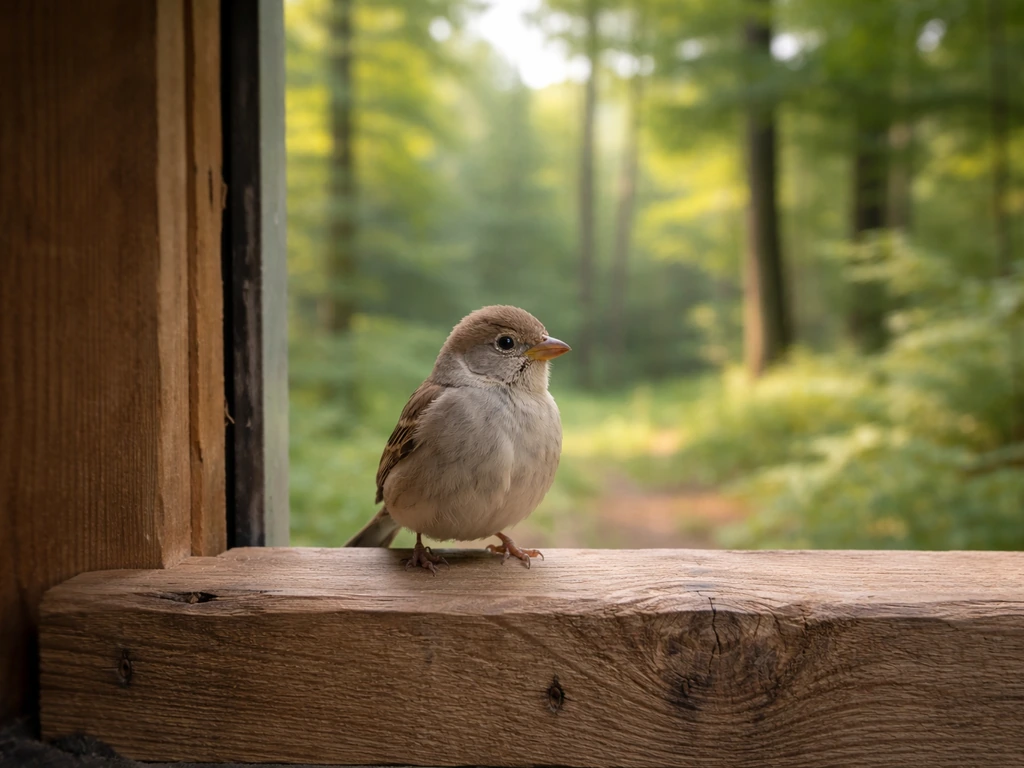
A wild dove that looks grounded or disheveled isn't automatically in trouble. Fledgling doves (feathered but not yet flying well) often spend a day or two on the ground as a normal part of their development. If the bird looks fully feathered, is hopping or fluttering, and you can see adult doves nearby, the safest move is usually to leave it alone and watch from a distance. The U.S. Fish & Wildlife Service is clear on this: unless there's a visible injury, shivering, bleeding, or a dead parent nearby, the best option is often to step back and monitor.
You do need to act if you see any of the following signs. This is where things get urgent:
- Visible bleeding or an obviously broken wing or leg
- The bird is shivering, fluffed up, or lethargic and not moving away from you
- It's completely featherless (a nestling that has fallen from its nest)
- There's evidence of a predator attack, like puncture wounds or missing feathers
- A parent bird is confirmed dead nearby
- The bird is panting heavily, unable to stand, or has blood in its droppings
If you have a pet dove at home that's acting sick, the triage question is simpler: any sudden change in behavior, posture, droppings, or appetite is a reason to start paying close attention. The rest of this guide applies to both situations, but I'll flag where the advice differs between a wild bird rescue and a pet bird scenario.
One important note: dove and pigeon chicks (called squabs) are genuinely different from other baby birds in terms of their diet and developmental needs. Don't assume generic baby bird advice applies. The care steps below are specific to doves.
Housing setup: cage or aviary size, warmth, ventilation, and safe space
For an injured or found wild dove, temporary housing isn't about comfort, it's about stabilization. Your goal is dark, warm, quiet, and contained. That combination reduces stress, slows down shock, and keeps the bird safe until you can get professional help.
The emergency container
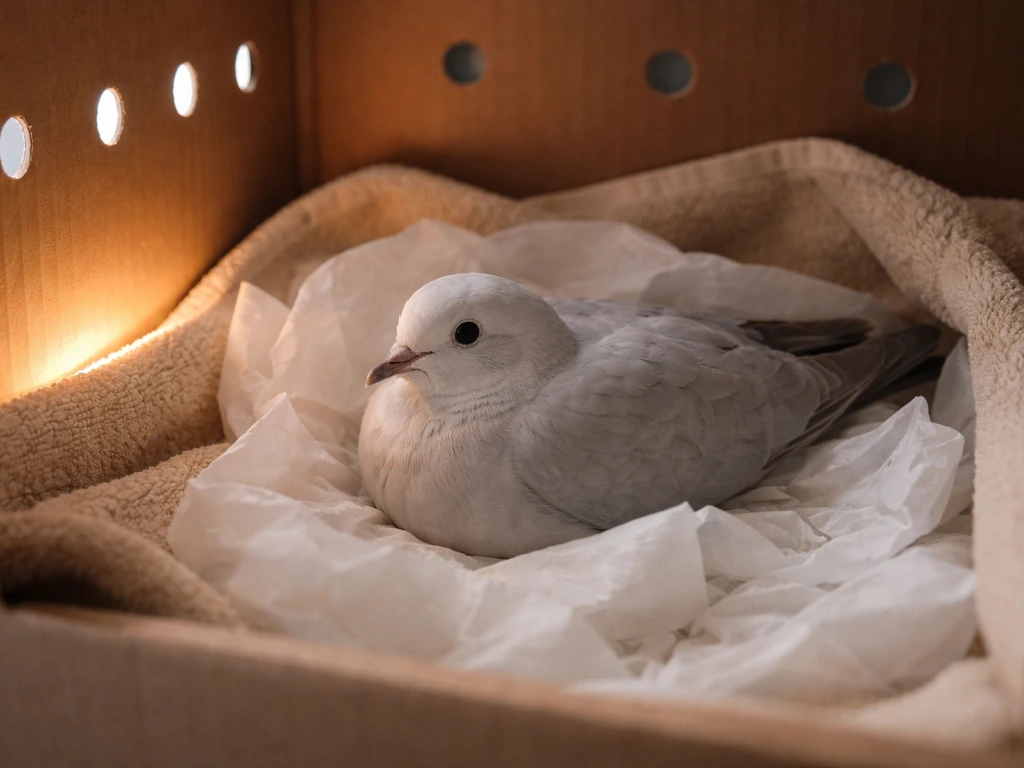
A cardboard box with a lid works perfectly for temporary housing. Punch a few small holes in the sides for ventilation, line the bottom with a non-slip surface like a folded towel or paper towels, and keep the box somewhere dark and quiet. Don't use a glass tank or fully sealed container, airflow matters.
Keep the bird away from children, other pets, loud music, and direct sunlight. According to Ohio Wildlife Center guidance, overnight containers should be placed in a room that is specifically dark, warm, and quiet. This isn't optional: stress alone can kill an already compromised bird.
Heat support
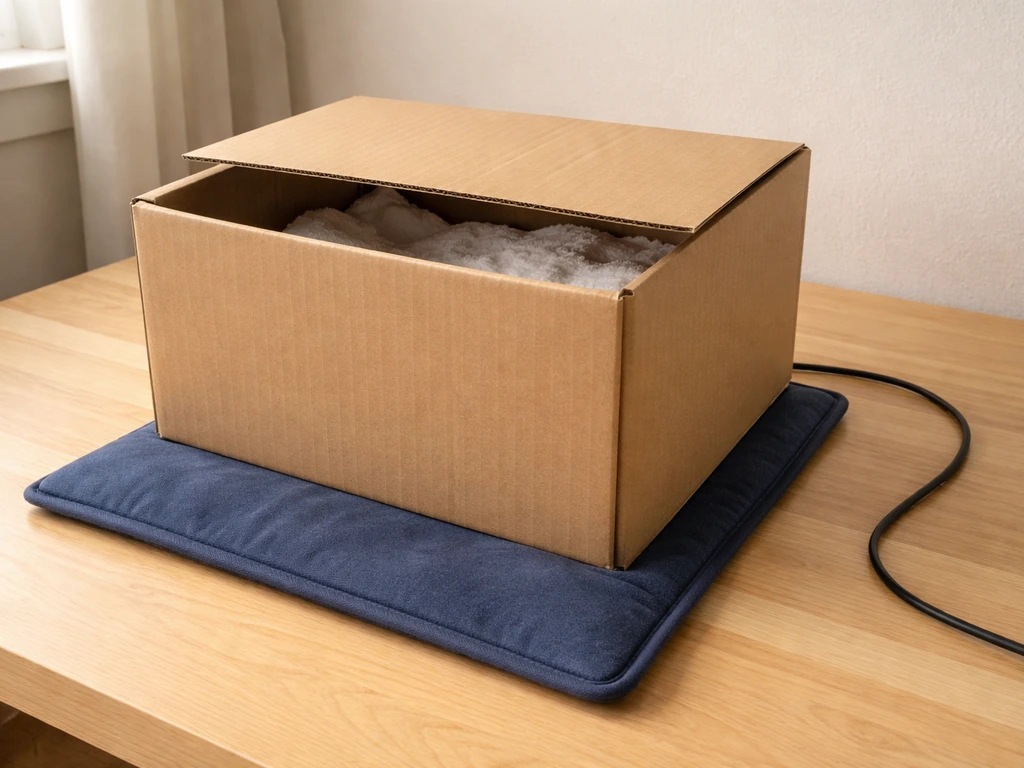
Heat is often the single most important thing you can provide a sick or injured dove in the first hour. Birds that are lethargic, fluffed up, chilled, wet, in shock, or recovering from injury lose body heat fast. Cascadia Pigeon Rescue is explicit about this: external heat support is a priority for any bird showing those signs.
The safest way to provide heat is to place a heating pad set to low under half the box, or use a warm (not hot) water bottle wrapped in a cloth and placed to one side of the container. The key is giving the bird a warm side and a cooler side so it can self-regulate. Texas Parks & Wildlife guidelines recommend the same approach: heating pads or insulated hot water bottles, never direct or uninsulated heat sources.
There's one important exception: if the bird is panting rapidly from what looks like respiratory distress rather than just being cold, skip high heat. Provide only mild warmth and make sure there's plenty of ventilation. Overheating a bird that's already struggling to breathe can make things much worse.
For pet doves kept long-term
If you're setting up permanent housing for a pet dove, the space requirements are more generous. Wildlife rehabilitation codes and avian welfare guidelines generally treat cage dimensions as regulated minimums, not suggestions. A single dove needs at minimum a cage roughly 24 inches wide by 24 inches deep by 24 inches tall, and bigger is always better. Doves need horizontal flying space more than vertical height. For a pair, double the floor space. Ventilation should be good but the bird shouldn't be in a direct draft, and the cage should never be placed in direct sun without shade available.
Feeding basics: what to feed doves, meal frequency, and hydration
This is where a lot of well-meaning people cause accidental harm, so read this section carefully before you do anything.
For injured or found wild doves: hold off on feeding
If you've just brought in an injured or sick wild dove, do not attempt to feed it or give it water right away. University of Illinois Veterinary Medicine's Wildlife Medical Clinic gives this advice directly: keep the bird dark, quiet, and warm, and do not attempt to feed or offer water before getting professional guidance. The same recommendation appears across multiple wildlife triage sources. A bird in shock, with a crop problem, or with certain injuries can be seriously harmed by premature feeding.
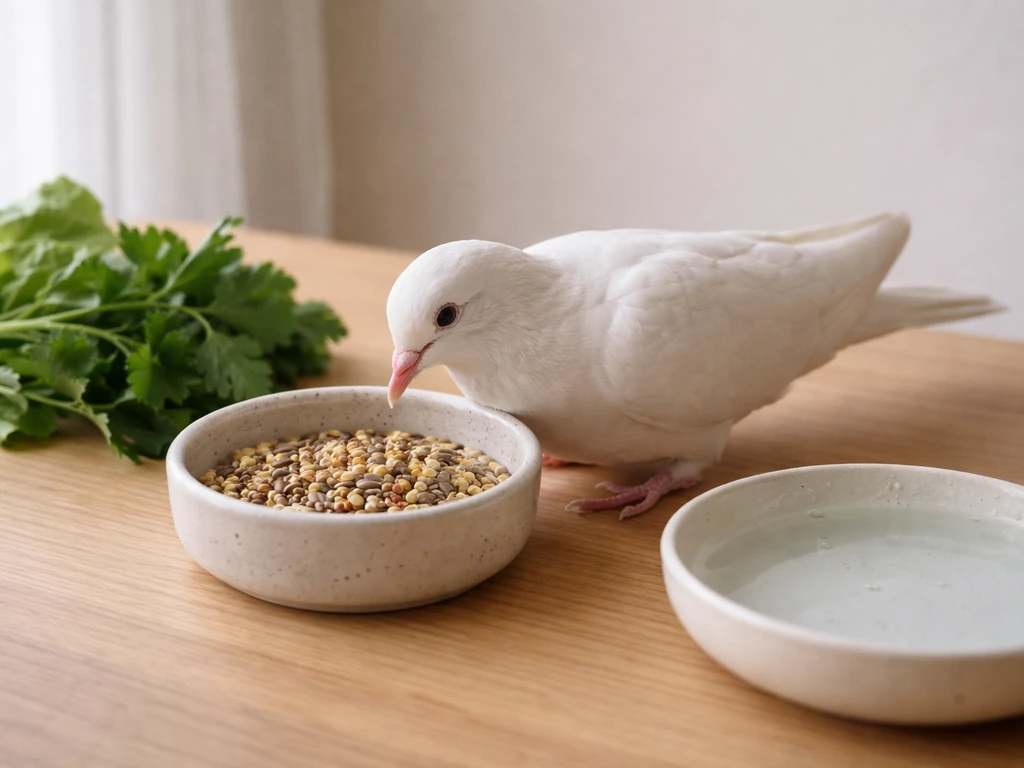
Water is particularly risky if given incorrectly. Dripping water into a bird's beak is genuinely dangerous and can cause the bird to aspirate and drown. If you feel you absolutely must offer water while waiting for help, place a very shallow dish near the bird and let it drink on its own. Doves drink by suction, so the container needs to be at least 1 inch (about 2.5 cm) deep for them to drink effectively, but not so deep they could fall in.
And please: do not attempt to tube-feed or syringe-feed a bird unless a rehabilitator or vet has shown you exactly how to do it. Cascadia Pigeon Rescue states this clearly and firmly: never attempt to give food or medication to a bird orally using a tube or syringe without hands-on instruction from someone experienced. This is one of the fastest ways to accidentally kill a bird you're trying to save.
For orphaned baby doves (squabs) in emergency situations
If a wildlife rehabilitator has confirmed you need to provide emergency feeding to a squab while waiting for handoff, Kaytee Exact Baby Bird Formula is the most commonly recommended substitute for pigeon milk. It's used by rehabilitators and avian vets for this purpose. Featherless nestlings need feeding every 15 to 20 minutes from sunrise until around 10 p.m., which immediately shows you why professional help is so critical: that schedule is nearly impossible to sustain correctly at home. There's no need to feed during the night.
If a squab's crop feels hard rather than soft and full, you can gently offer a small amount of warm water and softly massage the crop area. But this is a specific situation, not general advice. When in doubt, wait for professional guidance rather than improvising.
For pet doves
A healthy adult pet dove does well on a seed mix designed for doves or pigeons (millet, safflower, and small grains), supplemented with leafy greens and occasional fruit. Fresh water should always be available. Unlike the wild rescue scenario, a pet dove in normal health benefits from a consistent shallow water bowl that's refreshed daily. Dove care guides for foster situations suggest offering a shallow bowl of room-temperature water, which aligns with the dove's natural suction-drinking behavior.
Handling and minimizing stress: how to pick up, keep calm, and avoid harm
Doves are sensitive birds and stress alone is a real threat to a compromised bird. Keep handling to an absolute minimum, especially if the dove is injured or in shock.
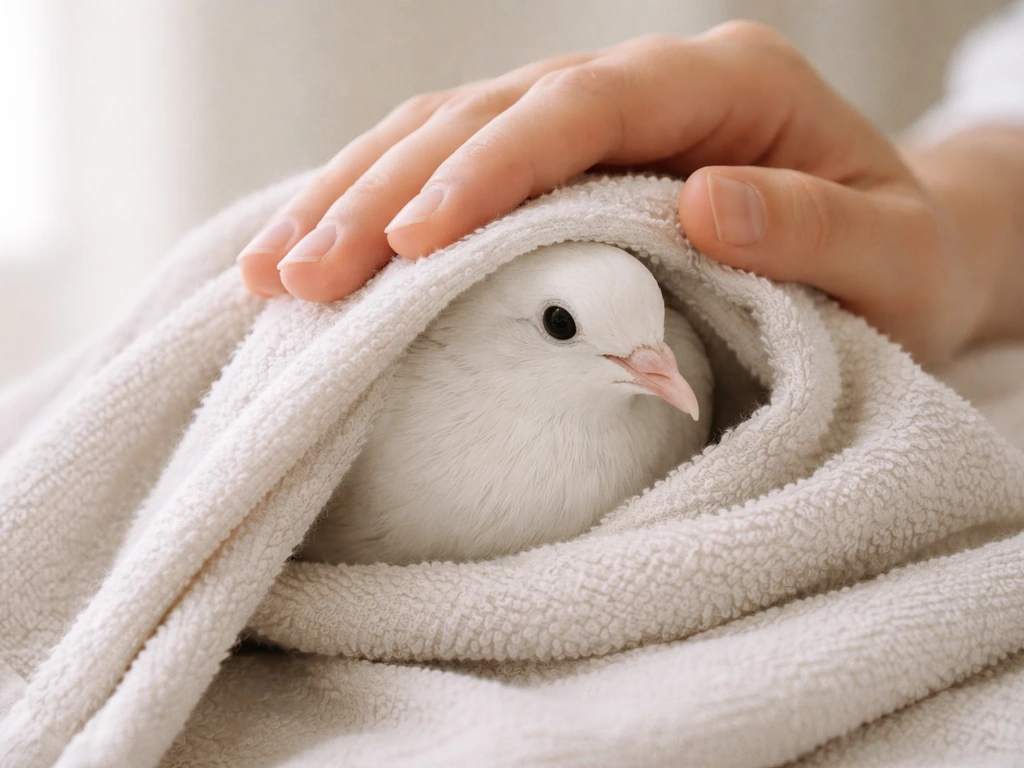
To pick up a dove safely, drape a light towel or cloth over the bird first. The towel does two things: it gives you a grip without applying pressure directly to the bird's body, and it reduces the bird's visual stimulation so it's less likely to panic and injure itself further. University of Illinois Veterinary Medicine recommends this approach specifically: use a towel or blanket as a barrier between you and the animal to help control it during capture.
Once you have the bird, cup it gently in both hands with its wings folded against its body. Don't squeeze. The bird should feel contained but not compressed. Place it into your prepared box as quickly and calmly as possible. Avoid looking directly at it, making sudden movements, or making loud sounds. Once it's in the box, close the lid and leave it alone.
If you're managing a pet dove that's tame, you can handle it more regularly, but even tame doves benefit from calm, predictable handling. Always approach from the front, move slowly, and let the bird step up onto your fingers rather than grabbing it from above, which mimics a predator strike and will frighten even a calm bird.
Health watch: common problems in doves and when symptoms mean emergency
Doves can mask illness well, which means by the time you notice something is wrong, it may already be serious. These are the most common problems to watch for and what to do about each.
| Sign or symptom | Possible cause | What to do |
|---|---|---|
| Fluffed feathers, lethargy, not eating | Illness, infection, or shock | Provide warmth, minimize handling, contact a vet or rehabber today |
| Panting or open-mouth breathing | Respiratory distress, heatstroke, or infection | Provide mild warmth and ventilation; this is an emergency, call immediately |
| Inability to stand or grasp | Neurological issue, severe weakness, or injury | Do not attempt home treatment; escalate to emergency avian care |
| Blood in droppings or frank bleeding | Internal injury, infection, or trauma | Emergency: contact an avian vet right away |
| White cheesy deposits in the mouth or throat | Trichomonosis (Trichomonas gallinae) | Do not attempt home treatment; this requires veterinary diagnosis and medication |
| Drooping wing or limping | Fracture or soft tissue injury | Contain gently, minimize movement, seek professional care |
| Crop that won't empty or feels hard | Crop impaction or infection | Do not feed more; contact a rehabber or vet for guidance |
| Swollen eyes or nasal discharge | Respiratory infection or Mycoplasma | Veterinary diagnosis needed; don't delay |
Trichomonosis deserves a specific mention because it's one of the more common illnesses in wild doves and pigeons. It's caused by a protozoan parasite (Trichomonas gallinae) and shows up as yellow or white lesions inside the mouth and throat. It looks alarming and it is serious, but it's also very treatable when caught early by a vet. Do not try to scrape or remove those lesions yourself.
The clearest emergency signals, the ones that mean stop what you're doing and call right now, are marked respiratory distress with prolonged panting, complete inability to stand or grip, and visible blood in the droppings. These signs indicate the bird is in serious danger and home care is not enough.
Dove first-aid and humane care steps
First aid for a dove is mostly about stabilization, not treatment. You're buying time to get the bird professional help, not fixing the underlying problem. Here's the sequence to follow.
- Assess from a distance first. Watch the bird for a minute before approaching. Is it moving? Breathing? Does it respond to your presence? This tells you a lot without adding stress.
- Contain safely using a towel. Drape, don't grab. Guide the bird into a prepared box as gently and quickly as possible.
- Provide warmth immediately if the bird shows any signs of shock, chill, or lethargy. Use a heating pad on low under half the box or a warm water bottle wrapped in cloth. Give the bird a cooler side to escape to.
- Keep it dark and quiet. Cover the box. Put it in a room away from noise, other animals, and foot traffic.
- Do not feed or water the bird yet. Wait for professional guidance unless a rehabber or vet has specifically told you to do otherwise.
- Check for obvious bleeding. If there is visible bleeding, you can gently apply light pressure with a clean cloth. Do not apply any ointments, antiseptics, or medications to wounds.
- Do not attempt to splint fractures at home. Improper splinting causes additional injury. Immobilize the bird by containing it in the box and let it rest.
- Call a wildlife rehabilitator or avian vet as soon as the bird is contained. The sooner you make that call, the better the outcome.
For those caring for a bird that appears to have been abandoned, these same stabilization steps apply while you work through whether the bird truly needs intervention or whether a parent is still nearby.
Rehab vs ownership: when to contact a wildlife rehabber or avian vet and release considerations
This is the part of dove care that most people underestimate. Home care has a ceiling, and it comes sooner than most people expect.
If you've found a wild dove that is injured, sick, or orphaned, your role in most places is to stabilize and transfer, not to rehabilitate. In the United States, keeping a wild migratory bird (including most wild doves) without proper permits is illegal. More importantly, a licensed wildlife rehabilitator has the equipment, training, and authorization to actually rehabilitate a bird for release. You don't.
When to make the call
Contact a wildlife rehabilitator or avian vet immediately if any of the following are true: the bird is injured, bleeding, or unable to fly; it's a featherless or barely feathered nestling; it's been in a cat or dog's mouth (puncture wounds from animals carry serious infection risk even when invisible); it's showing neurological symptoms like circling, head tilting, or seizures; or it hasn't improved after an hour of warmth and quiet. Don't wait to see if it gets better on its own if any of these apply.
When you call, be ready to describe: where you found the bird (exact location matters for eventual release), what it looks like and approximately how old, what symptoms you've observed, and what you've done so far. This helps the rehabber triage the situation over the phone and tell you exactly what to do next.
Release considerations
Release is not just opening the box. A bird that hasn't been properly assessed, treated, and conditioned for life in the wild has a low chance of survival even if it flies away from you. Wildlife rehabilitators assess flight capability, weight, and foraging behavior before any bird is released, and they release at the right location and season. This is why handing off to a professional matters so much, not just for legal reasons but for the bird's actual outcome.
WildCare Australia's guidance puts it simply: don't take baby birds from parents unless the bird is clearly sick, injured, or has been in a predator's mouth. That same principle runs through all responsible dove care: intervene only when necessary, minimize the footprint of your intervention, and get professional help involved as early as possible.
If you're keeping a dove as a pet
Pet doves (typically ringneck doves or diamond doves, not wild-caught birds) do well with attentive home care, but they still need an avian vet for annual checkups and whenever illness appears. An avian vet is not the same as a general small-animal vet. Find one before you need one. If your pet dove is showing any of the symptoms in the health watch table above, a same-day or next-day vet visit is appropriate, not a wait-and-see approach.
Dove care overlaps significantly with broader wild bird care principles. If you've found a different species alongside your dove, the guide on how to take care of a wild bird covers those general triage and stabilization principles in more detail. And if the bird you're dealing with turns out to be a sparrow rather than a dove, the advice in our guide on how to take care of a sparrow bird will walk you through species-specific differences. Similarly, if you're managing multiple rescue birds at once and one happens to be a starling, see our article on how to take care of a starling bird for guidance tailored to that species.
If what you have is less a dove and more a bird that fell from somewhere and you're not sure of the species at all, the steps in our guide on how to take care of a fallen bird are a good starting point while you figure out what you're dealing with. And on the more unusual end: if someone has directed you here while searching for exotic pet care and you're actually dealing with an arachnid, please note that our article on how to take care of a goliath bird eating spider is a very different situation requiring very different guidance.
The bottom line on dove care is this: stabilize quickly, handle minimally, and get professional help involved as soon as you can. The steps in this guide are designed to keep a dove alive and reduce harm while you make that happen, not to replace the care that a trained rehabilitator or avian vet provides. You're doing the right thing by looking this up. If you specifically have a starling, you can use the same basic approach of stabilizing and minimizing stress, then follow bird-appropriate starling care and feeding steps starling bird care. Now make the call.
FAQ
How can I tell if a grounded “baby dove” is actually fledging normally versus needing rescue?
If the dove is fully feathered and can sit upright, hop, or flutter, assume it may be a fledgling and monitor from a distance. Use your decision rule: intervene only for clear injury, active shivering, bleeding, or a nearby dead parent, otherwise limit contact and watch for normal movement over the next few hours.
What should I do if I’m tempted to feed a found wild dove before I call for help?
For wild doves, avoid offering food in the first hour unless a rehabilitator has told you exactly what to use and how. If you’re unsure, focus on dark, warm, quiet stabilization and call an avian rehabber or wildlife clinic rather than trying to improvise a diet, which can worsen crop and choking problems.
What’s the safest way to warm a dove without accidentally overheating it?
Do not use heat lamps or place the bird where it can overheat. Heat should be indirect and gentle, with a warm side and a cooler side inside the container, and ventilation maintained. If the bird is panting rapidly, reduce heat and prioritize airflow rather than adding more warmth.
Can I place a pet dove cage near a window or in a drafty room as long as it’s not in direct sun?
A pet dove should be kept in a cage with good airflow and shade, but your bigger risk is draft exposure near the cage, especially if the room is air-conditioned or fans are blowing. Place the cage where the bird cannot be hit by direct airflow, and provide a stable temperature rather than frequent changes.
How much ventilation is enough for a dove in a rescue box or cage?
Yes, but the “right” amount depends on the situation. In a container for a wild rescue, ventilation holes must not be so large that bedding falls out or the bird can get fingers or claws stuck. For a pet, aim for strong airflow without direct wind, and ensure the bedding or tray cannot be kicked into the water bowl.
My pet dove’s droppings changed suddenly. When is it serious enough to call a vet immediately?
If a dove’s droppings look very abnormal, the safest next step is to treat it as illness until proven otherwise and contact an avian vet. Sudden changes in posture, appetite, or droppings justify same-day care for pet doves, and for wild doves you should arrange rehab help promptly rather than waiting for normal stool to “resume.”
What should I do if I suspect trichomonosis or see yellow-white lesions in my dove’s throat?
Trichomonosis lesions inside the mouth and throat should not be scraped off. Attempting removal can cause bleeding and swelling that blocks breathing or feeding, and it can spread infection. Instead, keep the bird warm and calm and arrange an avian vet visit quickly for appropriate treatment.
The injury doesn’t look bad, but I suspect a cat or dog got to the dove. Do I still need professional care?
If a dove is injured by a cat or dog mouth, treat it as an emergency even if the wound is not obvious. Animal bite bacteria can create deep infection, and puncture wounds may be invisible. Hand off to a rehabilitator or avian vet as soon as possible, and in the meantime keep the bird warm and contained with minimal handling.
What if I found a featherless or barely feathered dove chick, and I cannot reach help right away?
If the dove is featherless or barely feathered, assume it is not self-sufficient and contact a wildlife rehabilitator immediately. While waiting, the stabilizing steps still apply (dark, warm, quiet). A feeding schedule is extremely time-sensitive for squabs, so delaying to “see if it improves” can be fatal.
When can I stop the rescue setup and let the dove out to move around?
For wild doves, leaving the bird outside the container should be a “last step” after assessment, but for a safe pause, keep it contained and quiet. For pet doves, returning to normal handling is only appropriate once the bird is stable, eating normally, and not showing respiratory signs. If you are seeing distress, do not attempt to keep it “active” or test flight.
How long should I wait to see improvement after warming a dove before calling a professional again?
If a bird has been waiting about an hour after warmth and quiet but is not showing improvement, it’s a strong signal that you need professional guidance rather than continuing home care. Document behavior changes and symptoms so the rehabber or avian vet can triage faster over the phone.
Is it safe to give a pet dove water differently during illness, or should I just offer a bowl?
For pet doves, keep fresh water available, but during suspected illness prioritize clean, shallow water and avoid forcing drinking. Replace water daily to prevent bacterial growth. If the bird is too weak to drink, that’s another reason to seek urgent avian care rather than trying to give water by hand.
Next Article
How to Release a Hand-Reared Bird Safely and Humanely
Step-by-step humane release for hand-reared wild birds: species checks, anti-imprinting care, soft vs hard release, afte