If you just found a bird on the ground and you're not sure what to do, here's the most important thing: slow down before you act. Most birds that look abandoned are not. A fledgling hopping around on the grass is usually in the middle of a normal learning-to-fly phase, with a parent nearby. A truly abandoned or injured bird needs your help, but the wrong kind of help can hurt it. The steps below will walk you through exactly how to tell the difference, stabilize the bird safely, and get it into professional hands.
How to Care for an Abandoned Bird: Immediate Steps
Marcus Holloway
30 Apr 2026
What to do in the first few minutes
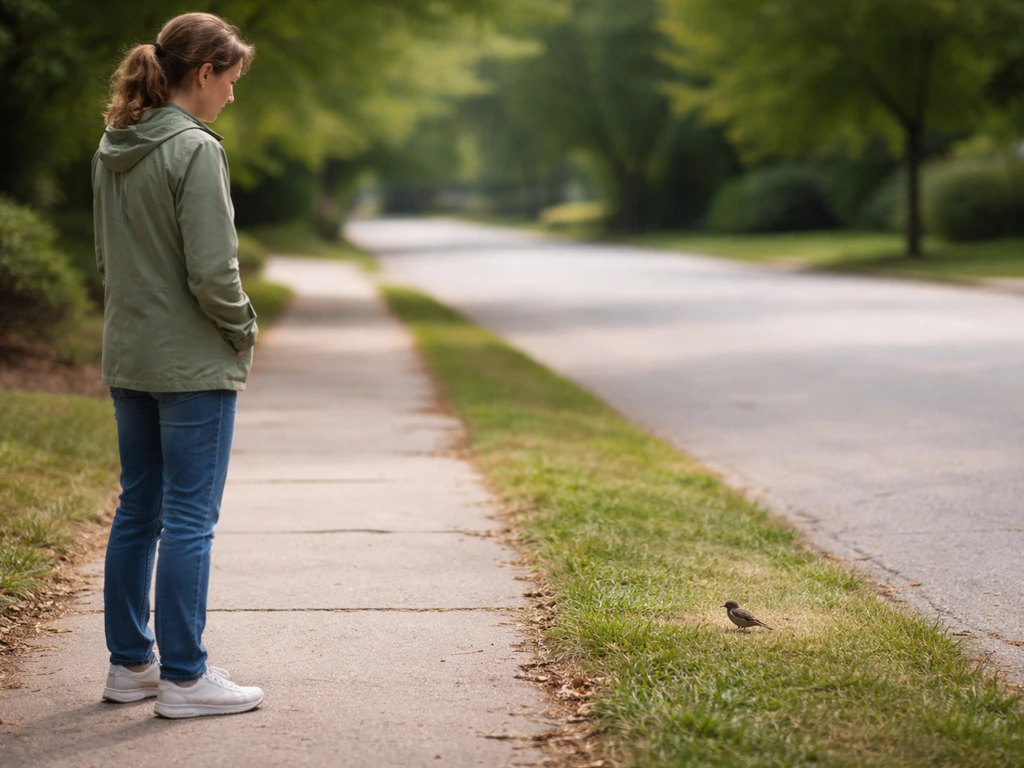
The first thing to do is nothing physical. Step back about 10 to 15 feet and just watch. Note where the bird is, whether it's moving, and whether any adult birds are nearby. This short observation window tells you a huge amount before you touch anything. If you rush in immediately, you can stress the bird, cause it to bolt into traffic or a predator's path, or separate it from parents who were about to return.
While you watch, remove any immediate threats you can control. If you have a dog or cat nearby, bring them inside. If the bird is in a road or driveway, you can gently herd it to a safer nearby spot using a piece of cardboard, without picking it up. If the bird is clearly injured and cannot move, that's when you move to the next step.
Also take a moment to protect yourself. Wild birds can carry bacteria and parasites, and a frightened bird can scratch or bite hard enough to break skin. Wash your hands before and after any handling, and if you have latex or nitrile gloves handy, use them. Handling a bird with your bare hands does not cause the parents to abandon it (that's a myth), but hygiene matters for your own health.
Is it actually abandoned? Injury vs. orphaning vs. fledgling
This is the most critical check, and it takes less than two minutes once you know what to look for. The bird's age and feather development are the clearest signals.
Nestlings: tiny, featherless, eyes closed
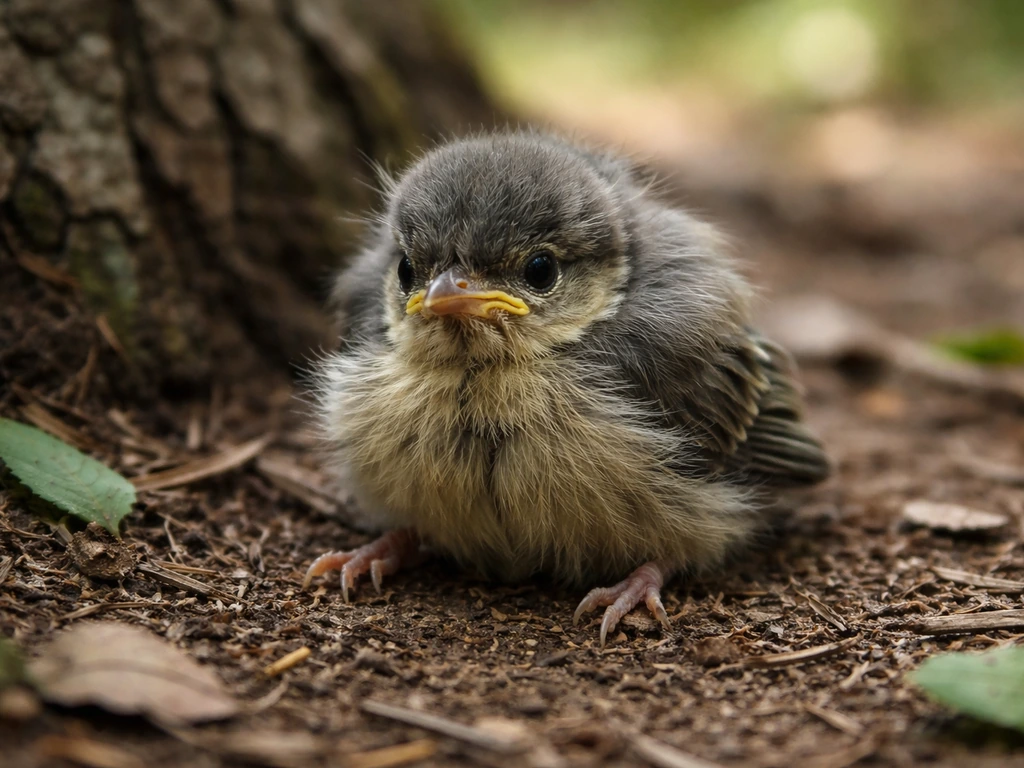
A nestling is featherless or nearly featherless, often with its eyes still closed, and has pink or grey skin showing. These birds genuinely cannot survive outside a nest. If you find one and can safely locate and reach the nest, place it back in. The parent will not reject it because you touched it. Then watch from a distance for at least an hour to see whether a parent returns to feed it. If no parent appears after an hour and the bird is cold, it likely needs help.
Fledglings: feathered, hopping, looks "abandoned"
A fledgling has most of its feathers, can grip a perch, and may be hopping or making short flights. This is the stage people most often mistake for abandonment. According to the U.S. Fish & Wildlife Service, a baby bird likely does not need your help unless it is featherless or has its eyes closed. The Washington Department of Fish and Wildlife notes that parents actively answer their fledgling's begging calls and are usually watching from a nearby branch or wire. If a fledgling looks alert and is moving, blank" rel="noopener noreferrer">leave it alone and watch from a distance. You can move it a few feet to a safer spot (a shrub, off a sidewalk) but do not take it indoors.
Signs of real injury or illness
Regardless of age, a bird that needs hands-on help will show at least one of the following signs: visible bleeding, a wing hanging at an odd angle, an inability to hold its head upright, it's been caught by a cat, it's cold to the touch and unresponsive to your approach, or it's been lying in the same spot for more than an hour with no parent contact. If you see any of these, intervention is warranted.
| What you see | What it probably means | What to do |
|---|---|---|
| Featherless, eyes closed (nestling) | Out of nest; genuinely needs help | Return to nest if reachable; watch 1 hour; call rehabber if no parent returns |
| Feathered, hopping, alert (fledgling) | Normal developmental stage | Watch from distance; move only if in immediate danger; do not take inside |
| Any age, visible wound or bleeding | Injured | Contain humanely; call wildlife rehabber or avian vet immediately |
| Cold, unresponsive, not moving | Injured or ill | Warm gently; contain; call for professional help now |
| Caught by cat or dog | Puncture wounds likely even if invisible | Contain and seek avian vet same day; cat saliva is dangerous to birds |
How to safely contain and transport the bird
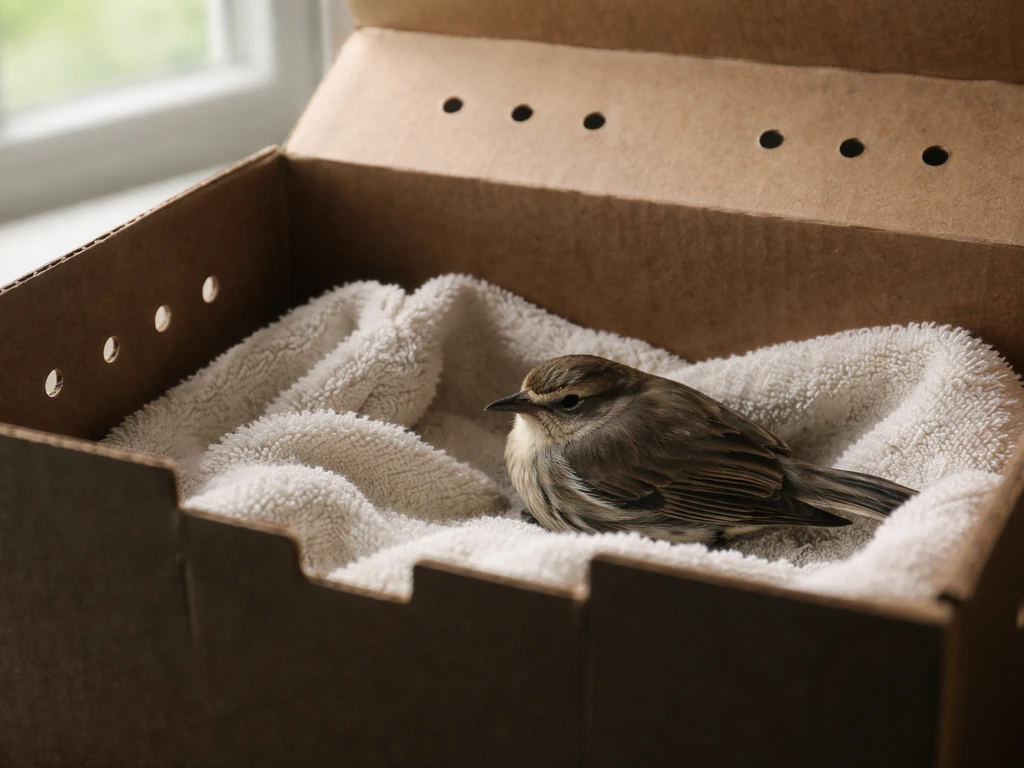
Once you've determined the bird genuinely needs help, containment is your next job. The goal is to reduce stress and prevent further injury while you arrange professional care.
Choosing the right container
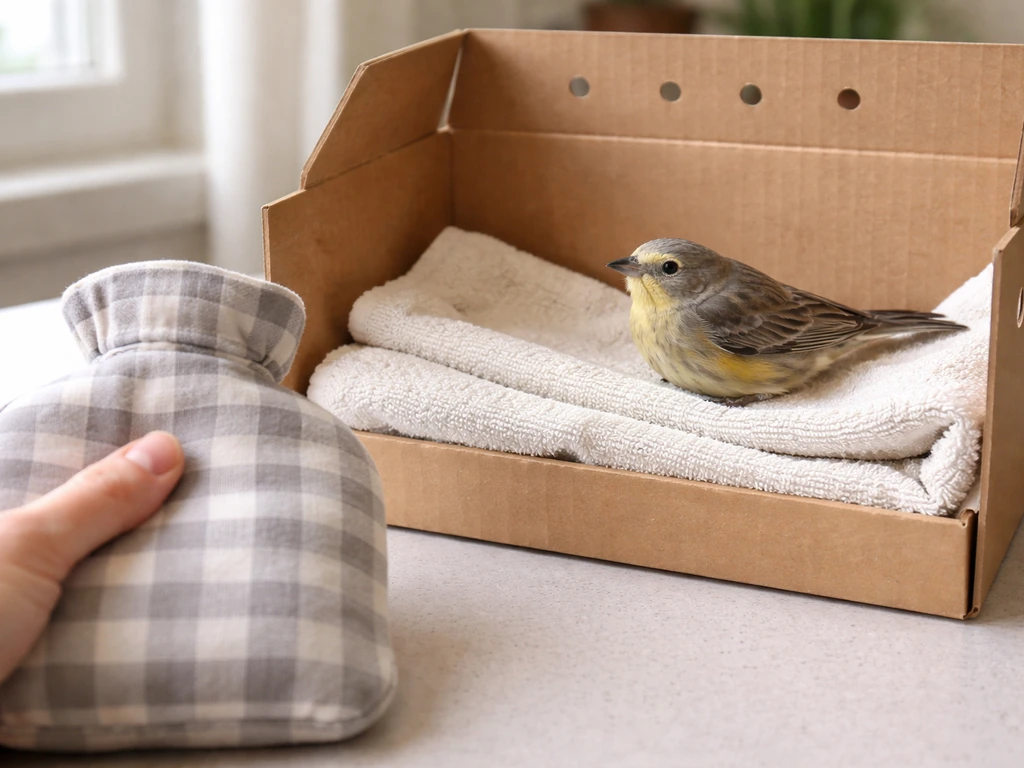
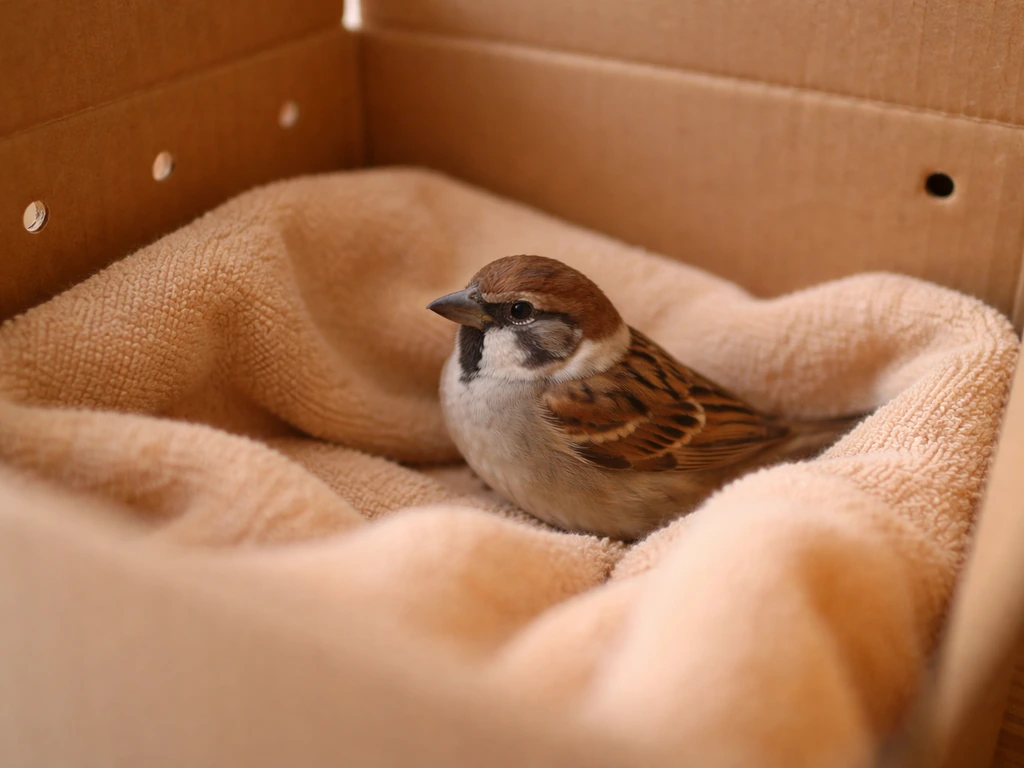
A cardboard shoebox or small cardboard box with a lid works perfectly for most songbirds. Punch a few small ventilation holes in the sides (not the top, so no light floods in). Line the bottom with a paper towel or a layer of tissue, not a terry cloth towel because loose loops catch tiny toes. Do not use a wire cage or a glass tank. Both allow too much visual stimulation and the bird will exhaust itself trying to escape.
Warmth without overheating
If the bird is cold, Tufts Wildlife Clinic recommends placing one end of the shoebox on a towel that's been folded over a heating pad set on low. This creates a temperature gradient so the bird can move toward or away from the heat. Never put the heating pad directly under the whole box, and never use a heat lamp close to the box. You want gentle, even warmth, not a hot spot that could overheat the bird while it's too weak to move away.
Handling and minimizing imprinting
Keep handling to a bare minimum. Every time you pick the bird up, its heart rate spikes and it burns energy it can't afford to lose. Wear gloves, scoop the bird gently using both hands cupped together, place it in the box, and close the lid. Then leave it alone. Do not keep opening the box to check on it, show it to children or neighbors, or talk to it at length. For baby birds especially, repeated human contact can cause imprinting, which makes them unreleasable into the wild.
Transporting to a vet or rehabber
Keep the box in the passenger footwell or a stable spot during transport so it won't slide. Keep the car quiet. No radio, no air conditioning blowing directly at the box. If you need to leave the box in the car briefly, park in shade and crack the windows. Never leave a bird in a hot car longer than a couple of minutes.
Basic first aid for common situations
First aid for a wild bird is mostly about doing as little as possible while preventing things from getting worse. Here's what you can safely address before professional help arrives.
Visible bleeding
If you see active bleeding, apply very gentle pressure with a clean piece of gauze or a folded paper towel for 60 seconds. Do not use cotton balls (fibers stick to wounds). Do not apply any antiseptic cream, hydrogen peroxide, or alcohol. These damage tissue and make a rehabber's job harder. Once bleeding slows, place the bird in its box. That's it. The goal is not to treat the wound, it's to stop active blood loss and get the bird to a professional.
Cat or dog attack
This is an emergency even when the bird looks fine. Cat saliva contains bacteria that cause sepsis in birds within hours. If a bird has been in a cat's or dog's mouth, it needs antibiotics from an avian vet the same day. Do not assume it's okay just because you see no wound. Puncture wounds from teeth are often invisible under feathers.
Window strike
Birds that hit windows are often just stunned and may recover on their own within 15 to 30 minutes if placed somewhere quiet and safe. Put the bird in a ventilated box in a dark, quiet room at room temperature. Check after 30 minutes. If it's alert and upright, take it outside and open the box somewhere safe. If it's still lethargic after an hour or tilting its head, it has a concussion or internal injury and needs veterinary care.
Cannot stand or perch
A bird that can't stand may have a leg injury, spinal trauma, or severe weakness from illness. Do not try to splint anything yourself. Keep it contained on a flat, padded surface (paper towel lining in the box is fine) and get it to a rehabber or avian vet. Any DIY splinting without proper training tends to restrict circulation and cause more harm than good.
Feeding and hydration: what to give and what to never give
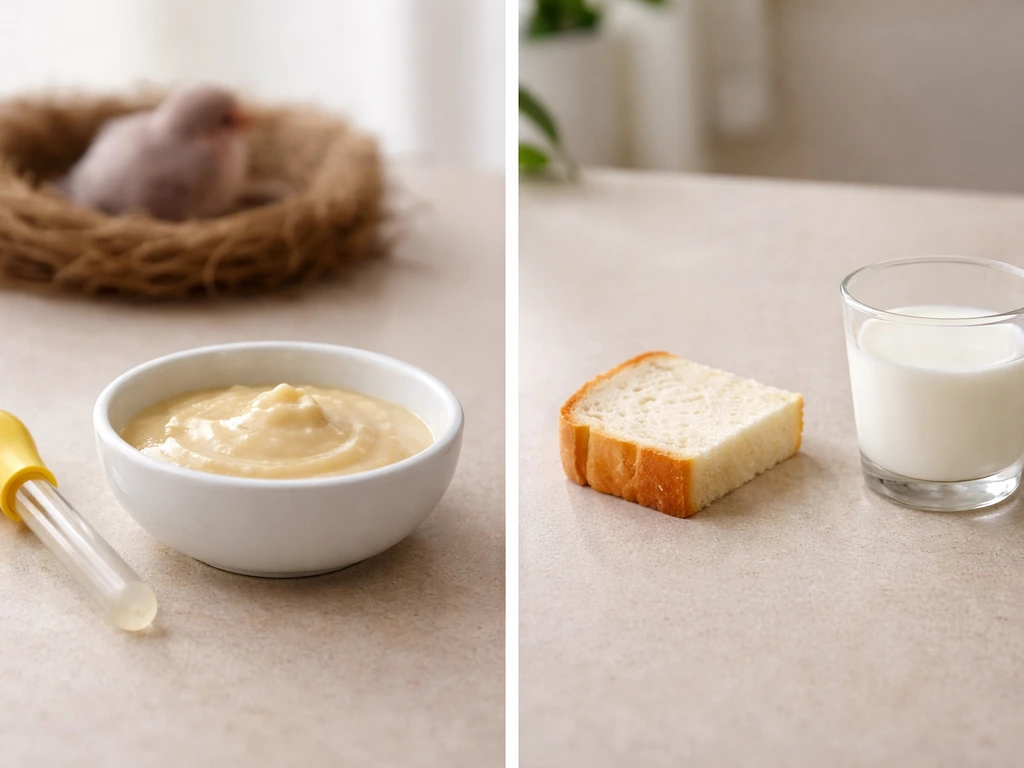
This is where good intentions most often backfire. Both the ASPCA and the Audubon Society are direct about this: do not attempt to feed or give water to an injured or orphaned wild bird. Not even water. Here's why that matters and what the nuances are.
Why "do not feed" is the right default
Baby birds have different dietary needs depending on species, and the wrong food causes malnutrition even if it looks harmless. Trying to drip water into a bird's beak is one of the most common causes of aspiration pneumonia in rescued birds because their airway opens on their tongue, not at the back of the throat like ours. Audubon advises that you should not try to feed or give water to young birds [Trying to drip water into a bird's beak](https://www.
audubon. org/debs-park/about-us/what-do-if-you-find-injured-or-orphaned-bird). Bread, milk, worms dug from your garden, and "baby bird" mixes you find online are all inappropriate unless a trained rehabber walks you through species-specific feeding. If you're only holding the bird for a few hours before professional help arrives, it is safer with no food than with the wrong food.
What you can offer in limited circumstances
If you have confirmed you are dealing with an adult wild bird (not a baby), it is clearly alert and upright, and you cannot reach a rehabber for 24 hours or more, you can place a small shallow dish of clean water in the corner of the container and let the bird drink on its own if it chooses. Do not force anything. For adult songbirds, a small amount of appropriate wild bird seed (not seasoned, no salt) or mealworms from a pet store is less risky than trying to hand-feed baby formula. But this is a last resort, not standard protocol.
- Never drip water into a bird's beak
- Never feed bread, milk, or dairy of any kind
- Never give cat food, dog food, or table scraps
- Never try hand-feeding a baby bird with an eyedropper unless directed by a rehabber
- Never give sugary liquids, sports drinks, or anything flavored
Temporary housing and monitoring until help arrives
Once the bird is in its box, your job is to maintain conditions and resist the urge to interfere. Tufts Wildlife Clinic is clear on this: keep the bird in a warm, dark, quiet place and minimize stimuli. That means a room with the door closed, away from pets, children, and noise. Dim or no lighting. No TV or music nearby.
Check on the bird no more than once every 30 to 60 minutes, and when you do, do it quickly. Open the lid just enough to see if it's breathing, upright, or showing signs of distress (rapid open-mouth breathing, seizing, or rolling). Then close the lid and leave it alone again.
Keep the temperature in the room between 70 and 80 degrees Fahrenheit if possible. If you're using a heating pad under one end of the box, check periodically that the box itself isn't getting too warm by touching the outside of the box near the heat source.
If the bird seems stable and you're waiting overnight for a rehabber to open in the morning, keep the setup consistent. Do not move it to a warmer or cooler spot repeatedly. Consistency reduces stress more than any single temperature tweak.
For birds that are recovering from a window strike and may be ready for release, move the box outside to a sheltered spot (shade, away from cats) before opening it. Never release a recovering bird indoors and let it find its own way out. The stress of being trapped inside adds unnecessary risk.
When to call a wildlife rehabilitator or avian vet right now
If any of the following apply, make the call immediately rather than waiting to see how things develop.
- The bird has been caught by a cat or dog
- There is visible bleeding that didn't stop within a minute of gentle pressure
- The bird cannot hold its head upright or is spinning in circles
- It has a visibly broken or dangling wing or leg
- It is a nestling (featherless or near-featherless) and no parent returned after one hour of watching
- The bird is cold and completely unresponsive
- It is a protected species you recognize (hawk, owl, heron, any raptor, or songbird) since almost all wild birds in the U.S. are protected under the Migratory Bird Treaty Act
How to find help fast
In the U.S., search the National Wildlife Rehabilitators Association (NWRA) or Wildlife Rehabilitators Association directories online, or call your state's fish and wildlife agency. Many areas also have local Audubon chapters that maintain rehabber referral lists. An avian vet (a vet who specializes in birds) is your best backup if no rehabber is reachable. General veterinary practices can assess injury and provide emergency stabilization but may not be licensed to keep wildlife.
Legal and ethical considerations
In the United States, it is illegal under the Migratory Bird Treaty Act to keep most wild birds without a federal permit, even temporarily with good intentions. This is not meant to scare you out of helping a bird in distress. Short-term emergency intervention (containing and transporting a bird to a rehabber) is generally understood as a humane exception. But keeping the bird at home for days, attempting extended hand-rearing, or deciding to "keep" it as a pet is illegal for most species and almost always results in a worse outcome for the bird. The legal and ethical path is the same: get it to a licensed professional as soon as possible.
What to do emotionally when you've done what you can
It's worth saying plainly: not every bird makes it, even with the best care. If you've contained the bird humanely, kept it warm and quiet, avoided the common feeding mistakes, and contacted a professional, you have done everything right. Wildlife rehabilitators understand that public rescuers are doing their best under stress. Hand the bird over, follow up if you want to know the outcome, and know that your intervention genuinely made a difference in that animal's chance of survival.
If you're caring for a specific species, the details matter more. For special cases like a goliath bird eating spider, the care steps depend on whether it is injured, handling can be risky, and you should use a specialist approach for warmth, housing, and safety. For starling birds, the same rescue steps apply, but feeding and handling details can differ by age and condition caring for a specific species.
Doves, sparrows, starlings, and other common birds each have slightly different needs around diet and handling, and getting species-specific guidance from your rehabber will help them give the best possible care once the bird is in their hands. If you're wondering how to take care of a dove bird, ask the rehabber for species-specific guidance on diet, warmth, and handling Doves, sparrows, starlings.
FAQ
My neighbor says the parents abandoned the baby bird. How long should I watch before I take it in?
If the bird is alert, has most of its feathers, and can grip, assume it is a fledgling learning to fly. Watch from a distance first, and only move it a few feet away from hazards using cardboard. Bring it indoors only if it is injured, chilled, unable to stand, or was in a cat or dog mouth.
What are the “red flags” that mean I should stop waiting and call for help right away?
Use the bird’s behavior to decide timing, not the clock alone. If you see active bleeding, an odd wing angle, head unable to stay upright, signs after a cat/dog bite, or it is cold and unresponsive, act immediately. If it is moving and alert with normal feathering, give it time to have a parent respond from nearby, then re-check once.
How often should I check the bird once it’s in a box?
Yes, you can still end up stressing it even when you follow the right steps. Common mistake is repeatedly opening the box to “check” on it. Instead, check briefly no more than once every 30 to 60 minutes, look through the smallest gap you need to assess breathing and posture, then close it completely.
Can I give water to an abandoned bird to prevent dehydration while I’m waiting?
Do not offer water by dripping it or putting drops into the beak, even if it looks thirsty. For fledglings and nestlings, feeding attempts often lead to aspiration. The safest option is zero food and no forced water until a licensed rehabber gives species-specific instructions; for an adult only, a small dish of water may be offered in its container if it can drink on its own.
What’s the safest way to warm a bird I found, and how do I avoid overheating it?
No. If the bird is cold, use gentle indirect warmth (heating pad on low under one end of the box creating a temperature gradient). Avoid heat lamps, avoid putting the heating pad directly under the entire box, and keep the box room-temperature safe by touching the outside near the heat source to confirm it is not overheating.
My cat knocked a bird off the porch. It seems fine now. Do I still need to get help?
If you see a bird hit a window and it perks up and stands normally after 15 to 30 minutes in a dark, quiet, room-temperature spot, you can return it outside. If it remains lethargic after an hour, tilts its head, or seems unable to coordinate, treat it as needing veterinary care due to possible concussion or internal injury.
There are no obvious injuries after a cat encounter. Is it really an emergency?
If it has been in a cat or dog mouth, it can deteriorate quickly even when there is no visible puncture wound. The key decision is exposure, not how the feathers look. Keep it contained and contact an avian-capable vet or rehabber the same day, because puncture wounds and sepsis risk can be delayed.
When is it safe to release a bird I found, and should I do it indoors first?
Do not set a wild bird free immediately after you bring it outside if it is still weak, tilted, or uncoordinated. For window-strike birds and other injuries, move the container to a sheltered outdoor spot before release, but only open when the bird looks stable enough to stand and move normally.
Do I need to identify the exact bird species before I can help it?
Species matters because diets and handling differ. The fastest way to get it right is to tell the rehabber exactly where you found it (ground, nest area, window, cat location), its approximate age/feathering, and what you observed it doing. If you need interim housing, use a generic ventilated box setup, but rely on the rehabber for species-specific feeding or care.
What should I do if there’s no wildlife rehabber available for a full day?
If you can’t reach a rehabber, consider an avian-experienced vet or an emergency vet for stabilization. Avoid keeping it at home for days, and avoid long-term hand-rearing, because most wild birds are not legal to keep without proper permits and the care often worsens outcomes.
Is it dangerous to handle a wild bird without gloves?
For gloves, any clean latex or nitrile is fine, and handwashing is the priority. Avoid touching the bird more than necessary, and keep your face and bare skin away from the bird’s beak and feet to reduce scratches and bites.
What are the most common mistakes people make after they contain a bird?
Yes. Carrying it around the neighborhood, letting kids hold it, putting it on the couch for “fresh air,” or keeping it in a bright room increases stress and can impair recovery. Keep it in a warm, dark, quiet area away from pets and noise, and transport it promptly in the container so it doesn’t slide.
The bird is lying down and won’t move. Should I try to prop it up or splint it?
If you find the bird still cold and unresponsive, do not try to “revive” it by blowing air or forcing movement. Use gentle warmth in the box with a temperature gradient, keep the environment quiet, and seek professional help. Improvised splinting or forcing posture can worsen injuries.
Next Article
How to Take Care of a Fallen Bird: First Aid Steps
Step-by-step first aid for a fallen bird: assess stage, warm safely, feed correctly, house temporarily, and know when to