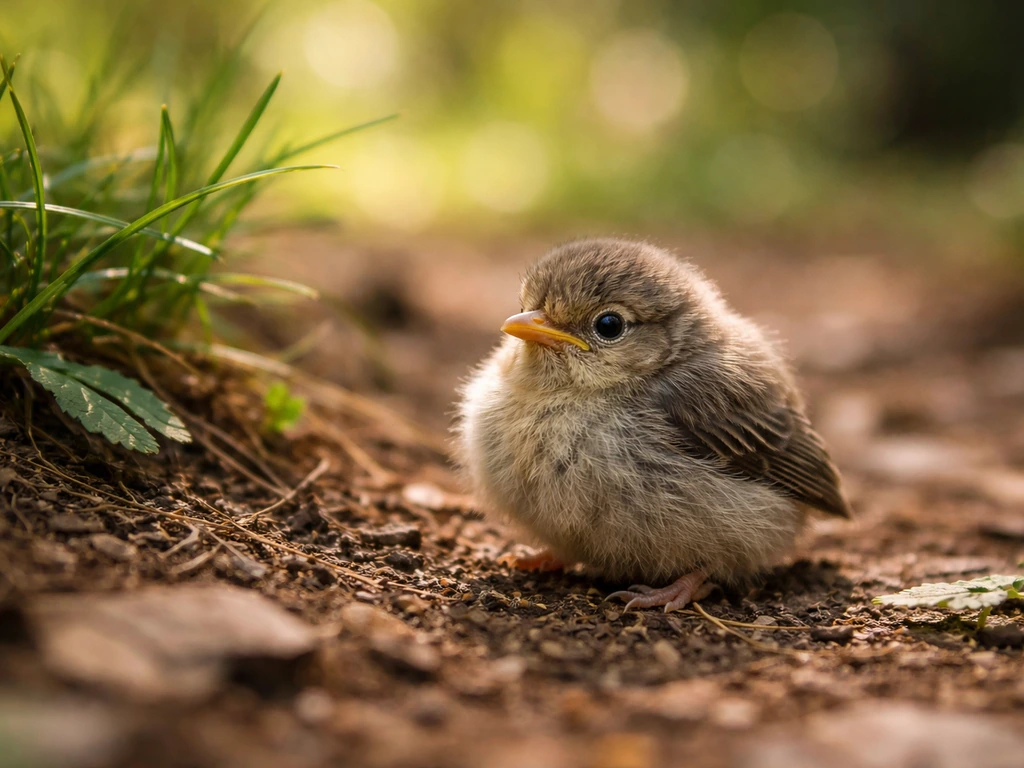
If you've just found a juvenile bird and you're not sure what to do, here's the short answer: stop, don't feed it, don't give it water, and take two minutes to figure out whether it actually needs rescuing before you touch it. Wildlife Center of Virginia advises that many young wild animals, including baby birds, may not need human “help,” so call for advice before you intervene call for advice before intervening.
What to Do With a Juvenile Bird: Right Steps Now
Marcus Holloway
22 Apr 2026
Most juvenile birds found on the ground are fledglings doing exactly what they're supposed to be doing. If you can, figure out whether the bird is a nestling or a fledgling, because that determines what to do next for what to do with a bird fallen out of nest what to do with a bird that has fallen out of the nest. But some genuinely need help.
Getting that first call right makes an enormous difference for the bird's survival.
First: does this bird actually need your help?
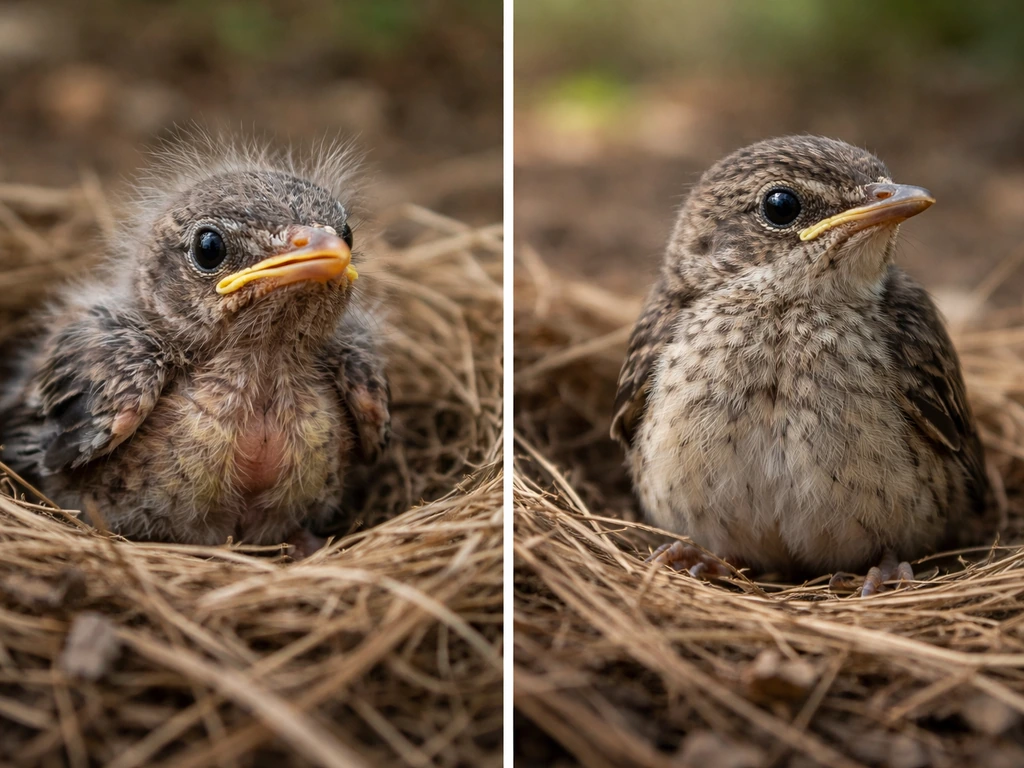
The single most important question is whether the bird is a nestling or a fledgling, because the answer changes everything about what you should do next.
A nestling is a very young bird that has no feathers or only sparse, patchy pin feathers. Its eyes may still be closed or barely open. It absolutely should not be out of the nest. If you find one on the ground, it has fallen or been knocked out, and it does need help.
A fledgling is a different situation entirely. Fledglings have most or all of their feathers, a short stubby tail, and they can hop and grip with their feet. Finding one on the ground is completely normal. This is the stage where young birds leave the nest and spend several days on the ground or in low branches while their parents continue feeding them and they learn to fly. If the bird you've found looks like this, it probably does not need rescuing.
The Wild Bird Fund puts it simply: if the baby bird has feathers and is hopping on the ground, that's normal fledgling behavior. The Wildlife Center of Virginia adds that a fully feathered bird on the ground that can't yet fly is most likely just going through the fledgling process. VCA Animal Hospitals echoes this, noting that parents often continue caring for fledglings even while they hop around on the ground.
Quick checks: normal behavior vs. a bird that's in trouble
Before you pick the bird up, run through these observations from a few feet away. You're looking for signs of real distress versus signs of a healthy bird doing its thing.
| What you see | What it likely means | What to do |
|---|---|---|
| Fully feathered, hopping, alert, calling out | Healthy fledgling — normal behavior | Watch from 30 feet away for 2+ hours; don't intervene |
| No feathers or only sparse pin feathers | Nestling out of nest — needs help | Try to return to nest; if not possible, contain and call a rehabber |
| Feathered but lying flat, eyes closed, not moving | Injured or ill fledgling | Contain safely and call wildlife rehab urgently |
| Visible bleeding, broken or drooping wing | Injured bird | Contain and get to an avian vet or rehabber today |
| Gasping, gurgling, or labored breathing | Medical emergency | Call rehabber immediately; handle minimally |
| Bird was caught by a cat or dog | Puncture wounds likely even if not visible — urgent | Get to an avian vet or rehabber within hours |
| Cold, stiff, or unresponsive | Hypothermic — critical | Warm gently and call for help immediately |
If you're not sure whether the bird is a nestling or a fledgling, the Bi-State Wildlife Hotline recommends calling a wildlife hotline and describing what you see. That's always a safe move. You're not committing to anything, and the person on the other end can walk you through the triage in real time.
One more check worth doing: watch from a distance. The Wild Bird Care Centre suggests observing for at least two hours to see if a parent bird comes down to feed or call to the juvenile. The Wildlife Care Association's guidance suggests a window of roughly 4 to 8 hours if you need to monitor longer without seeing parents. If adults are visiting, the bird is not abandoned.
Immediate rescue steps: handling, warmth, and temporary housing
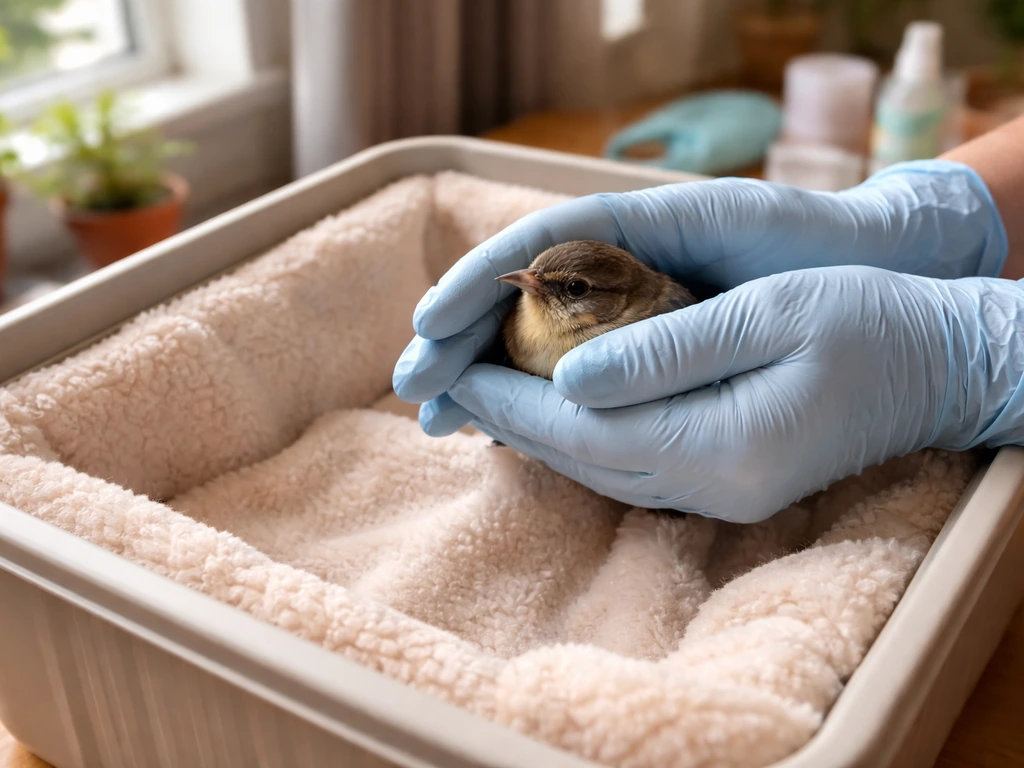
If the bird genuinely needs to be contained, do it as quickly and calmly as possible. Stress alone can kill a compromised bird, so every second of handling counts.
How to pick it up safely
Use gloves if you have them, especially if the bird is large or could bite. If you don't have gloves, a light cloth or small towel works. Gently place your hand over the bird, let it settle, then cup it loosely with both hands. Don't squeeze. blank" rel="noopener noreferrer">HSVMA's wildlife first-aid guidance frames it clearly: gently pick up the bird and place it in the prepared container. That's the whole move. Don't linger, don't examine it thoroughly, don't let people crowd around it.
Also: don't worry about your scent transferring and causing parents to abandon it. The Wildlife Center of Virginia is direct on this point, saying that contrary to popular belief, bird parents are not frightened off by human scent and will return.
Setting up a temporary container
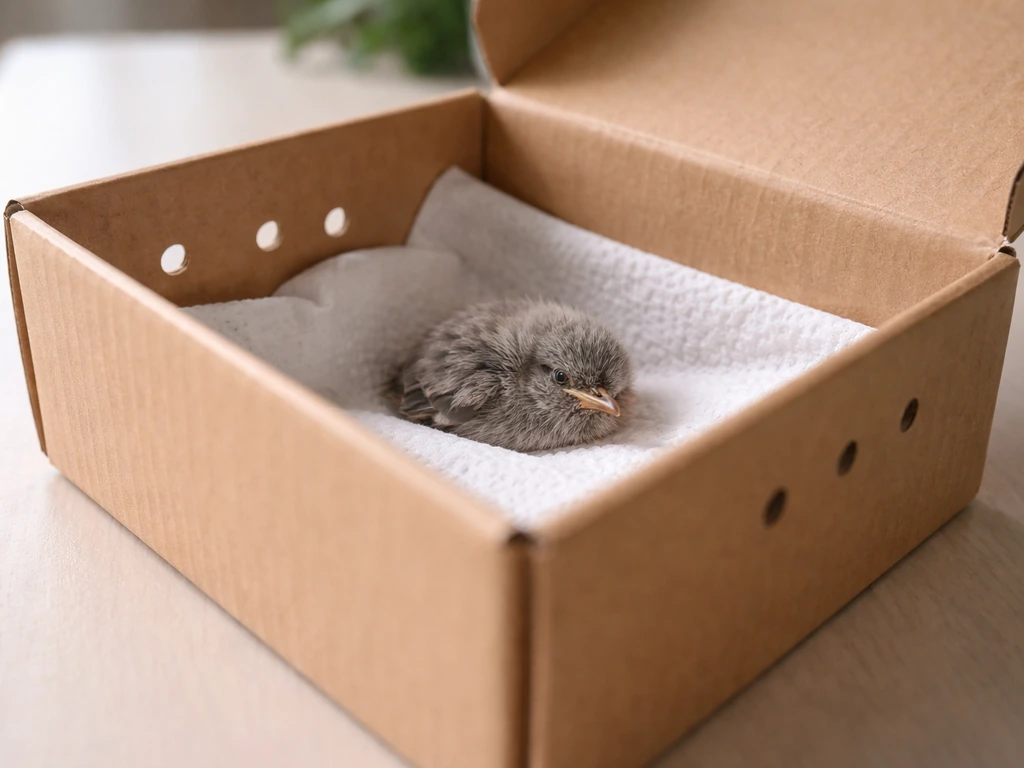
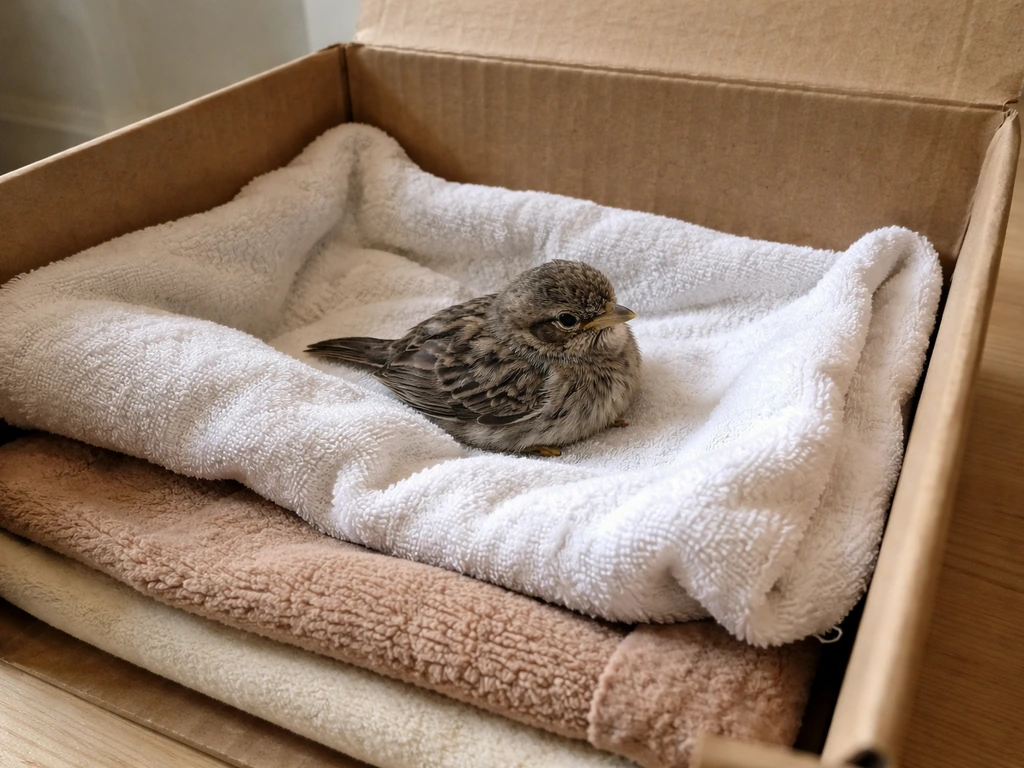
A small cardboard box with a lid works well. Punch a few small air holes in the sides. Line the bottom with paper towels, not terry cloth towels, because loose threads from towels can wrap around tiny toes and cause serious injury. Keep the box in a quiet, dark, warm place away from pets, children, and noise. Do not put the bird in a wire cage or anything it can grip and hang from.
Keeping the bird warm
Warmth is often the most urgent need, especially for nestlings. blank" rel="noopener noreferrer">The target ambient temperature inside the container is around 85 to 95°F, according to HSVMA's wildlife care guidelines. The bird should be warm but also able to move away from the heat source if it gets too hot.
A practical approach from the Wild Bird Fund: fill a clean sock with uncooked rice, microwave it for about 30 seconds, wrap it in a thin towel, and place it next to (not under) the bird. A hand warmer wrapped in a cloth works the same way. The Wild Bird Care Centre notes that if you can't get the bird to a facility within an hour, providing a heat source is time-critical. One important caution from the Bi-State Wildlife Hotline: once your heat source cools down, it can actually pull warmth away from the bird, so check it regularly and reheat as needed.
What NOT to do: the mistakes that hurt birds most
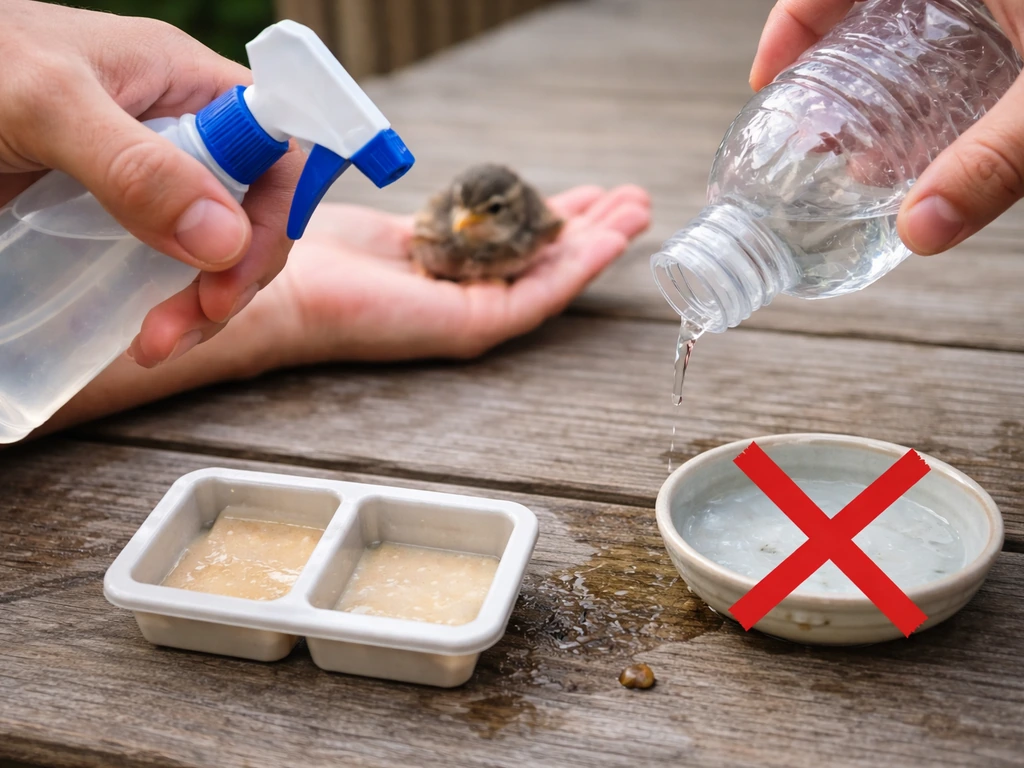
This section might be the most important one. Well-meaning people cause real harm trying to help juvenile birds, usually through feeding and watering. Here's what to avoid:
- Do not give water. Squirting or dripping water into a bird's mouth is one of the fastest ways to cause aspiration, which can be fatal. CA Wildlife 911 and Audubon both explicitly warn against this.
- Do not feed the bird anything unless a rehabilitator has specifically told you to and told you exactly what to give. The Raptor Trust, Audubon, the Bi-State Wildlife Hotline, and multiple other sources all say the same thing: no food until a professional advises it.
- Do not feed bread, milk, seeds, or anything from your kitchen. These are not appropriate foods for wild juvenile birds and can cause choking, crop impaction, or nutritional harm.
- Do not force-feed. A bird that is stressed, cold, or injured cannot safely process food and is at high risk of aspiration.
- Do not put the bird in a pocket or hold it against your body as a warming method. DFW Wildlife Hotline specifically calls this out as inadequate and potentially harmful.
- Do not handle the bird more than necessary. Stress is physiologically harmful. Contain it, keep it dark and quiet, and leave it alone.
- Do not let children or pets near the container.
- Do not assume internet feeding guides are safe. CA Wildlife 911 warns specifically about misinformation from online sources about emergency feeding.
Feeding and care basics: when to wait and when to act
The default position for any juvenile bird you've contained is: warmth yes, food and water no, until a professional tells you otherwise. This is not overcaution. It's the standard first-aid protocol recommended across virtually every credible wildlife rehabilitation source.
AZ Wildlife Resource puts it clearly: wait to offer food or water until you've consulted a rehabilitation facility. Forcing water into a traumatized or dehydrated animal can cause harm rather than help.
The exception would be if you've already reached a rehabilitator and they've given you specific instructions, including what to feed, how much, and how to deliver it. In that case, follow their guidance exactly. But if you haven't yet reached anyone, warmth is your entire job for now.
WildCare makes an important broader point: raising a wild bird properly requires intensive, specialized care. Even if a bird survives initial handling, an improperly imprinted or fed bird often cannot be released successfully. The goal of everything you do before the rehabber takes over is to keep the bird alive and as unstressed as possible, not to start a rehabilitation process yourself.
Returning the bird to its nest when you can
If you have a nestling and you can see or reach the nest, putting it back is the best possible outcome. WildCare advises returning the bird to its original nest with its siblings, not a substitute location. Look for the nest in the nearest tree or shrub above where you found the bird.
If the original nest has been damaged or knocked down, you can make a substitute. Line a small basket or berry container with dry grass or leaves, attach it to the tree as close to the original nest location as possible, and place the nestling inside. Then watch from a distance for the parents to return.
For fledglings that you've temporarily moved for safety (say, away from a busy road), the Wild Bird Fund recommends returning the bird to the exact spot where you found it, stepping back about 30 feet, and waiting up to 45 minutes to see if a parent comes to feed it. If a parent shows up and is actively feeding, your job is done. Leave the area.
The RSPCA notes that if a fledgling is in immediate danger, you can move it a short distance (just a few meters) to a safer spot. Moving it further than that makes it harder for parents to locate it.
If you can't find or reach the nest for a nestling, the U.S. Fish & Wildlife Service advises placing the bird in a shaded area rather than assuming it's been abandoned, while you arrange to get it to a rehabilitator.
When to call wildlife rehab or an avian vet, and how fast
Some situations need professional help right away. Others can wait a couple of hours while you monitor. Here's how to read the urgency.
Call immediately (same-day, within hours)
- The bird was caught by a cat or dog, even if it looks fine. Cat saliva carries bacteria that cause fatal infections within hours.
- There is visible bleeding that isn't stopping.
- The bird has a drooping, broken, or twisted wing or leg.
- It is gasping, making gurgling sounds, or breathing with obvious effort.
- It cannot stand or hold its head up.
- It is completely unresponsive or cold and stiff.
- You have a nestling with no feathers that you cannot return to a nest.
Call within a few hours (still today)
- A feathered fledgling that seems lethargic or weak but has no obvious injury.
- A bird that has been in your care for more than an hour and you're unsure what it needs.
- You've watched for 45 minutes to 2 hours and no parent bird has appeared.
- The bird is alone in a situation where predators are nearby and you can't safely monitor it.
How to find help and what to say
Search for a licensed wildlife rehabilitator in your area through the National Wildlife Rehabilitators Association (NWRA) or the Wildlife Rehabilitator Network directory. You can also call your state's department of fish and wildlife, a local humane society, or an avian vet. Many areas have wildlife hotlines that can direct you quickly.
When you call, be ready to describe: the approximate size of the bird, its feathering (nestling vs. fledgling), where you found it (urban, rural, near water, etc.), what symptoms you've observed, and how long you've had it. The more detail you give, the faster they can advise you.
Audubon's guidance is a useful benchmark: if parents haven't returned within about an hour after you've placed the bird at its original location, that's when to make the call. You don't need to wait all day hoping the situation resolves.
The bottom line is that your role as a first responder is to keep the bird warm, contained, and calm until a professional takes over. If you want to know how to raise a bird that fell from a nest, start with these first-aid steps and then follow guidance from a licensed wildlife rehabilitator.
If you’re dealing with a bird that fell out of its nest, these same first-aid steps and watch-and-monitor checks can help you decide how urgent it is to get professional help bird fell out of nest what should i do. If it is a fledgling, use the same kind of first-aid mindset and focus on observation and keeping it safe until you can get help if needed.
If it turns out to be a true fledgling needing help, the next step is figuring out where to take a fledgling bird so a licensed rehabilitator can assess it. You don't need to fix it. You just need to keep it stable. That's genuinely enough, and it matters more than anything else you could do in those first hours.
FAQ
Do I always need to tell the difference between a nestling and a fledgling before I act?
Even if you suspect it is a fledgling, you should still prioritize safety. For example, if it is on a road, in a yard with active pets, or in a location where it cannot get out of immediate danger, you can move it a short distance to a safer spot, then step back and monitor for parents.
What should I feed a juvenile bird if it looks hungry?
Do not give milk, bread, seed, or any homemade mix. The article’s guidance that you should not offer food or water applies unless a licensed rehabilitator has already instructed you with a specific diet and delivery method.
Can I give water to a juvenile bird to prevent dehydration?
Replace water with warmth and a safe container. If the bird is hydrated enough to be responsive and feathered (typical fledgling behavior), it usually does not need water from a bystander, and attempts to hydrate can be harmful.
What if the bird is small and my gloves are too big or I do not have gloves?
Gloves help, but if the bird is tiny, a small towel can reduce injury from struggling. After you contain it, keep handling brief, avoid examining the eyes or mouth closely, and keep people and pets away so the bird can settle.
What should I do if I cannot tell whether the bird is distressed or just learning to be on the ground?
If you are unsure, it is better to delay touching and do observation. A safe approach is to watch from a distance first, and call a wildlife hotline with a clear description of feathering and behavior rather than guessing and moving it right away.
How long should I wait before deciding a fledgling is abandoned?
Yes, and the timing matters. If you place a fledgling where parents can access it, step back immediately and monitor for roughly up to 45 minutes, then contact a rehabilitator if parents do not arrive.
What if I see parents nearby but the juvenile bird still looks hurt?
If adults visit but the bird still looks weak, chilled, or injured, do not interpret adult presence as “no problem.” Document what you see (limping, labored breathing, inability to stand) and contact a wildlife hotline or rehabilitator so they can assess without you feeding or watering.
What container is safest if I have to temporarily hold the bird?
Avoid wire cages or anything that the bird can grip and hang from, because struggling or slipping can cause leg injuries. Instead, use a lidded cardboard box with air holes and a soft paper-towel lining (no terry cloth threads).
How do I know the bird is warm enough, and what should I watch for during heating?
Monitor the heat source continuously by touch and reassess regularly. If using a sock with warmed rice or a hand warmer, it can cool and then pull warmth away, so reheat as needed rather than letting the container get cold.
Are there times when a fully feathered bird on the ground still needs immediate help?
Yes. If the bird is fully feathered and hopping normally, that is often typical fledgling behavior, but if it cannot stand, has visible injury, is making repeated open-mouth gasping sounds, or is in active danger, you should seek help sooner.
If it is a nestling, should I always relocate it to a substitute nest?
For a nestling you can reach, aim to return it to the original nest in the nearest shrub or tree above where you found it. If the original nest is destroyed, create a temporary substitute lined with dry material and place the nestling in it, then monitor from a distance.
What is the maximum distance I should move a fledgling to keep it safe?
You can move a fledgling only a short distance for immediate safety, generally just a few meters, and then place it down and step back. Moving it farther makes it harder for parents to relocate it, even if it seems safer to you.
What if I cannot locate the nest for a nestling after I find the bird?
If you cannot find the nest, shaded placement is a stopgap, not a solution. Keep the bird warm and calm, then arrange a handoff to a licensed wildlife rehabilitator rather than continuing to “manage” care at home.
Why is warming and containment enough for the first stage, instead of trying to keep it fed at home?
Do not attempt to raise or rehabilitate yourself. Even if the bird survives the first hours, improper feeding and handling can lead to long-term problems that prevent successful release, so use containment and warmth only until a professional provides instructions.
What should I do if I see a parent arrive, then leave, and the bird seems unchanged?
If the bird is actively being fed by a parent after you placed it, you should stop intervening and leave the area. If feeding does not resume within the monitoring window or the bird has injury signs, call for guidance rather than trying to feed it yourself.
Next Article
What to Do If You Find a Fledgling Bird: Emergency Steps
Quick emergency steps to help a fledgling bird: assess injury or dependence, warm safely, feed only if needed, contact r