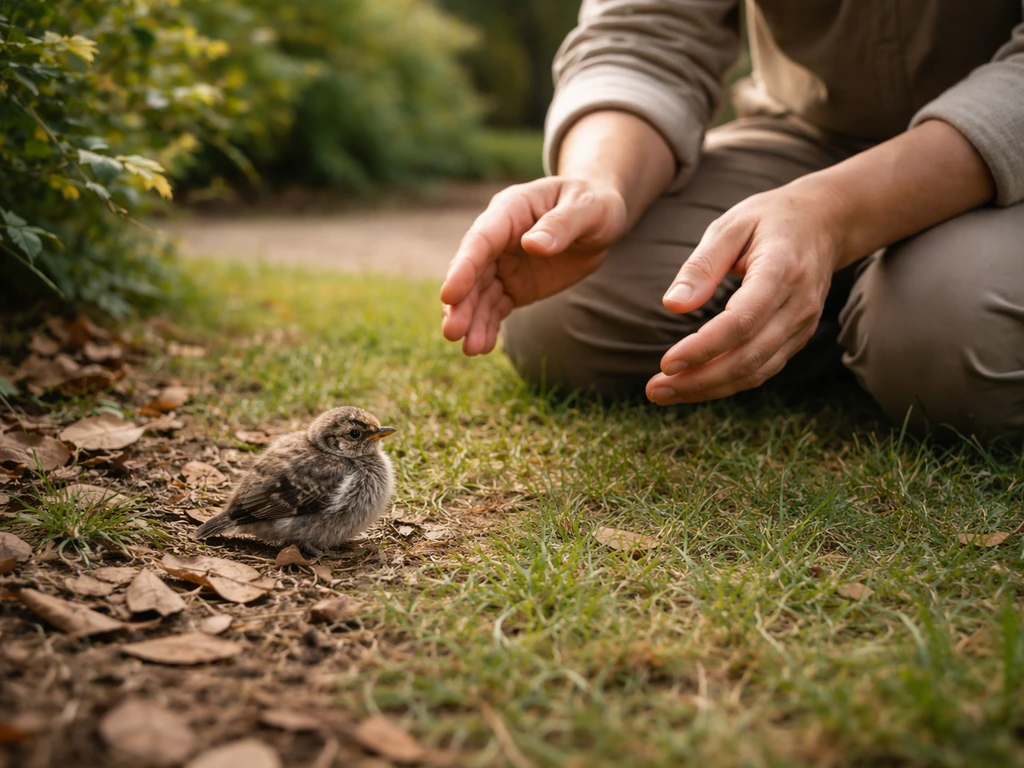
If you find a fledgling bird on the ground, the first thing to do is pause and look before you touch. Most fledglings are completely healthy, they're in the middle of learning to fly, their parents are almost certainly nearby, and the kindest thing you can do is leave them alone. Knowing how to help a fledgling bird also means knowing when to leave it alone and when to provide safe temporary care. But if the bird is bleeding, has a broken limb, was attacked by a cat, or is shivering and unresponsive, it genuinely needs help. This guide walks you through exactly how to tell the difference and what to do in either case.
How to Rescue a Fledgling Bird: Step-by-Step Guide
Marcus Holloway
14 May 2026
First: stay calm and check for real danger
Your instinct to help is good, but acting too fast can make things worse. Before you do anything, take 30 seconds to scan the situation. Is the bird in immediate danger from a car, a cat, or a dog? Is it on a busy road or in direct sun with no shade? If yes, you may need to move it a short distance to safety. If it's just sitting on a lawn or under a bush, it's probably fine right where it is.
Keep kids and pets well away. A dog or cat approaching a fledgling will cause panic and injury, and it also prevents the parents from coming back down to feed it. Give the bird space, ideally watch from inside a window or from at least 15 to 20 feet away.
Don't call a wildlife rehabber just yet. First, figure out what you're actually dealing with, because that determines everything that comes next.
Is it a fledgling, a nestling, or something else?
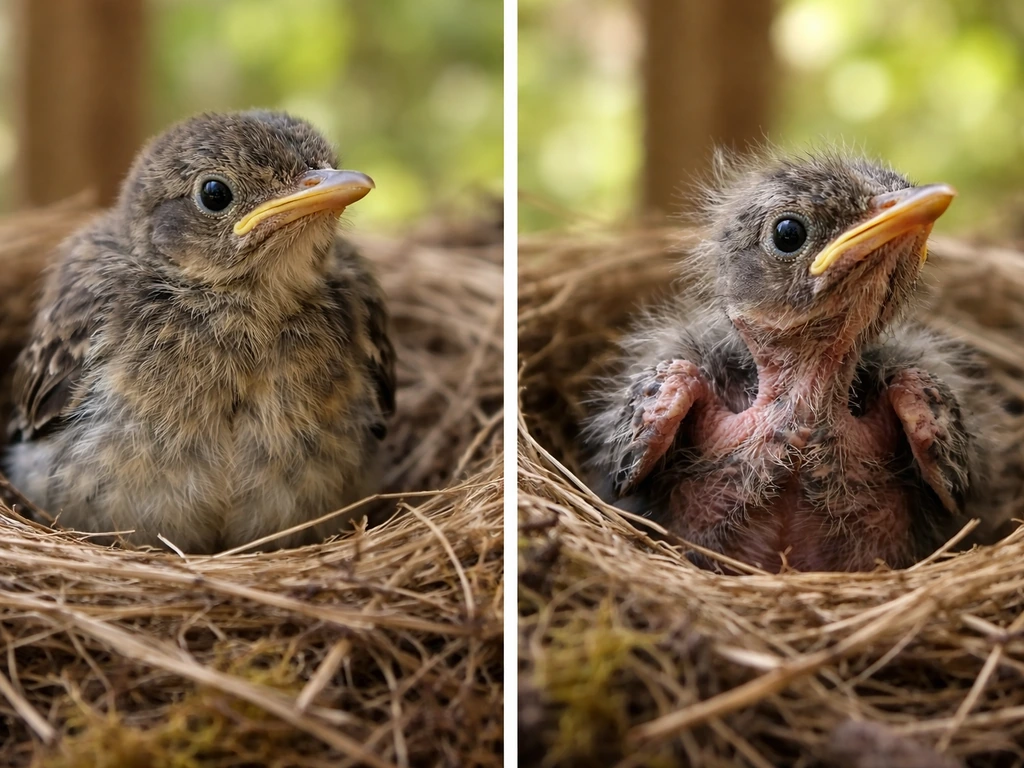
The word 'fledgling' gets used loosely, but it has a specific meaning that changes how you should respond. A true fledgling is a young bird that is mostly or fully feathered. It may look a bit scruffy, have a short tail, and hop around awkwardly, but it has feathers covering its body. A nestling, by contrast, is pink, naked, or only has patchy fuzz, and it clearly cannot survive outside a nest on its own.
| Feature | Fledgling | Nestling |
|---|---|---|
| Feathers | Mostly or fully feathered | Naked or patchy fuzz only |
| Movement | Hops, flaps, attempts short flights | Cannot stand or walk |
| Eyes | Open | Often closed |
| Typical situation | On ground, learning to fly | Fallen from nest |
| Normal to be on ground? | Yes, often | No, needs nest |
| Parents nearby? | Almost always | Possibly, if nest is close |
If what you have is a nestling (tiny, featherless, helpless), that's a different situation entirely and closer to what you'd find in a guide on how to raise a newborn bird. This article focuses on fledglings specifically.
Does this fledgling actually need rescuing?
Here's the honest truth: the majority of fledglings people bring to wildlife centers don't need to be there. They were healthy birds in the middle of a normal developmental phase. That's not a criticism, it's just important context, because unnecessary handling adds stress and can cause real harm.
A fledgling does NOT need rescuing if it is fully feathered, alert, and moving around on its own, even if it can't fly well yet. Wildlife Center of Virginia notes that it can be normal for fledgling birds to be on the ground, but if the bird looks fully feathered and cannot fly, consult a rehab professional first because injury and age and feather development affect outcomes. Parents continue feeding fledglings on the ground for days after they leave the nest. This is completely normal bird behavior.
A fledgling DOES need help if you can see any of the following:
- Visible bleeding or open wounds
- A broken or drooping wing or leg
- A cat or dog has bitten or grabbed it (even with no visible injury — puncture wounds from cat bites cause internal infection quickly)
- Maggots, fly eggs, or large bubbles visible under the skin
- The bird is tilting its head to one side repeatedly
- It's shivering, unresponsive, or lying on its side
- A dead parent is nearby and no other adult has appeared
- You've watched from a distance for several hours and no parent has returned
If none of those apply, keep pets away, watch from a distance, and let the parents do their job. That's genuinely the best help you can give.
Reuniting with parents: try this first
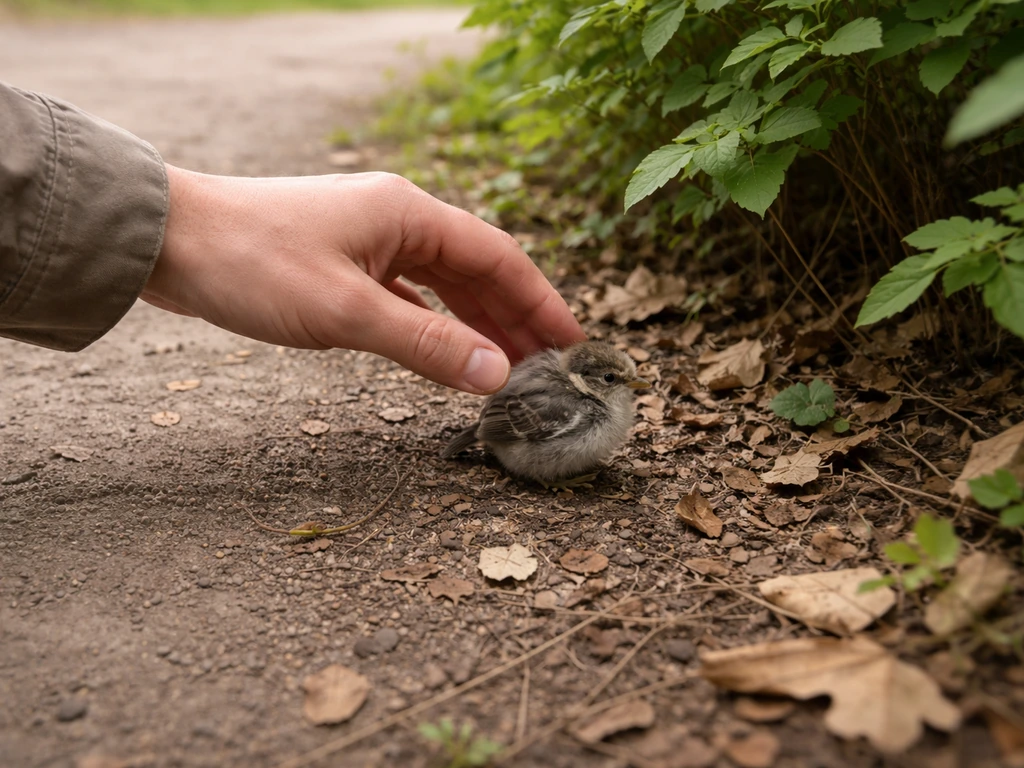
If the bird is in a risky spot (middle of a path, exposed to a cat) but appears uninjured, the first move is to gently relocate it a few feet to a safer nearby area, under a bush, on a low branch, somewhere sheltered but still in the same general location so the parents can find it. You do not need gloves for this; the myth that parent birds will reject a chick because of human scent is not true.
Then step back and watch from inside your house or from a good distance. Give it at least an hour, preferably two. Parent birds are cautious and will not approach if they sense you hovering nearby. If after a couple of hours in a quiet situation you still haven't seen a parent return, that's when it's worth calling a rehabilitator for advice.
If you believe the original nest is nearby and accessible, you can also gently place the fledgling back in it. If the nest is too high or has been destroyed, set the bird in a sheltered spot at ground level where the parents were last seen active.
How to safely handle and capture a fledgling that needs help
If the bird clearly needs intervention, keep your movements slow and quiet. Approach from the front, not from above, coming from above mimics a predator and triggers panic. Drape a light cloth or small towel loosely over the bird, then gently scoop it up with both hands underneath. Hold it firmly but without squeezing; you want to feel it but not compress its chest, because birds breathe by expanding their ribcage.
Minimize the time it's in your hands. Every second of handling is stressful for the bird. Get it into a container as quickly as possible.
Setting up a safe temporary container
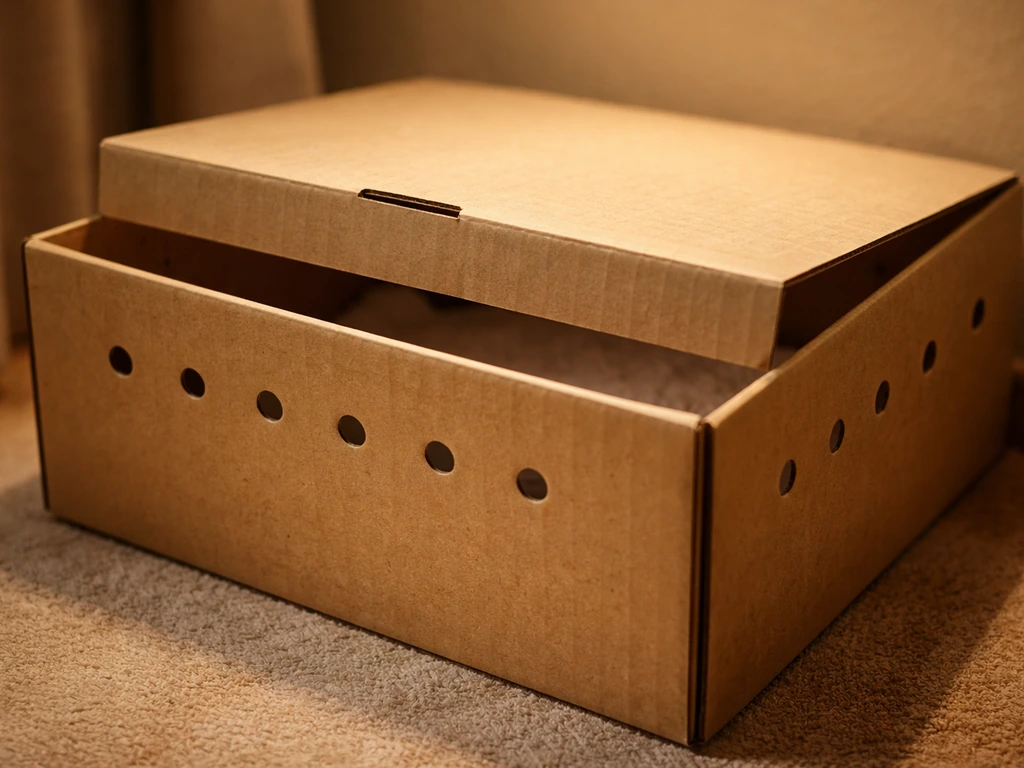
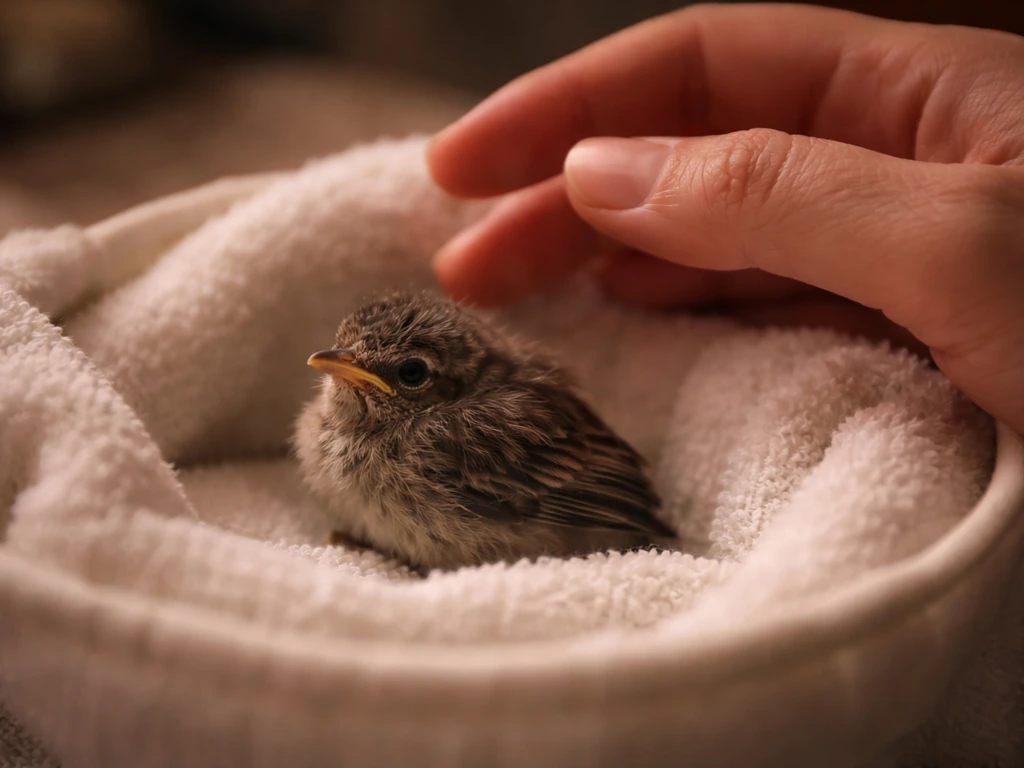
A cardboard box with a lid is ideal. Poke a few small air holes in the sides (not the top, light coming in from above stresses birds). Line the bottom with a thin layer of paper towels or a soft cloth. Do not use terry cloth or anything with loops that claws can get caught in.
Keep the container in a warm, dark, quiet room away from people, pets, TVs, and noise. Darkness reduces panic. Do not peek in repeatedly to check on it, every time you open the box, you restart the stress response.
Fledglings lose body heat quickly, especially if they're in shock. Provide gentle warmth by placing a hand warmer or a sock filled with dry rice (microwaved for about 90 seconds) wrapped in a thin cloth on one side of the box, not underneath the bird. The bird should be able to move away from the heat source if it gets too warm. Do not use a heat lamp directly over the bird and do not put the bird in direct sunlight. If using a heating pad, set it to low and place it under only half the box so the bird can self-regulate.
Feeding and hydration: what not to do
This is the section where most well-meaning people cause the most harm: do not feed the bird and do not give it water. That advice sounds counterintuitive, but it's consistent across every major wildlife organization for good reason.
Fledglings have very specific dietary needs depending on their species, and the wrong food can cause malnutrition, aspiration, or death. Bread, milk, water dripped into the beak, worms from your garden, all of these can seriously harm or kill a fledgling in ways that aren't immediately obvious. Young birds can inhale liquid directly into their lungs when you attempt to give them water, and the damage is fatal.
A healthy fledgling can go several hours without food while you get it to a rehabilitator. A sick or injured bird that has food or liquid forced on it is in much greater danger than one that simply waits. Unless a licensed rehabilitator has specifically told you what to feed and how, keep the box closed and get the bird to a professional.
Basic first aid for common emergencies
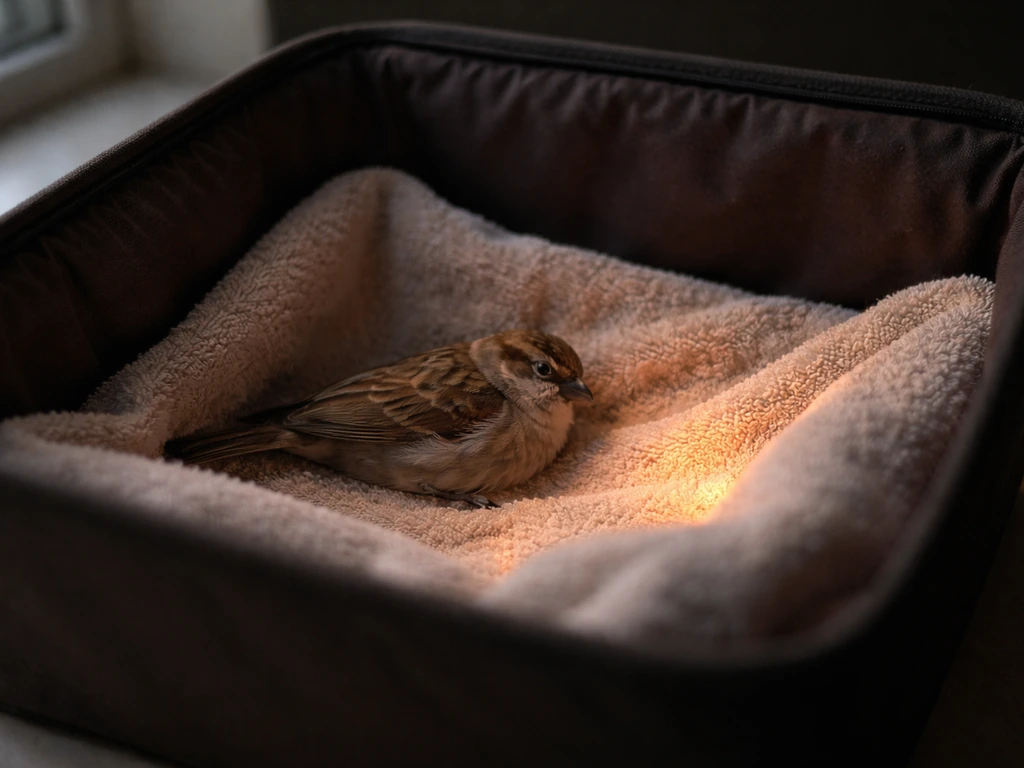
You're not a vet, and you shouldn't try to be. But there are a few things you can do in the first few minutes that make a real difference while you arrange professional care.
Shock
A bird in shock will be limp, unresponsive, or sitting with eyes half-closed. The most important thing you can do is place it in a warm, dark, quiet container immediately. Warmth alone helps stabilize a bird in shock. Do not try to stimulate it, hold it upright, or offer food. Just get it warm and dark and call a rehabber.
Bleeding
If there is active bleeding, apply gentle pressure with a clean cloth or paper towel for a few minutes. Do not use cotton balls, which stick to wounds. Once bleeding slows, get the bird boxed and move on to calling for help. Don't try to clean or dress the wound yourself.
Breathing trouble
If the bird is breathing with its mouth open, has a clicking sound when it breathes, or seems to be struggling, keep the environment calm and dark and contact a rehabber or vet immediately. There's nothing safe for you to do for respiratory distress beyond reducing stress.
Cat or dog attack
Treat any cat-caught bird as an emergency even if it looks fine. Cat saliva contains bacteria that cause fatal infections within hours. The bird needs antibiotics fast. Box it up and call a wildlife vet or rehabilitator right away, and mention specifically that it was caught by a cat.
Broken wings or legs
Do not try to splint anything. Incorrect splinting causes more damage. Keep the bird still in a snug (not tight) container so it can't thrash around and make the injury worse, and get it to a professional.
When to contact a wildlife rehabilitator or vet
Call a wildlife rehabilitator or a vet with wildlife experience any time the bird has visible injuries, was caught by a cat or dog, is unresponsive or in shock, or has been on the ground with no parental contact for more than a couple of hours. Don't wait to see if it gets better on its own.
To find a licensed wildlife rehabilitator near you, check your state's fish and wildlife agency website, most maintain searchable online directories. The U.S. Fish and Wildlife Service also recommends contacting your state conservation agency for a local list. If you're in the UK, the RSPCA can guide you to specialist care. In many areas, your local vet can either treat the bird or connect you with a wildlife contact.
When you call, have this information ready:
- The bird species if you can identify it, or a description of its size and coloring
- Where exactly you found it (address or location type)
- What condition it's in — symptoms you've observed
- Whether it was caught by a pet
- How long ago you found it
- What you've done so far (have you moved it, given it anything)
Transporting the bird safely
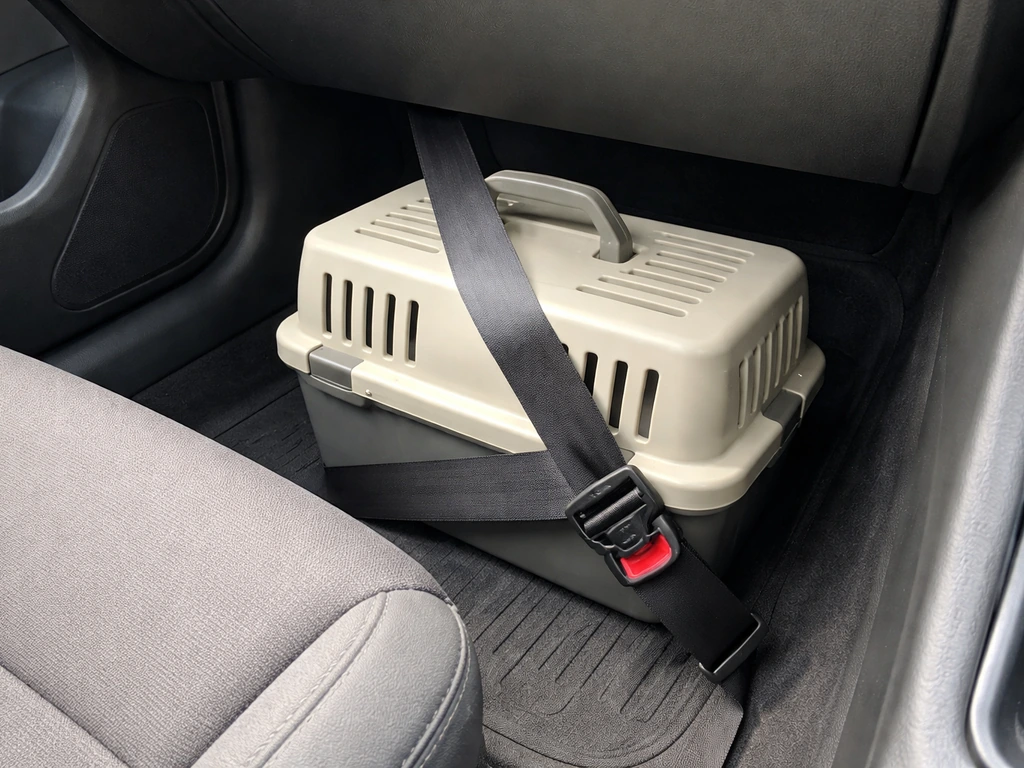
Keep the bird in the same box for transport. Don't transfer it to a cage or open container. Put the box in the footwell or on the seat with a seatbelt looped around it so it doesn't slide. Keep the car quiet (no loud music), and keep the temperature moderate. Drive smoothly. The whole point of a dark, closed box is that the bird can't see what's happening, that darkness is what keeps its stress level manageable during the ride.
Don't bring children who will want to peek inside, and don't open the box at stoplights to check on it. Get there as directly as you can.
A few things that genuinely help (and a few that don't)
| Action | Helpful or Harmful? | Why |
|---|---|---|
| Leaving a healthy fledgling alone | Helpful | Parents are almost always nearby and provide far better care than humans can |
| Moving it a short distance from danger | Helpful | Reduces immediate risk without separating it from its territory |
| Watching from a distance for parental return | Helpful | Confirms whether intervention is actually needed |
| Keeping pets away | Helpful | Allows parents to approach safely |
| Placing in a warm, dark, quiet box | Helpful | Reduces shock and stress during temporary holding |
| Giving water or dropper feeding | Harmful | Birds can inhale liquid; wrong diet causes harm |
| Force-feeding worms or bread | Harmful | Wrong nutrition, aspiration risk |
| Keeping it as a pet or hand-rearing without training | Harmful | Causes imprinting, removes it from the wild |
| Opening the box repeatedly to check | Harmful | Resets stress response each time |
| Using terry cloth as bedding | Harmful | Claws get caught and can break toes or legs |
What happens next
Once the bird is with a licensed rehabilitator, they'll assess it properly, treat any injuries, and raise it with the right food, socialization with other birds of its species, and a plan for release. If you've been asked to hold a bird temporarily while a rehabber arranges pickup, follow their specific instructions exactly, they may give you different guidance than the general rules here based on what the bird needs.
If the fledgling turns out to be healthy and just in an awkward spot, you'll likely be told to return it to where you found it. There's a real skill to releasing a fledgling correctly so it can reconnect with its parents, and understanding how that process works makes a difference in whether it succeeds. The bird's eventual release back into the wild is the whole goal of everything you're doing right now.
FAQ
My “fledgling” looks like it is struggling to stand. How do I know if it actually needs rescue?
If you find a fledgling that is fully feathered and moving normally, do not assume it needs rescue because it cannot fly yet. A good decision aid is to check for the article’s red flags first (bleeding, broken limb, cat/dog attack, shivering and unresponsive, or no parental activity). If none are present, the best action is to keep people and pets back and watch for parent return for at least 1 to 2 hours before calling anyone.
What should I do differently if the bird is actually a nestling and not a fledgling?
If a nestling (naked or mostly naked) is involved, the safest next step is to contact a wildlife rehabilitator immediately, because nestlings cannot be reliably cared for with general advice. Keep the nestling in a warm, dark, quiet container while you wait, but do not feed or water it unless the rehabilitator instructs you, since species-specific diets are critical.
Can I relocate a fledgling if it is healthy but in danger where I found it?
Yes. If it is uninjured but in a dangerous spot (busy road, active lawn where a cat can reach it, direct exposure to traffic), you can move it a few feet to a nearby sheltered location in the same general area so parents can still find it. Use minimal disturbance, then step back and wait, do not attempt to “hide” it far away from where it was found.
Is it okay to open the box often to check whether the bird is breathing or alert?
Do not. Even if the bird is quiet, you should avoid peeking repeatedly because opening the container resets the bird’s stress response. Keep handling to an absolute minimum, and if you need to check, do it quickly and no more than necessary until you reach professional care.
What if the bird seems to be breathing strangely, but I’m not sure it is seriously injured?
If the bird is panting, mouth-open breathing, making clicking sounds, or appears to be in respiratory distress, you should treat it as urgent and contact a wildlife rehabilitator or wildlife-experienced vet immediately. Your job is essentially to reduce stress by keeping it warm, dark, and quiet, and not to try to administer any medication or fluids.
If I can’t reach a wildlife rehabilitator right away, who should I call instead?
If you cannot find a rehabilitator, a general vet is still often better than DIY care, but you should call first and say the bird is a wild fledgling and that you are asking whether they can treat wildlife or direct you to the right contact. Also, cat-caught birds are emergencies and should not wait for “routine” options.
What if I don’t have the right box, can I use a different container in the meantime?
If you accidentally use the wrong container type, the immediate priority is safety and stability. Stop attempting to improvise mid-process, transfer as little as possible, and ensure there are small air holes, a dark cover, and a non-looping surface that won’t snag claws. If the bird is already in the box, keep it closed and secure rather than repeatedly switching containers.
Can I give a tiny amount of water or food if the bird seems calm and quiet?
Do not give water, and do not offer food unless a licensed rehabilitator specifically tells you what to feed and how. The fresh practical rule is: for transport, you only need warmth, darkness, and minimal handling. A healthy fledgling can typically tolerate several hours without food while you arrange care.
How do I provide warmth without overheating the bird?
Warmth should be applied to one side or half the container so the bird can move away if it gets too warm. Avoid overheating, do not place heat directly under or over the bird, and do not use direct sunlight or a heat lamp, since those can quickly push a stressed bird into a dangerous temperature range.
How long should I wait for the parents before I intervene or call for help?
If a parent has not returned after 1 to 2 hours in a quiet, low-disturbance setup, it is reasonable to call for advice or rescue. But if the bird is still in a safe nearby spot and you can keep distance, waiting is often the difference between unnecessary handling and successful parent feeding.
The bird was in my yard near a cat, but I did not see a bite. Should I still treat it like an emergency?
If you suspect a cat or dog was involved, treat it as an emergency even when the bird looks okay, box it immediately, keep it dark and quiet, and tell the responder it was a cat-caught or dog-caught bird. Injuries can be internal or infected soon after, and antibiotics are time-sensitive.
What’s the safest way to handle bleeding if it won’t stop right away?
If bleeding is active, apply gentle pressure with a clean cloth or paper towel for a few minutes, then stop and move on to boxing for transport. Do not try to clean wounds, dress them, or remove any objects embedded in the tissue, because those actions can worsen damage and delay professional treatment.
How should I transport the bird safely in the car?
For transport, keep the bird in the same closed box, avoid opening at stoplights, and secure the box so it cannot slide. A useful detail is to drive smoothly and keep the car at a moderate temperature, since vibration and temperature swings can worsen shock.
When a rehabber says to return the bird, how do I do it correctly without making things worse?
If a rehabilitator tells you to return the bird, put it back at the original spot or the exact location they specify. The key practical point is to avoid “rescuing” it again by moving it repeatedly, since each relocation interrupts parent finding and increases the chance the bird ends up in a riskier area.
Next Article
How to Release a Fledgling Bird Safely and Humanely
Humane step-by-step guidance to release a fledgling: identify, assess health, reunite, place safely, and avoid do-not-re