If you've just found a baby bird and you're not sure what to do, here's the short answer: figure out whether it's a nestling or a fledgling, then decide whether it actually needs your help. Most fledglings don't. Most nestlings on the ground do. Everything else flows from that one distinction, and the rest of this guide walks you through each step from triage to release.
How to Raise a Newborn Bird: Nestling vs Fledgling Care
Marcus Holloway
5 Apr 2026
Nestling or fledgling? This is the most important call you'll make
These two terms describe very different developmental stages, and they lead to completely different courses of action. Getting this wrong is the most common mistake well-meaning people make.
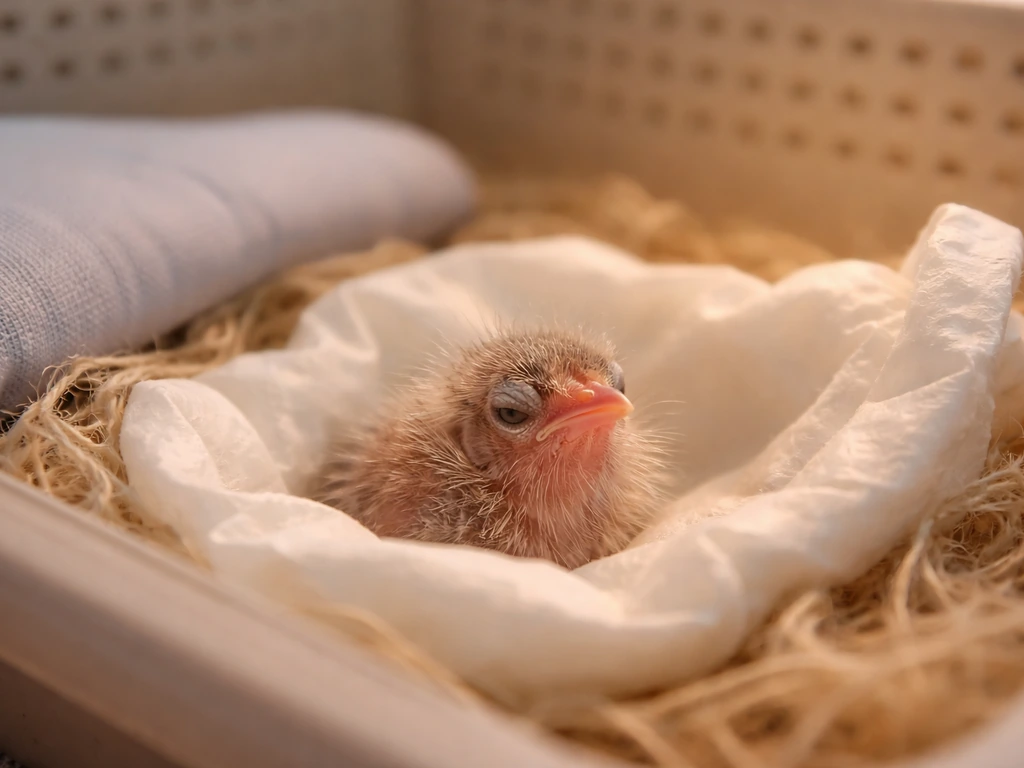
A nestling is essentially helpless. It has little or no feathers, may have closed eyes, and absolutely cannot survive outside the nest on its own. If you're looking at a tiny, mostly bare bird with pink skin showing, that's a nestling. If it's uninjured and you can locate the nest, the right move is to put it back immediately. The myth that parent birds will reject a chick because you touched it is just that: a myth. Birds do not abandon their young based on human scent, so don't let that stop you from returning a nestling to where it belongs.
A fledgling looks dramatically different. It's well feathered, can stand upright, and may hop or flap its wings. It might look grounded and vulnerable, but that's normal. Fledglings spend days on the ground as part of their natural development, and their parents are almost always nearby continuing to feed them. If the bird is feathered, alert, and moving around, the default action is to leave it alone. You can help a fledgling bird most by keeping cats and dogs away from the area and watching from a distance for 30 to 60 minutes to confirm the parents are still visiting.
The U.S. Fish and Wildlife Service puts it plainly: baby birds likely don't need your help unless they are featherless or have their eyes closed. When in doubt, that's the line to draw.
| Feature | Nestling | Fledgling |
|---|---|---|
| Feathers | Bare or sparse pin feathers | Mostly or fully feathered |
| Eyes | Often closed | Open and alert |
| Movement | Cannot stand or hop | Walks, hops, may flutter |
| Location | Should be in nest | Naturally on ground |
| Parent care | Entirely dependent | Parents still feeding nearby |
| Default action | Return to nest if uninjured | Leave in place unless injured |
If you cannot safely reach the nest, you can place a nestling in a makeshift nest (a small container with soft material) and secure it in a nearby tree or shrub where the parents can find it. That's still far better than bringing it indoors.
Quick triage: is this bird actually in trouble?
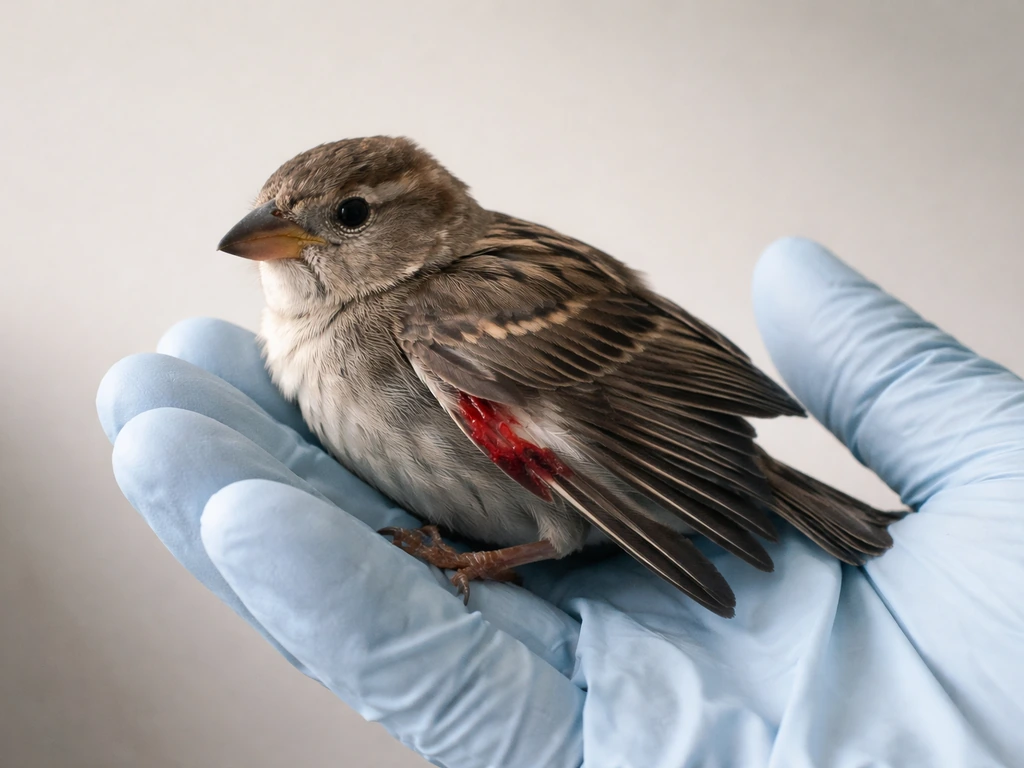
Before you do anything else, do a fast visual check. You're looking for signs that tell you whether this bird needs emergency care right now or just needs to be repositioned.
Red flags that mean the bird needs immediate help:
- Visible wounds, blood, or broken limbs
- Labored or open-mouth breathing at rest
- Extreme lethargy (limp, not reacting to your presence)
- Cold to the touch and unresponsive
- Eyes sunken or skin tented (signs of dehydration)
- Oily or wet feathers that suggest the bird has been in a cat or dog's mouth
- Known cat or dog attack (even without visible wounds, bacteria from a bite are life-threatening)
If you see any of those, the bird needs a licensed wildlife rehabilitator or avian vet as soon as possible. Your job at this point is stabilization and transport, not treatment. If the bird looks alert, eyes are bright, and it's breathing quietly, you have a little more time to assess and make calls.
One thing to understand about shock: a cold, hypothermic bird will not be able to digest food, and it's actually more likely to inhale liquid into its lungs than swallow it. Warming comes before anything else. But even then, do not feed or give water until you've spoken to a rehabilitator. This isn't overly cautious advice: aspiration (fluid entering the airway) can kill a bird quickly, especially one that's weak or not actively begging.
Setting up safe temporary housing
The goal of temporary housing is simple: keep the bird contained, safe, quiet, and at the right temperature while you arrange proper care. You're not setting up a permanent home.
The container
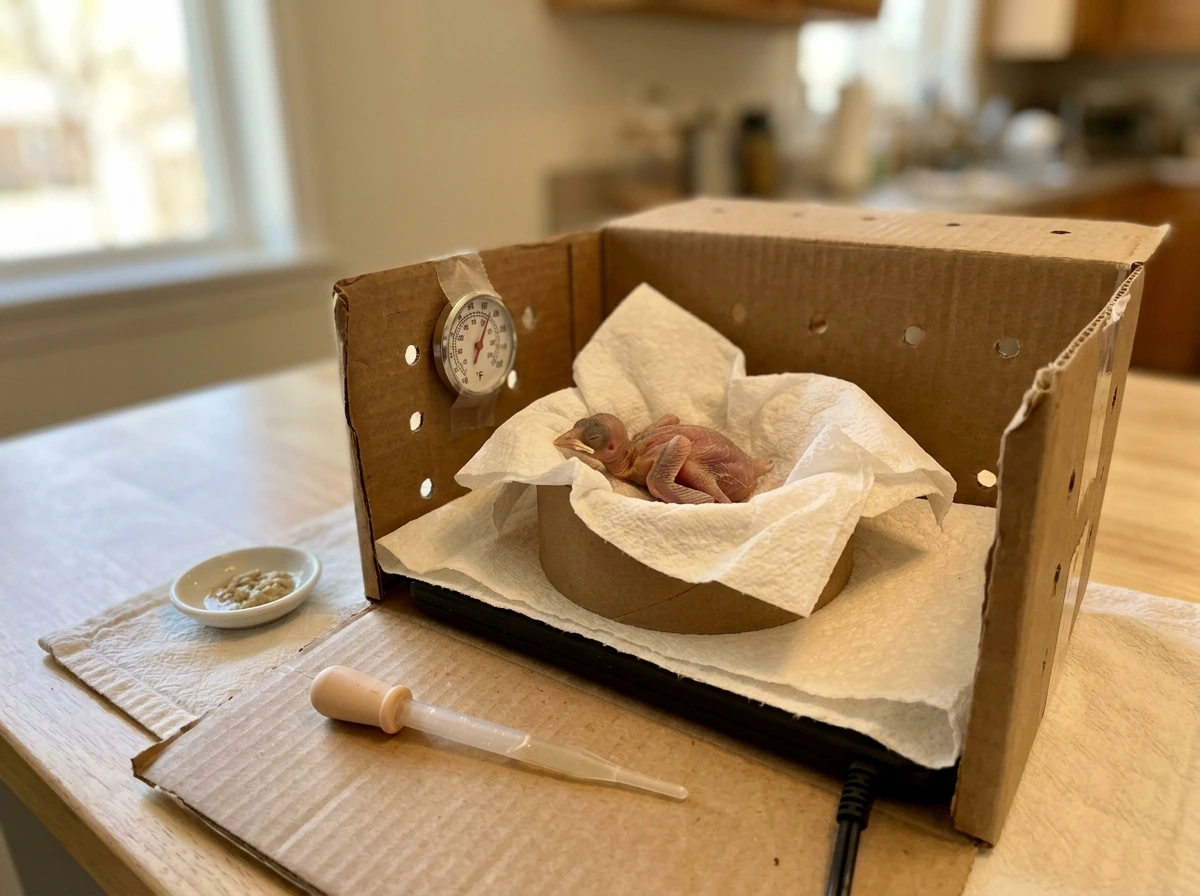
A shoebox or small cardboard box with several air holes punched in the lid works well for most songbirds. Line the bottom with a few layers of paper towels or a soft cloth (avoid anything with loose threads that can snag toes). Don't use a glass aquarium or anything airtight. Place the bird inside, put the lid on, and keep it somewhere quiet and dim. A dark environment reduces stress significantly.
Warmth
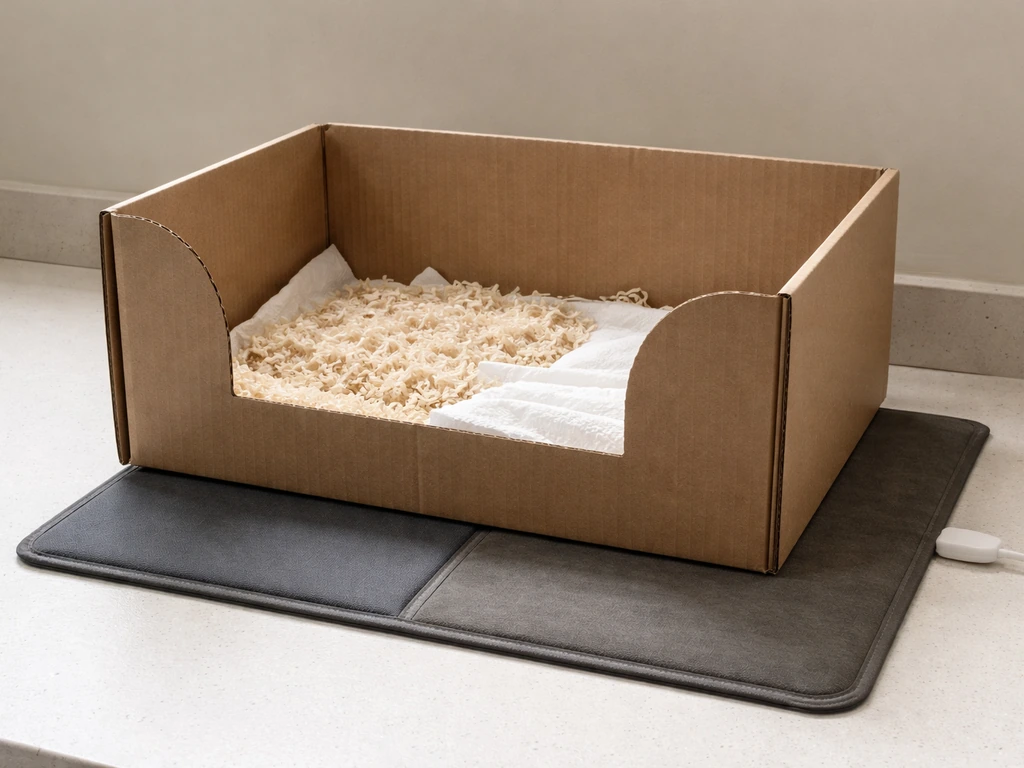
Featherless nestlings lose heat fast. You need to provide supplemental warmth, but direct heat is dangerous. A few safe options: place a heating pad set to low under half the box (so the bird can move away if it gets too warm), or fill a clean plastic bottle with warm (not hot) water, wrap it in a washcloth, and place it next to the bird. A light source or uncovered incandescent bulb positioned near (not over) the box can also raise ambient temperature gently. Aim for roughly 85 to 90°F (29 to 32°C) for a featherless nestling. Fledglings with a full coat of feathers need much less supplemental heat.
Never place the box in direct sunlight, near a vent, or in a drafty spot. Never use a microwave to warm the bird or any heating element that cycles on and off unpredictably.
Humidity and hygiene
Most makeshift setups don't need active humidity control for short-term care. What you do need is cleanliness. Change the paper towel liner each time the bird defecates. Baby birds defecate frequently, and a soiled substrate quickly becomes a source of bacterial infection and chilling.
Feeding basics: what to give, how much, and how often
This section assumes you've already contacted a rehabilitator and they've confirmed it's appropriate for you to attempt feeding while transport is being arranged. If you haven't done that yet, skip feeding entirely for now.
The first rule: watch the crop
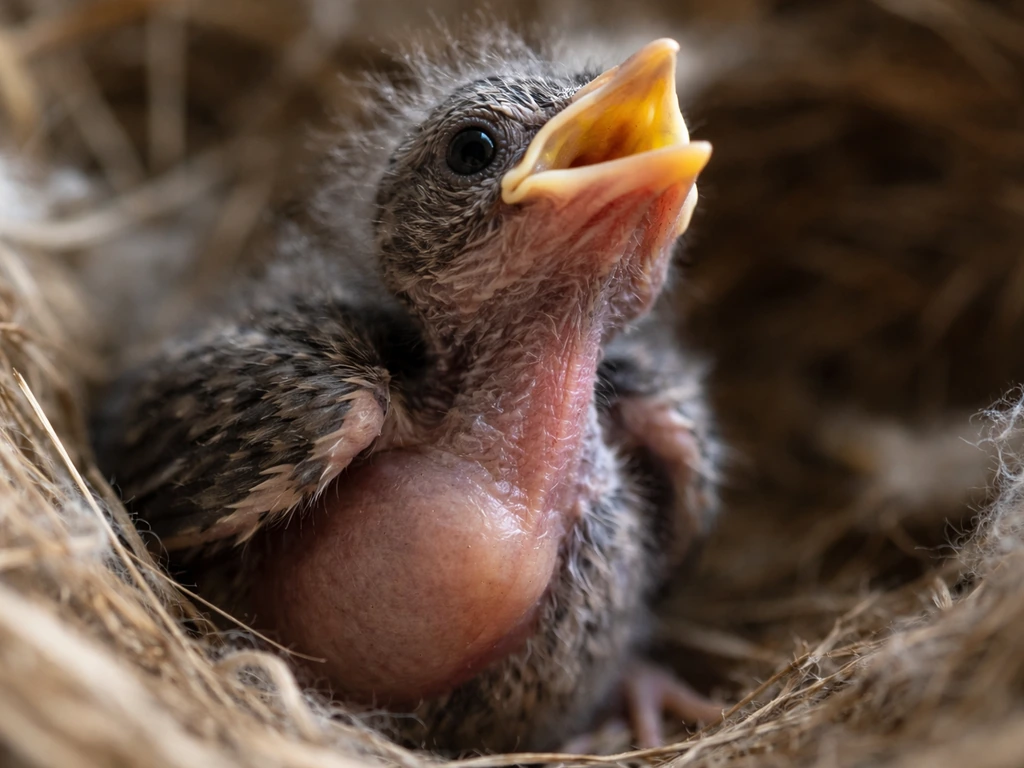
The crop is a small pouch at the base of the throat where food collects before digestion. In nestlings it's usually visible as a slight bulge on the left side of the chest. Never feed a bird whose crop is still full. Wait until it empties before the next feeding. Crop stasis (food sitting there without moving) in a depressed or lethargic bird is a medical emergency, not something to push through with more food.
Nestlings
Very young nestlings feed constantly in the wild, every 15 to 20 minutes during daylight hours. In a temporary care setting, you won't be able to replicate that fully, but feeding every 20 to 30 minutes during the day (stopping overnight) is a reasonable approximation. The specific diet depends heavily on species, which is exactly why you need species guidance from a rehabilitator. A generic, low-risk option sometimes used as a short-term bridge is moistened high-protein puppy kibble or mealworms for insectivorous species, but even this carries risks if done incorrectly.
Fledglings
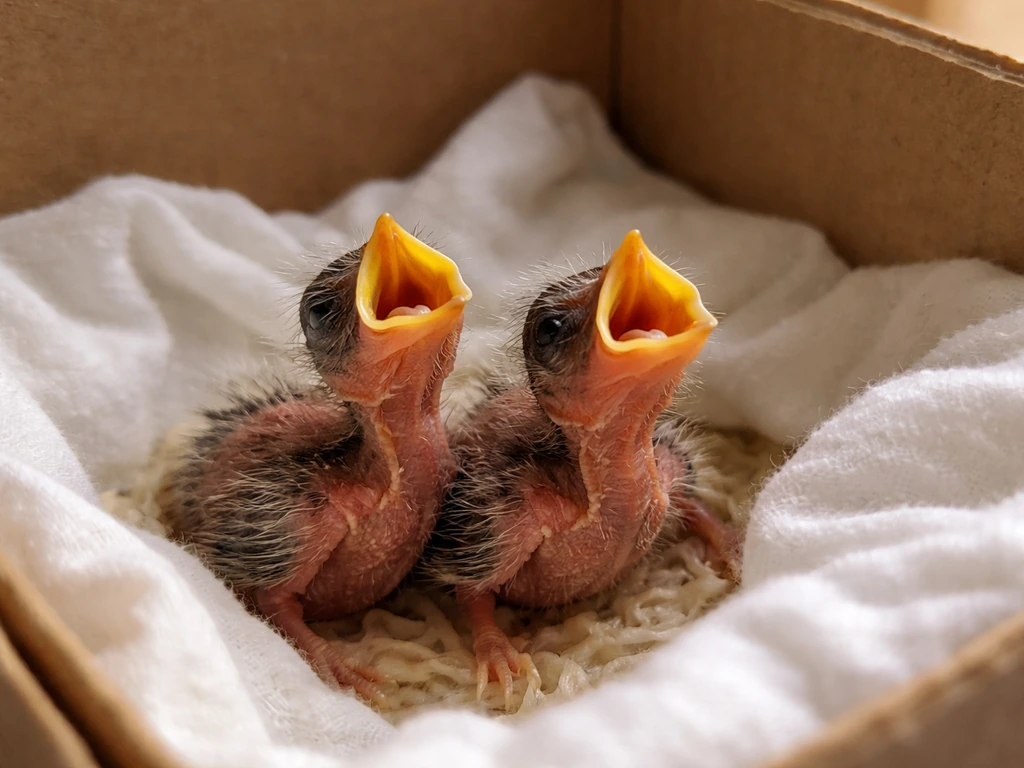
Fledglings that are genuinely injured and can't be left to their parents have more developed digestive systems and can often eat slightly larger items less frequently. That said, the same crop-emptying rule applies. If the bird is not actively gaping (opening its beak in a feeding response), do not attempt to force food. Aspiration risk increases sharply when a bird isn't actively soliciting food or when you're using any kind of forced delivery.
Feeding method
For short-term emergency feeding, use blunt-tipped tweezers or your fingertips to place small pieces of soft food at the back of the tongue when the bird gapes. Never use a syringe to squirt liquid into the mouth, and never attempt tube feeding at home. Tube feeding can puncture the crop and create complications that require surgical repair.
Hydration, digestion, and troubleshooting common problems
Here's something that surprises most people: baby birds do not drink water. In the wild, they get all the moisture they need from their food. The opening to the trachea sits at the base of the tongue, making it extremely easy for any liquid you offer to go straight into the lungs instead of the stomach. This is one of the most common causes of death in home-rescue attempts. Do not offer water in a dish, dropper, or syringe.
If a bird appears dehydrated (sunken eyes, loose skin that doesn't snap back when gently pinched), that's a veterinary concern, not something to address with a water dropper at home. Rehydration in that state requires subcutaneous fluids administered by a professional.
Things that go wrong and what they usually mean
- Crop not emptying after 4+ hours: possible crop stasis, stop feeding and contact a vet or rehabilitator immediately
- Clicking or gurgling sounds when breathing: possible aspiration, stop all feeding and get veterinary help
- Pasty or off-color droppings: could indicate infection or incorrect diet
- Bird feels cold after warming efforts: heat source may be insufficient or bird is in shock
- Gasping or labored breathing: emergency, transport immediately
- No gaping response after warming: bird may be too weak to eat safely, do not attempt feeding
What not to do: avoiding the biggest mistakes
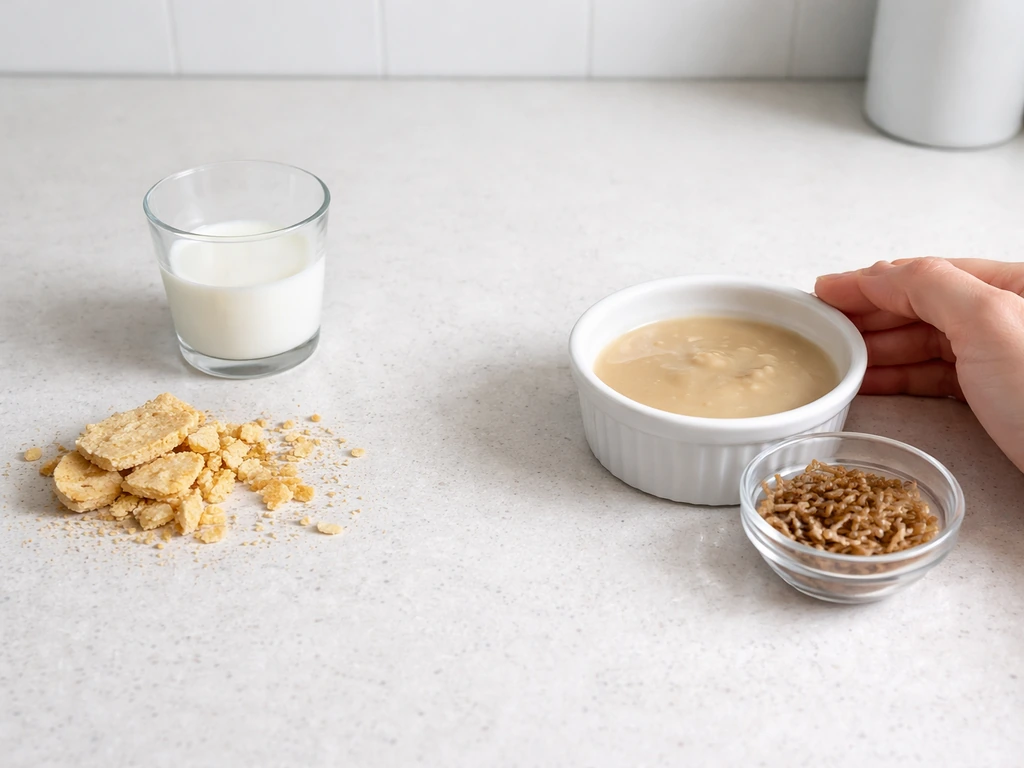
Most harm done to rescued baby birds comes from well-intentioned actions. These are the ones that cause the most damage.
Food mistakes
- Bread, crackers, or any dry starchy food: no nutritional value and can swell in the crop
- Milk or dairy: birds cannot digest it and it causes bacterial issues quickly
- Water by dropper or dish: aspiration risk is very high
- Worms dug from the garden: can carry pesticides and parasites
- Feeding a bird that isn't actively begging or gaping: major aspiration risk
- Overfeeding: the crop has limited capacity and overfilling causes regurgitation and aspiration
Handling and environment mistakes
- Handling the bird too often: every handling session is a stress event that depletes energy
- Keeping the bird in a noisy, busy room: stress suppresses the immune system and inhibits recovery
- Exposing the bird to pets, even briefly: the smell of a predator is enough to cause fatal stress
- Using cotton balls or fluffy synthetic materials for nesting: threads can wrap around toes and cut off circulation
Imprinting: the long-term risk of too much human contact
This one matters even if the bird seems healthy. Birds that imprint on humans during a critical developmental window lose the ability to function in the wild. They don't learn to fear predators, they don't develop normal social behaviors with their own species, and they often can't be successfully released. It is never in a wild bird's best interest to be handled frequently by humans, even if the bird seems to enjoy it or appears calm. Keep handling to the bare minimum needed for care and transport.
If you're hand-raising a nestling over several days while waiting for a rehabilitator placement, keep human interaction purely functional: feeding, cleaning, warming. No talking to the bird more than necessary, no bringing it out for handling, and no letting other people interact with it out of curiosity.
When to stop home care and get professional help
Home care for a wild baby bird is always a bridge, not a destination. The goal is to keep the bird alive and stable until it reaches someone licensed and equipped to give it a real chance. Here's when that handoff becomes urgent.
Contact a licensed wildlife rehabilitator or avian vet immediately if:
- The bird was found after a cat or dog attack (even no visible wounds: bacteria in saliva require antibiotic treatment within hours)
- The bird has been hit by a car or window
- There is visible bleeding, a broken limb, or a wound of any kind
- The bird is not warming up after 30 to 60 minutes of gentle heat
- Breathing is labored, clicking, or open-mouthed at rest
- The crop is not emptying or the bird is showing signs of crop stasis
- The bird has been in your care for more than 24 hours without improvement
- You cannot identify the species and don't know what to feed it
To find a rehabilitator near you, start with the National Wildlife Rehabilitators Association (nwrawildlife.org) or the Wildlife Rehabilitator directory at the Humane Society. Your state's fish and wildlife department website will also list licensed local contacts. When you call, describe the bird's size, feather coverage, behavior, and any visible injuries. They may be able to give you phone guidance immediately even before you can transport the bird.
If you've found what appears to be a fledgling rather than a nestling, you may want to read more on how to rescue a fledgling bird before assuming it needs to come inside at all. The rescue decision for fledglings is more nuanced than for nestlings, and in many cases the right call is strategic repositioning rather than intervention.
Getting the bird ready for release
Release is not something you decide on your own after a few days of home care. A bird is ready for release when it can fly well, find and eat food independently, and demonstrate normal fear responses toward humans and predators. For nestlings you've raised from early stages, that timeline is weeks, not days, and it requires the involvement of a rehabilitator.
The transition process matters as much as the timing. Birds that have been in care need a gradual exposure to outdoor conditions, appropriate flock socialization where possible, and a soft-release approach rather than simply being set outside. Releasing a fledgling bird correctly involves a step-down process that bridges the gap between a controlled environment and full independence.</p>
For birds that have been hand-reared over a longer period, the release process is even more carefully managed. The concerns around imprinting, predator awareness, and foraging ability all become more significant the longer the bird has been in human care. If you've been involved in raising a bird over several weeks, guidance on releasing a hand reared bird is worth reading carefully before you make that call.
Your next steps right now
If you've just found a baby bird and you're reading this, here's your immediate action list:
- Determine nestling vs fledgling using the feather and eye criteria above
- If it's an uninjured nestling, locate the nest and return it immediately
- If the nest is inaccessible or the bird is injured, set up a ventilated box with soft lining and gentle warmth
- Do not offer food or water until you've spoken to a rehabilitator
- Call a local licensed wildlife rehabilitator or avian vet right now while the bird warms up
- Keep the bird in a quiet, dark, warm location away from pets and household noise
- Follow the rehabilitator's instructions precisely for any feeding or transport preparation
- Plan transport to a professional as quickly as possible, ideally the same day
The most important thing you can do is move fast on that phone call. Rehabilitators deal with these situations every day and can give you species-specific guidance within minutes. The bird's chances improve dramatically when it gets professional care quickly, and your job is mostly to keep it safe, warm, and calm until that handoff happens.
FAQ
I think it might be a nestling, but its eyes aren’t clearly open yet. What should I treat it as?
Treat it as a nestling and prioritize re-nesting or emergency stabilization. When eyes are closed or mostly closed, it typically indicates a stage where the bird cannot thermoregulate well or feed itself, so do not delay warming and transport while you try to identify the nest.
How do I find the right nest location if I can’t clearly see where the bird came from?
Look for the closest feasible nest site rather than searching far. Use the parents’ behavior as a clue (watch from a distance for visits, note direction of travel, and then place the nestling in a nearby shrub or branch where the species commonly nests). If you cannot find a safe, realistic placement quickly, a temporary makeshift nest in nearby cover is preferable to keeping the bird indoors.
What if the baby is injured, but it seems alert, not lethargic. Should I still skip feeding and focus on transport?
Yes, if there are any red flags or you cannot confirm proper crop status and species-specific diet guidance. Alertness can still coexist with internal injury or a problem like crop stasis. Feeding before a rehabilitator confirms it is appropriate can cause aspiration, worsen injuries, or mask symptoms.
Is it okay to give food “just a little” to a bird whose crop looks full?
No. A full crop means food is already waiting, and feeding again risks overflow and aspiration. Wait until the crop empties, and if the bird is depressed, not begging, or the crop does not empty normally, treat it as a medical emergency and get professional help fast.
How can I tell if a fledgling is healthy enough to leave alone versus needing help?
A healthy fledgling is usually feathered, can stand, and shows normal movement and alert posture. If it cannot right itself, has visible injuries, is repeatedly being knocked down by people or pets, or appears unable to flap or hop to safety, that’s a stronger reason to intervene (often by moving it to a safer spot) and contact a rehabilitator for confirmation.
Can I keep a fledgling in a box for a while if I’m worried about cats at night?
Short-term protection is sometimes appropriate, but confinement should be temporary and minimal. The better approach is to keep predators away and, if needed, move the fledgling to a nearby safer location where parents can still reach it. If you must box it, keep it dim, ventilated, and only long enough to address the immediate danger while you arrange advice.
Do I need to provide heat for a feathered fledgling or older nestling?
Usually less than for featherless nestlings. If the bird is feathered and alert, you generally avoid aggressive warming, since overheating and drying can worsen stress. Focus on containment, quiet, and species guidance, and only add gentle warmth if the bird is clearly cold (rehabilitator advice is best).
What should I do if I accidentally feed too much or the bird starts coughing or gaping oddly?
Stop feeding immediately and do not offer water. Coughing, bubbling, or abnormal gaping can indicate aspiration. Keep the bird warm but not hot, minimize handling, and contact an avian vet or rehabilitator right away for next steps.
Is it ever safe to offer water to a baby bird if it looks thirsty?
In most home rescue situations, no. Birds get moisture from their food, and liquids can enter the airway easily. If dehydration signs are present, treat it as a veterinary issue, not a problem to solve with a dropper, dish, or syringe.
What cleaning routine should I use during temporary care?
Change the liner promptly after each defecation and keep bedding dry. Use plain paper towel or a soft cloth without loose fibers, and avoid scented cleaners. A clean, dry setup reduces chilling and lowers bacterial risk during the short bridge period.
Can I raise a bird longer than a few days while waiting for a rehabilitator?
It depends, but the article’s “bridge, not destination” warning still applies strongly. Longer stays increase imprinting risk and make it harder to ensure correct diet, temperature, and species-appropriate development. If placement is delayed, get guidance daily from a rehabilitator on what you can safely do until transfer.
When is it safe to attempt release steps on my own?
Do not self-determine release after only a brief period of home care. Release readiness requires that the bird can fly well, eat independently, and show normal fear responses. If you raised a nestling from an early stage, the timeline is typically weeks and should involve rehabilitator oversight, including soft-release planning.
Next Article
How to Care for a Newborn Featherless Bird: Step-by-Step
Step-by-step care for a featherless newborn bird: rescue, warmth targets, safe feeding, cleaning, monitoring, and when t