If you've found a bird that looks hurt, stunned, or abandoned, here's the short answer: don't feed it, don't give it water, get it somewhere dark and quiet, and call a licensed wildlife rehabilitator as soon as possible. That covers the next 10 minutes. The rest of this guide walks you through exactly what to do after that, including how to tell whether the bird actually needs your help at all.
How to Help Bird Life: Rescue, Triage, and Next Steps
Marcus Holloway
18 Apr 2026
Quick triage: what's wrong with the bird
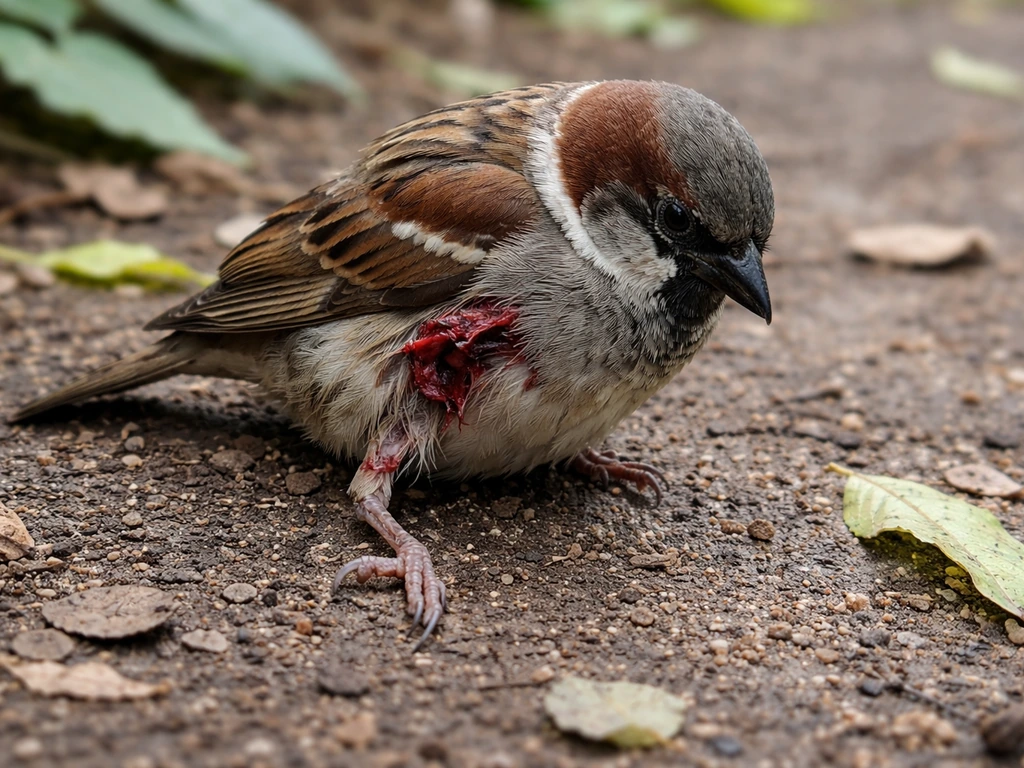
Before you touch anything, spend 60 seconds looking at the bird from a short distance. You're trying to answer one question: does this bird need immediate intervention, or is it fine on its own?
These are the signs that a bird genuinely needs help right now: visible bleeding or an open wound, a wing or leg that dangles at an unnatural angle, the bird is lying on its side or cannot stand, it's shivering or appears non-responsive, or there's a dead parent nearby. Any one of those is a clear signal to step in.
Signs that look alarming but may not mean what you think: the bird is on the ground and fully feathered, the bird is hopping but not flying, or the bird seems 'lost' in an open area. A fully feathered bird on the ground is often a fledgling, which is a normal developmental stage. More on that below.
If the bird is breathing hard, making labored movements, or completely unresponsive, treat that as an emergency. The Wildlife Center of Virginia explicitly lists trouble breathing and non-responsiveness as wildlife emergencies that need immediate professional attention.
Immediate do's and don'ts for safe handling
If you've confirmed the bird needs help, you'll need to pick it up. Keep it brief and calm. Wild birds find human contact extremely stressful, so the goal is to handle the bird as little as possible and get it contained quickly.
- Wear gloves or use a towel to pick up the bird. This protects you and reduces stress on the bird.
- Scoop gently from underneath, keeping wings folded against the body.
- Place the bird directly into a prepared box (more on that below).
- Wash your hands thoroughly after handling.
- Do NOT chase the bird. Chasing an already-stressed injured bird can cause further injury and cardiac stress.
- Do NOT attempt to force the bird's wings or legs into any position.
- Do NOT put it in a wire cage where it can injure itself against the bars.
- Do NOT keep handling it to check on it. Once it's in the box, leave it alone.
Watch for talons and beaks. Even small birds can scratch or bite when frightened. A towel gives you a safe grip and keeps the bird from thrashing. For larger birds like raptors or herons, it's better to call for help first rather than attempt solo handling.
Housing, warmth, and minimizing stress
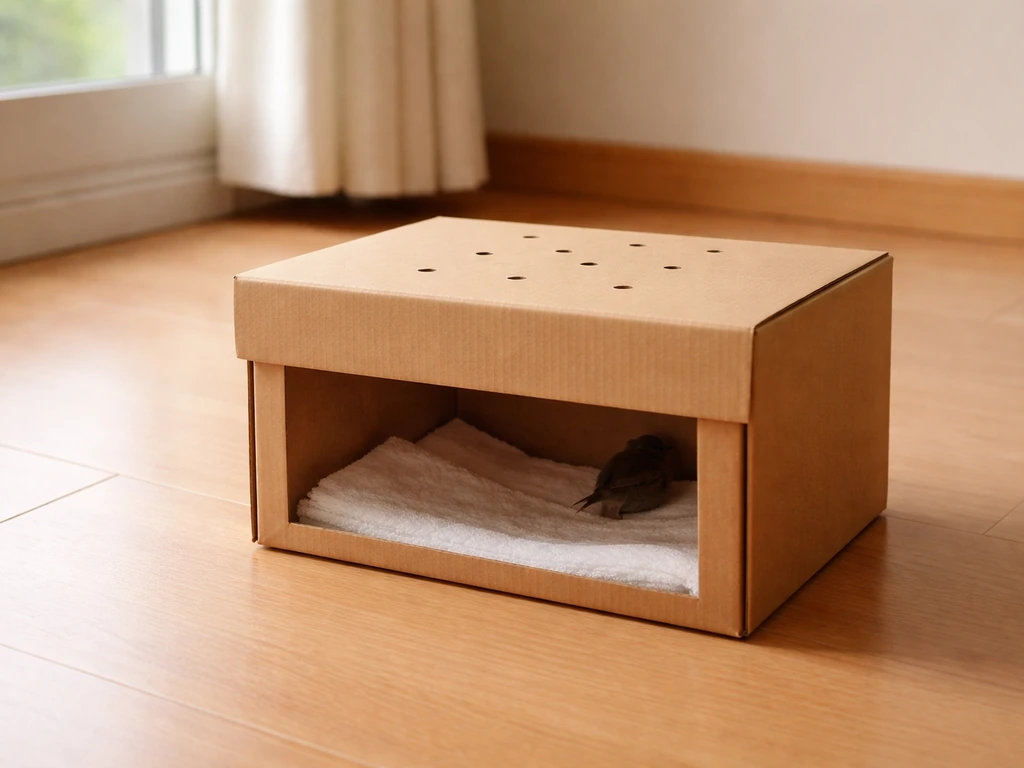
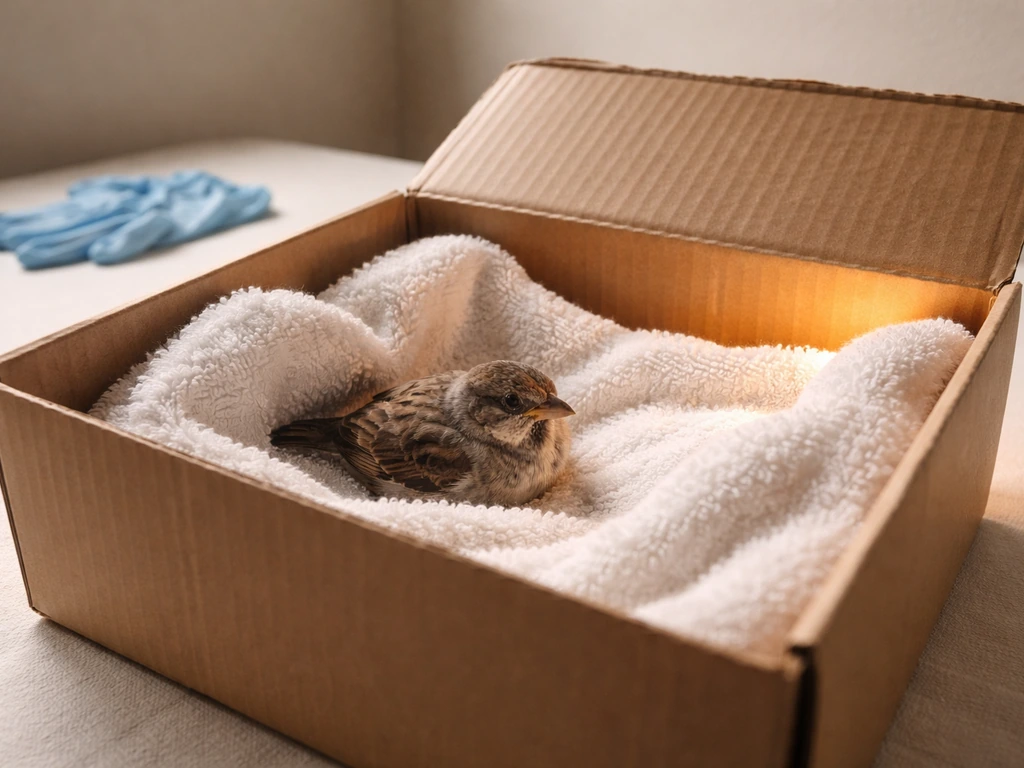
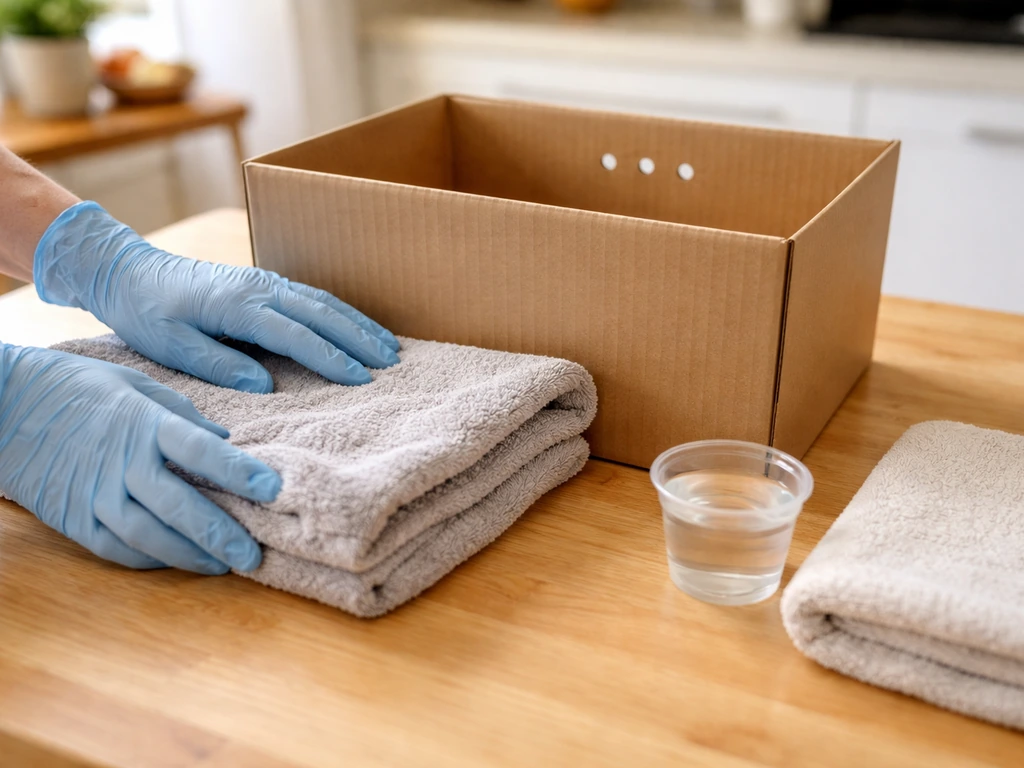
A cardboard box is your best temporary housing option. Poke several small air holes in the lid for ventilation, line the bottom with a soft cloth or paper towels, and make sure the lid can close securely. The box should be just big enough for the bird to sit comfortably, not so large it can flap around and hurt itself.
Once the bird is inside, put the box in the warmest, quietest spot you have. Tufts Wildlife Clinic advises keeping the bird in a warm, dark, quiet place and contacting a local wildlife rehabilitator for care. Darkness calms birds significantly. Keep it away from pets, children, televisions, and loud noise. Resist the urge to peek inside every few minutes.
Warmth matters, especially for baby birds or any bird that feels cold to the touch. You can place a heating pad set to its lowest setting under one half of the box (not the whole bottom, so the bird can move away from the heat if needed). Alternatively, fill a sock with dry rice, heat it in the microwave for 30 to 60 seconds, and place it near but not directly under the bird. The heat source should feel warm to your hand, not hot. Birds normally run a body temperature of around 103 to 106°F, so they chill quickly when injured or in shock.
Do not put the box in direct sunlight. Overheating is a real risk, especially in a closed car. If you're transporting the bird, run the air conditioning if it's a warm day.
Feeding and hydration guidelines (when/when not)
This is the most important thing to get right: do not feed the bird and do not give it water unless a licensed wildlife rehabilitator has specifically told you to. This applies to injured adults and baby birds alike.
Here's why. A bird that has suffered head trauma, internal injuries, or shock may aspirate liquid directly into its lungs. Water put into a baby bird's mouth can go straight to the lungs and kill it. Even well-meaning feeding of the wrong foods can cause serious harm. Giving a baby bird bread, milk, or worm pieces without guidance can cause choking or nutritional damage that makes recovery much harder.
blank" rel="noopener noreferrer">Tufts Cummings School of Veterinary Medicine puts it plainly: don't give food or water because it can easily drown the bird or cause death. That's a hard rule to follow when you're looking at a distressed animal, but it's genuinely in the bird's best interest. Knowing how to help a bird correctly means knowing when not to intervene, and feeding is the area where well-meaning people accidentally cause the most harm.
If you're waiting several hours before a rehabilitator can take the bird, and a professional has advised you on next steps, they may give you specific guidance for hydration. Follow their instructions exactly. Don't improvise.
Where to get help: wildlife rehab, vets, and hotlines

Your first call should be to a licensed wildlife rehabilitator. These are permitted professionals who legally care for injured, diseased, orphaned, or abandoned wildlife, and they're your best resource. You can find one through your state's wildlife agency website, or through these starting points:
- NWRA (National Wildlife Rehabilitators Association) rehabilitator finder at nwrawildlife.org
- Your state's Department of Fish and Wildlife (search "[your state] wildlife rehabilitator directory")
- Bird Alliance of Oregon Wildlife Care Center hotline: 503-292-0304 (available for injured bird triage and baby bird questions)
- Bi-State Wildlife Hotline (Missouri and SW Illinois): a 24-hour hotline that connects callers with licensed rehabilitators for sick, injured, or orphaned animals
- Your local Audubon Society chapter
- An avian vet, if no rehabilitator is immediately reachable
State-level directories can vary in detail. New York's DEC maintains a wildlife rehabilitator resource page, though not all rehabilitators accept every type of bird. Indiana Audubon also maintains a rehabilitator finder for that region. If you're not sure where to start, call your nearest wildlife agency and ask for a referral.
When you call, have this information ready: the species if you know it (or a description), where you found it, what condition it's in, and what you've done so far. Be specific. "There's blood on one wing and it can't stand" is far more useful than "it looks hurt." The more detail you give, the better advice you'll get.
Don't wait for a callback before stabilizing the bird. Get it into a box in a dark quiet space first, then make the call. If it's a clear emergency (severe bleeding, non-responsive), call while someone else handles the box.
Aftercare and monitoring: signs of improvement or emergency
Once the bird is boxed and you've made contact with a rehabilitator, your main job is to leave it alone and monitor from a distance. Checking on it constantly adds stress and slows recovery.
Signs the bird is stabilizing: it's sitting upright on its own, its breathing appears normal and unlabored, it reacts to sound or movement (alert eyes), and it's no longer shivering. These are encouraging signs while you wait for transport.
Signs the situation is getting worse and you need to escalate your call:
- Bleeding that isn't stopping
- The bird is now lying on its side or has stopped moving entirely
- Breathing has become visibly labored or the beak is open and gasping
- The bird is having seizures or visible muscle tremors
- It feels cold even after you've provided a heat source
If you see any of those, call back immediately and describe what's changed. In some cases, an emergency avian vet visit is necessary even before a rehabilitator can take over. Don't assume the situation will stabilize on its own if it's actively deteriorating.
For broader context on how to help bird populations through longer-term action, there's a lot individuals can do beyond individual rescues, but right now your focus should stay on the bird in front of you.
If the bird isn't actually injured: handling fledglings and parents nearby
This scenario is extremely common, and it's the one most people misread. You see a small bird on the ground, it can't fly, and you assume it's hurt or abandoned. In many cases, it's neither. It's a fledgling, a bird in the normal stage between leaving the nest and learning to fly, and its parents are almost certainly nearby watching it.
Here's how to tell the difference between a fledgling and a bird that actually needs rescue:
| Feature | Fledgling (usually fine) | Needs rescue |
|---|---|---|
| Feathers | Fully or mostly feathered | Naked or sparsely feathered and on the ground |
| Movement | Hopping, alert, reacting to you | Lying still, on its side, or non-responsive |
| Visible injury | None | Bleeding, dangling limb, open wound |
| Parent activity | Adults seen or heard nearby | No adult activity after 1 hour of watching |
| Location | In or near shrubs, trees, or yard | In road, near predator, or in obvious danger |
The single best thing you can do for a fledgling is watch from a distance for 30 to 60 minutes. Keep pets indoors and ask people to back away. If an adult bird comes to feed it within that window, it's not orphaned. The parents are doing their job. Leave it alone.
If the fledgling is in immediate danger (near a road, in a driveway, or exposed to a cat), you can gently move it to a nearby shrub or sheltered spot within a few feet. You are not abandoning it, and the parents will still find it. The myth that parent birds reject babies touched by humans is not true for most species.
If an hour has passed and no adult bird has appeared, that's the point to call a rehabilitator. Don't try to feed it or bring it inside at that stage. Just make the call and describe what you're seeing. The Ohio Wildlife Center recommends the 30 to 60 minute observation window as the standard before deciding to intervene. Understanding how to help a wild bird often means recognizing when walking away is the right move.
If you find a nest that's been knocked down and there are nestlings (naked or barely feathered babies) inside, that's a different situation. You can try to place the nest back in or near the original tree. If the nest is destroyed, a small berry basket or plastic container with holes punched in the bottom and lined with dry leaves or grass can substitute. Hang it as close to the original location as possible, place the nestlings inside, and watch to see if the parents return. For more detailed steps on this specific situation, the guidance on how to help a nesting bird goes deeper into nest restoration and what to do when a nest is compromised.
Your next 30 minutes, step by step
- Observe the bird from a short distance for 60 seconds. Look for bleeding, a dangling limb, inability to stand, or non-responsiveness.
- If it's clearly injured or in immediate danger, put on gloves or grab a towel and gently place it in a ventilated cardboard box lined with cloth.
- Add a gentle heat source under one half of the box. Keep it in a dark, quiet room away from pets and noise.
- Do not feed it. Do not give it water. Not even a drop.
- Call a licensed wildlife rehabilitator, your state wildlife agency, or an avian vet. Give them the species, location, and condition.
- If it's a fledgling with no visible injury, step back and watch for 30 to 60 minutes to see if parents return before making any calls.
- Monitor the bird from a distance while you wait, and call back immediately if its condition worsens.
That's it. You don't need to do more than that to give the bird a real chance. The professionals who take it from here are trained and equipped in ways that even the most well-meaning amateur isn't. Your job is stabilization and handoff, and you're fully capable of doing both well.
FAQ
Is it ever okay to give a found baby bird water from a dropper?
No. Unless a licensed wildlife rehabilitator specifically tells you to, do not give water or food. Even small amounts can go into the lungs and cause aspiration, especially with head trauma or shock. If the rehabilitator advises hydration, follow their exact method and amount.
What should I do if I found a bird and I cannot reach a rehabilitator right away?
Stabilize only: place the bird in a dark, quiet box with ventilation and warmth as described, then call again as soon as possible. If you cannot get instructions by phone, do not feed. If the bird is non-responsive, severely bleeding, or having trouble breathing, call for emergency avian help or animal control services in your area while the bird stays contained.
How can I safely identify whether it is a fledgling or a nestling (and avoid the wrong rescue)?
A fledgling is usually fully or mostly feathered and looks like a small version of the adult, even if it cannot fly yet. A nestling is typically naked or barely feathered and usually belongs in a nest. If you see nestlings, treat it as a nest situation, not as a “found alone” case, and focus on nest restoration and parent return.
If the parents are nearby, should I still pick up the bird?
Usually no, if it looks like a fledgling and it is not in immediate danger. Watch from a distance for 30 to 60 minutes and keep pets away. Pick it up only if it is in immediate harm (road, driveway, cat access), then move it a few feet to a safer sheltered spot.
What if the bird is covered in oil or looks coated (like from a spill)?
Do not try to wash it yourself. Oily feathers can damage insulation and increase stress, but bathing can worsen hypothermia or cause ingestion. Contain it in a box in a quiet area, then call a rehabilitator and mention that it appears oiled or contaminated.
Can I put the bird in a towel-lined carrier instead of a box?
A covered cardboard box is usually safer because it limits movement and reduces stress. If you use a carrier, ensure it is escape-proof, has ventilation, and has enough coverage to keep the bird calm. Avoid glass or overly open containers where the bird can see constantly and thrash.
Should I give the bird a warm bath or mist the feathers if it seems cold or dirty?
No. Do not immerse or spray the bird. Provide warmth indirectly (heating pad on low under part of the box or a warm sock with dry rice nearby), keep it dark, and avoid water contact unless instructed by a professional.
What’s the safest way to move a bird if it’s in my yard and I’m worried about my safety?
If the bird is in a risky spot or you must intervene, use a towel as a buffer to protect your hands and prevent thrashing. For larger birds like raptors or herons, prioritize calling for help first rather than attempting handling. If you feel unsure, contain the area (bring pets inside) and wait for guidance.
How do I tell if I should treat this as an emergency before calling?
Treat it as urgent if the bird is non-responsive, seems unable to breathe normally, has visible severe bleeding, has an open wound, or shows a leg or wing hanging at an unnatural angle. In these cases, get it boxed and call immediately, ideally while someone else stabilizes the bird.
After I box the bird, can I drive with the windows down to “help ventilation”?
Avoid overheating and avoid unnecessary exposure. Use a calm, stable environment, and on warm days run air conditioning instead of relying on open windows. Keep the box in the vehicle where it cannot tip, and limit extra checking during the trip.
Is it okay to keep checking the bird by lifting the lid repeatedly?
No. Frequent peeking increases stress and can slow recovery. Place the box in a safe quiet area and monitor from a distance. Only check briefly if you’re looking for clear breathing changes or obvious deterioration to report on your call.
What should I do with my own clothes or gloves if the bird scratched or if it touched blood?
Use basic hygiene: wash hands after handling, and consider changing clothes if they have visible blood or waste. Avoid touching your face while handling wildlife. If the bird bit or scratched you, seek medical advice promptly and let the rehabilitator know so they can plan safely for transport and handling.
If I find a bird at night, does the advice change?
The same core steps apply: keep it dark and quiet, contain it in a ventilated box, avoid feeding or watering, and call a rehabilitator. In the dark, be extra careful not to let the bird escape while transporting, and keep any lights dim to reduce stress.
Next Article
How to Help a Bird: First Aid, Safe Handling, and Next Steps
Step-by-step first aid for injured or orphaned birds: safe handling, warmth, feeding rules, and when to contact rehab.